
- LIFESTYLE
- FASHION
- FOOD
- ENTERTAINMENT
- EVENTS
- CULTURE
- VIDEOS
- WEB STORIES
- GALLERIES
- GADGETS
- CAR & BIKE
- SOCIETY
- TRAVEL
- NORTH EAST
- INDULGE CONNECT
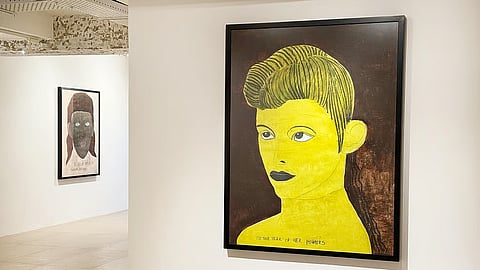
Our faces tell the world who we are. They carry memory, emotion, and identity. But what happens when we are asked to soften them, to look down, to hide parts of ourselves in order to be accepted? In Belgian artist Saskia Pintelon’s solo exhibition No One Can Silence Me at Pristine Contemporary in Delhi, the face becomes a site of insistence. The show brings together over 27 works created in the past year, each centring on expressive, unguarded faces accompanied by handwritten texts. Alongside it is a book of the same title featuring more than 60 works, with essays by Kathleen Weyts and Diana Campbell.
“You cannot muzzle art. Art has become a form of communication — even revolution,” says gallerist Arjun Swahney. “Even if you make someone quiet, they will speak through their art.” The exhibition’s title reads less like a slogan and more like a refusal to be silenced.
Face as resistance
Born in Belgium and based in Sri Lanka since 1982, Pintelon has worked at the crossroads of cultures and silences. Having lived through civil war, political instability, the tsunami, and ongoing struggles around gender and representation, she has developed a stance on who gets to be seen, and how. “My work attempts to give form to unspoken and overlooked opinions, allowing them to surface without explanation or mediation,” she says.
Early in her practice, Pintelon sketched people in markets, trains, and temples. Over time, that fascination evolved into a sustained investigation of the face as both representation and resistance.
“The face is where conformity is most aggressively demanded and most quietly resisted,” she notes. “In these faces, you encounter non-conformity to gender, to social roles, and to arbitrary standards of beauty that are imposed and internalised. We are often told, implicitly or explicitly, to be ‘smooth’. But can one truly conceal feeling?”
Within her works, the face becomes a political register, “that cannot be entirely controlled”. She continues, “It is nearly impossible for the face to lie completely: a glimmer in the eye before a tear falls, a barely perceptible tension between the brows.”

Unsettling the gaze
The show opens with ‘Welcome to the Madhouse’—a black-and-white face punctuated by a slash of orange lipstick. The woman winks, tongue out, teasing the viewer with mischievous, almost defiant playfulness. The gesture mocks the demand for decorum, especially for women. If society is a madhouse, the work seems to say, why not grin back at it?
“My practice has always been a mirror held up to society as I experience it,” she says. She has long engaged with structures—marriage, gender conformity, nationality, inequality. In the works, some figures are subtle, others confrontational; some appear morose like a sigh back while a few are calm and composed. There are women, men, and androgynous subjects across varied features and skin tones, from button noses and broad forehead, lingering in a space of mystery that leaves the viewer to wonder about their inner worlds.
“By isolating the face, I invite the viewer into that uncertainty,” the artist says. “Who are these people? What are they thinking? What pressures shape their lives?”
Undoing the picture perfect
In a world dominated by digital identities and curated images, Pintelon’s faces push back against the politics of the filtered self. “Saskia is intrigued by interesting faces,” says gallerist Arjun Butani. “What might be considered unconventional is precisely what makes a face compelling.”
Dark lips, furrowed brows, unexpected hues — yellow skin in ‘To the Peak of Her Powers’; chalky pallor in ‘Hear and Be Heard’, a young boy’s face that glows in the dark. None of her portraits are idealised through glamour or conventional standards of beauty. In ‘What Is Sexy Now’, a face tilts sideways, tongue grazing lips, eyes turned away — a sly dismantling of the very question. Sexy according to whom? And who benefits from the answer?
She insists on beauty as unconventional and subjective. “Filters and social masks are temporary constructions,” she adds, “and while they promise control, they often produce lasting insecurity and loneliness.”
Marked by imperfections and normality, her subjects resist flattening. “To show faces as presence rather than performance is to allow them to exist without correction or apology,” she says. They are unpolished, sometimes awkward — confused, even lost — yet authentic in the way they reflect pain, humour, and play. They are, as she describes them, “sites of accumulation — of lived experience.”
Interrupting silence
Handwritten phrases run across the canvases — flashes of humour, rage, calm. Speech is fleeting, she says, while writing endures, becoming a form of documentation that resists erasure.
The phrases do not explain the faces; instead, they interrupt the canvas, heightening their strangeness and giving space “for what cannot be said out loud.” “What is written is often not said, and what is said is often never written,” she notes.
At 81, Pintelon speaks candidly about growing older. Her portraits examine how age and gender are read. Some faces are lined, others youthful, some ambiguous — but none are diminished. Importantly, she resists the activist label. She adds, “they brush against those realities. It doesn’t claim protest, but it acknowledges presence — quietly, honestly.” And perhaps that quiet insistence is precisely what makes 'No One Can Silence Me' resonate. In a culture of noise, these faces do not shout. They hold your gaze — and refuse to lower it.
'No One Can Silence Me' is on view at Pristine Contemporary, Bhishma Pitamah Marg, South Extension I, until February 28, from 11 am to 6 pm
This article is written by Adithi Reena Ajith