
- LIFESTYLE
- FASHION
- FOOD
- ENTERTAINMENT
- EVENTS
- CULTURE
- VIDEOS
- WEB STORIES
- SPORTS
- GADGETS
- CAR & BIKE
- TRAVEL
- SOCIETY
- GALLERIES
- NORTH EAST
- INDULGE CONNECT

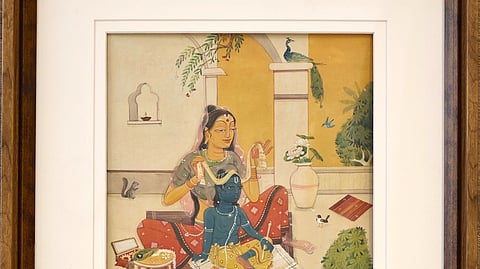
At Gallery G in Bengaluru, The Masters & The Modern: East Edition unfolds as a carefully calibrated conversation across time. Curated by Kallol Bose, the exhibition brings together early masters of the Bengal School, post-independence modernists, and contemporary artists from Bengal, Bihar, Odisha and Jharkhand. The result is a dense, searching proposition that refuses a tidy art-historical arc in favour of something closer to lived experience.
Kallol has spent more than three decades researching and archiving Bengal modernism, through his work with Janus Art Gallery and his role at the Academy of Fine Arts, Kolkata. That long view informs the exhibition’s premise. Rather than arranging works according to influence, succession, or progress, Kallol resists what he describes as “the conventional logic of chronology, found in museums often produces a linear story of ‘progress’”. His challenge was to allow multiple generations to speak without turning the masters into monuments or the contemporary artists into footnotes.
“The artistic practice of Eastern India has evolved through overlapping pedagogies, ideological debates, and shared visual vocabularies,” Kallol says. “Avoiding hierarchy was another challenge. Old and modern masters are figures who inevitably carry institutional weight, but this exhibition sought to position them not as endpoints but as nodes within a network of influence.”
That network is immediately apparent. Early figures such as Dhirendranath Brahma, Sunil Madhab Sen, and Sudhir Munshi appear not as historical preludes but as active presences. Their emphasis on atmosphere, tonal nuance, and inner life feels unexpectedly proximate to contemporary concerns. Kallol notes that many of these artists “are remembered as a part historical presence, and I attempted to enliven their contributions to Eastern art”.
Running through the exhibition is Kallol’s expanded understanding of “East”. It is not a directional marker so much as a cultural condition shaped by reform movements, literary experimentation, political radicalism, and spiritual inquiry. “East here refers to a cultural-intellectual formation,” he explains. Within the broader narrative of Indian modernism, often dominated by Bombay or Delhi, Eastern modernism insists on different priorities. “Eastern modernism emphasises inner life, social empathy rather than heroic individualism.”
This position draws directly from the legacy of figures such as Abanindranath Tagore, Nandalal Bose, and Benode Behari Mukherjee. Kallol is careful to dismantle any idea of the Bengal School as stylistically fixed. “It would be misleading to look at the style of Bengal School as one-dimensional,” he says, pointing out that Abanindranath Tagore “tried out different styles over time”, while later artists introduced variations that absorbed Western modernism without submission to it.
That adaptability carries through to the post-independence generation. Artists such as Paritosh Sen, Jogen Chowdhury, and Sunil Das reworked figuration into something psychologically charged and socially alert. Their compressed spaces, distorted anatomies, and uneasy surfaces speak to a period marked by political unrest and moral tension, yet remain rooted in regional experience.
For Kallol, continuity across these moments does not sit in appearance. “Continuity operates less at the level of style and more at the level of questions,” he says. Across generations, artists are engaged in “negotiating how to inhabit modernity without erasing local memory”. Tradition and modernity, in his framing, “are manifestations of advancement”, rather than opposing forces.
Pedagogy emerges as a crucial thread. Many of the early masters were influential teachers who viewed art education as a form of cultural labour. “Artist-teachers of Eastern India profoundly shaped the artistic knowledge as cultural work, not merely technical training,” Kallol explains. Studios and institutions functioned as sites of debate around nationalism, craft, and social responsibility. That ethos persists. Artists such as Alok Sardar and Kartick Pal continue to work “with respect, love, and care for their native traditions”, even as global influences circulate more freely.
The contemporary section brings these ideas into sharp focus. Seventeen artists respond to urbanisation, ecological strain, and shifting social identities through painting, sculpture, and mixed media. Their works do not read as reactions to the masters on the walls nearby. Kallol is explicit on this point. Contemporary works are presented “not as ‘responses’ or ‘departures’ from one style to another but as parallel articulations of enduring questions of identity, spirituality, landscape, community, and modernity itself”.
Geography, too, plays a role. Kallol notes that artists from Eastern India “seldom get opportunity to connect with the artists, art lovers and collectors from Southern India”. By staging the exhibition in Bengaluru, he hopes to create “a platform for the artists as well as the art lovers to connect under one roof”.
After decades in the archive, this exhibition signals a shift in Kallol’s own thinking. “Curatorial initiatives involves moving from preservation to activation,” he says. History here is not displayed as evidence but mobilised as a resource for thought. By placing historical works alongside contemporary practices, the exhibition asks viewers to recognise “dilemmas that run through the veins of the latter-day art practices”, from questions of cultural identity in a global world to the artist’s role as a social being.
There is, finally, a note of urgency. “While we tend to adopt global art trends that fail to resonate with our own cultural identity,” Kallol reflects, “I hope that Reimagining the East will encourage us to reevaluate the future of Indian art and acknowledge its true potential.” In doing so, The Masters & The Modern: East Edition makes a persuasive case for the East as an active, questioning presence within Indian art today.
Entry free. Till March 31. At Gallery G, Lavelle Road.
For more updates, join/follow our WhatsApp, Telegram and YouTube channels.