
- LIFESTYLE
- FASHION
- FOOD
- ENTERTAINMENT
- EVENTS
- CULTURE
- VIDEOS
- WEB STORIES
- SPORTS
- GADGETS
- CAR & BIKE
- TRAVEL
- SOCIETY
- GALLERIES
- NORTH EAST
- INDULGE CONNECT

There is a particular clarity that emerges when diverse artistic positions are allowed to coexist without hierarchy. The Art Amalgam-Edition 1 operates precisely in this space, bringing together multiple generations of artists and visual languages without forcing them into a single interpretive framework. Instead, the exhibition allows difference to remain visible across medium and intent.
The premise of the exhibition rests on how ideas evolve—how thought becomes form, how memory becomes material, and how perception reshapes itself through looking. With works ranging from modern masters like MF Husain, Anjolie Ela Menon, Akbar Padamsee, Ganesh Pyne, and Sohan Qadri to contemporary voices, the show becomes a shared visual terrain. We speak to a few contemporary artists from the lot who talk about their respective distinct languages in artworks.
One such artist whose works quietly anchor the exhibition is Sanjay Tikkal, whose abstract landscapes operate somewhere between geography and consciousness. His paintings draw from the Western Ghats, yet what emerges on canvas is not a landscape in the literal sense but what he calls a “mindscape.” He explains, “My artistic journey started from doing landscapes. I was doing it regularly. However, my father was a traditional weaver. So, after working and observing him for many years, a texture started developing at the back of my mind. Through the texture, I got a new angle to look at the painting.” This texture, layered painstakingly with about 25–30 layers in it becomes a way of holding time, memory, and sensation together for Sanjay.
The artist speaks of light not as a visual device but as an inner search. “As I painted, I found myself on a bit of a quest for that internal glow—that positive spark we all carry, trying to coax it out from within the depths of abstraction.” His process too has evolved from planning to spontaneity.
Nature, for him, is not just inspiration but responsibility. His practice is deeply entwined with conservation, trekking, and an ongoing engagement with heritage sites. “I explore nature a lot and I have plans to save nature,” says Sanjay on his plans beyond the world of art.
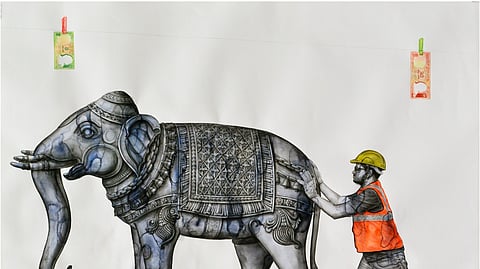
However, if Sanjay’s works invite inward reflection, Srinivasa Reddy’s watercolours pull you firmly into the social world. Based on socio-political observation, his works reflect what it means to live, work, and survive in contemporary India. “My works were initially reflections of my personal life. But soon I realised that we are a product of the socio-political context we occupy.” Growing up near Vidurashwatha in Karnataka, studying in Chennai, and absorbing temple rituals, labour movements, and urban expansion, he constructs layered narratives through collage-like imagery.
A recurring presence in his works is the common man—often represented through his own self-portrait in watercolours. Currency notes, construction workers, and temple vahanas populate his compositions, turning symbolism into lived experience. Speaking of his Shesha Vahana works, he says, “The weight of the world truly belongs to the common man. In this self-portrait, I see myself simply as a vessel for that shared experience; there’s no grand moralising here, just an honest nod to the everyday grit we all carry.”
A shift in tone arrives with Bhavana Sonawane’s luminous, dreamlike landscapes. Her works feel like pauses that are soft, joyful, and unburdened by realism. “Amalgam is mixture. It’s mixture of thoughts in the exhibition,” she says, reflecting on being part of a show that includes artists she admired as a student. Bhavana’s paintings, rendered in acrylic with metallic accents, celebrate simplified forms and repetition—mostly nature.
Travel feeds her visual vocabulary. “My landscapes are essentially a travelogue of my life—from childhood trips with my parents to solo adventures today. However, I’ve always preferred the finer details. Whether it’s a building or a forest, I shy away from big shapes, opting instead for teeny-tiny brushes to paint every flower and leaf one by one. It’s an approach inspired by years of travel, combining repetitive forms with a palette of shimmering pastels. I want my collectors to feel that same ‘sea of light’ I experienced on my journeys.”
The exhibition takes a sharper satirical turn with Sanjeeva Rao Guthi’s vibrant watercolours, populated by animals, stars, and exaggerated human figures. Grounded in close observation of everyday behaviour, his works translate social attitudes into visual metaphors. Zebras and donkeys stand in for inflated egos and hollow ambition—figures that may appear attractive on the surface but are driven by regressive ways of thinking. As the artist explains, “Zebras are beautiful, but so is a donkey—they may be living the life of a zebra, but their thoughts and attitude are those of a donkey.” Importantly, Sanjeeva’s practice is not cynical; elephants emerge as symbols of strength and integrity, representing those who continue to uphold values within an increasingly fractured social landscape.
Stars hover above every head in his art, not as irony but affirmation. “I’ve often noticed how everyone wants to be the hero of their own story, to stand out and be seen. I use vibrant, bold colours to capture that ‘look-at-me’ energy we all have. But I also believe life is as delicate as a sheet of paper—there are no warranties or guarantees. It can be a festival one moment and a bit of a muddle the next.” The takeaway is disarmingly simple: Enjoy and embrace the journey that is life and find the positives in it everyday.
On till January 10. Open to all. Tuesday – Saturday 3 pm to 6.30 pm. At Apparao Galleries, Nungambakkam.
For more updates, join/follow our
https://www.whatsapp.com/channel/0029Vb677uz60eBXiDYheb0n