
- LIFESTYLE
- FASHION
- FOOD
- ENTERTAINMENT
- EVENTS
- CULTURE
- VIDEOS
- WEB STORIES
- SPORTS
- GADGETS
- CAR & BIKE
- TRAVEL
- SOCIETY
- GALLERIES
- NORTH EAST
- INDULGE CONNECT

In the crowded calendar of centenary tributes, few manage to feel genuinely alert to the present. Across The Century, AstaGuru’s selling exhibition of works by Krishen Khanna, does. Held in Mumbai from January 21 to 25, the showcase resists the temptation to flatten a long career into reverence. Instead, it stages Khanna’s work as a series of returning questions, each sharpened by time, history and lived experience.
Krishen turns one hundred this year, a milestone marked by the simultaneous launch of a major centenary publication that draws together works from institutional and private collections around the world. The exhibition functions as a companion rather than an illustration. It is compact, tightly edited, and structured around themes that have preoccupied the artist for more than six decades. Bandwallahs, biblical suppers, porters bent under invisible weight, figures in transit: these motifs recur, change register, and accumulate meaning.
“For us, the challenge was never about compressing six decades into a linear survey,” says Manoj Mansukhani, Director at AstaGuru. “It was about distilling the emotional and philosophical through-lines that have sustained Krishen’s practice over time.” That decision shapes the experience of the exhibition. Works are not ordered chronologically, nor do they announce themselves as milestones. They speak sideways to one another, creating a rhythm of movement between spectacle and restraint, outward ceremony and inward reckoning.
The Bandwallahs, among Krishen’s most recognisable figures, form an important anchor. These uniformed musicians, drawn from wedding processions and civic display, have often been read for their colour and cadence. Here, their irony feels closer to the surface. In The Wedding Procession (Pentaptych), bodies overlap and tilt, reds and yellows collide, and the sense of music is almost physical. Yet there is a fragility to the procession, a suggestion that the performance masks hierarchy and fatigue. Mansukhani notes that these works mark Krishen’s early engagement with urban spectacle, where “beneath their ceremonial exuberance lies a subtle melancholy that signals his lifelong concern with the human condition.”
That concern deepens as the exhibition moves inward. The Emmaus series, represented by an oil on canvas depicting the biblical moment of recognition after resurrection, shifts the tone dramatically. Figures gather around a table, their gestures minimal, the palette reduced. The drama is internal. Krishen’s interest here is less theological than human. Revelation arrives through proximity and pause, through the shared act of sitting, waiting, seeing. The painting carries the weight of memory and belief without insisting on either.
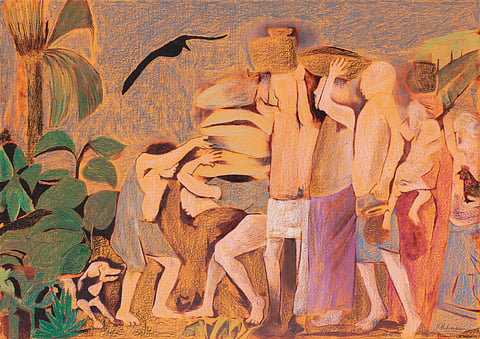
Between these two poles sits a body of work that may be Krishen’s most persistent. Paintings and mixed-media works focused on labour, journey and transit recur throughout his career. Porters, migrants, anonymous figures moving through space appear again and again, their faces often indistinct, their posture doing the work of expression. In Untitled (The Journey), warm, earthy tones and a layered surface convey motion that feels both physical and existential. The body is bent forward, pulled by necessity rather than destination.
“These works bring us back to his enduring empathy for the working body and displacement,” says Mansukhani. “They are shaped by his lived experience of Partition and post-Independence India.” Krishen, who worked in banking before committing fully to painting, has always been alert to systems that structure everyday life. His figures carry the weight of economic reality, social transition and historical rupture without slipping into illustration.
What distinguishes Across The Century is the way it allows these strands to remain unresolved. The exhibition does not argue for a single reading of Krishen’s legacy. Instead, it proposes continuity as a form of inquiry. Mansukhani describes the selection as guided by themes rather than periods, revealing “an artist who remained steadfast in his humanism, constantly refining his visual language while returning to shared vulnerabilities and resilience.”
That sensibility extends to the accompanying centenary publication, a substantial volume assembled through years of research and close collaboration with Krishen and his estate. Bringing together works from collections across India and abroad was, by Mansukhani’s account, an exercise in trust as much as logistics. “Many of these works have not circulated publicly for decades,” he says. “Collectors and institutions were generous but meticulous in allowing them to be documented with scholarly precision.” The process uncovered early and transitional works that complicate familiar narratives of Khanna’s development, offering glimpses of a language still forming.
The dual nature of the project, scholarly and commercial, is addressed openly. AstaGuru positions the selling exhibition as part of a broader responsibility to place significant works thoughtfully into circulation. “The commercial and cultural aspects are not opposites for us,” Mansukhani explains. “They are complementary.” This approach is evident in the range of works on view, which includes paintings and works on paper that offer different points of entry for collectors and viewers encountering Krishen for the first time.
For younger audiences and students, the exhibition offers proximity rather than distance. By presenting early works alongside later, more familiar images, Krishen emerges less as a fixed modern master and more as an artist in continuous dialogue with his world. The questions he poses about labour, faith, hierarchy and endurance remain unsettled, and perhaps that is the point.
Across The Century asks for attention rather than reverence. By bringing Krishen’s figures into close proximity with one another, AstaGuru allows the work to operate in the present tense. The exhibition frames the centenary as a continuing conversation, one that acknowledges history while remaining alert to the pressures that shaped it. In a city defined by movement, labour and public display, Krishen’s paintings feel acutely situated. Their power lies in how they hold complexity without resolution, returning again and again to the shared conditions of work, belief and passage that continue to shape everyday life.
Exhibition Dates: 21–25 January
Location: ICIA Gallery, Kala Ghoda, Mumbai.
For more updates, join/follow our WhatsApp, Telegram and YouTube channels.