
- LIFESTYLE
- FASHION
- FOOD
- ENTERTAINMENT
- EVENTS
- CULTURE
- VIDEOS
- WEB STORIES
- SPORTS
- GADGETS
- CAR & BIKE
- TRAVEL
- SOCIETY
- GALLERIES
- NORTH EAST
- INDULGE CONNECT

When you talk of Bishnupur, the first imagery that comes to mind is the beautiful terracotta temples. The triangular silhouette of Raas Mancha with all its glory is one of the best remnants of terracotta architecture. But the city of Bishnupur is known for one more thing- The Dashabtar playing cards. These have just earned global recognition through a GI tag and that is being seen as a motivation for the artisans to take this age-old art form to newer heights.
Before the world knew what a card game was, this quaint, historic and cultural town in West Bengal was already ahead of its years. This deck, which is so drastically different from the card deck we know today, comprises 120 cards that are circular in shape.
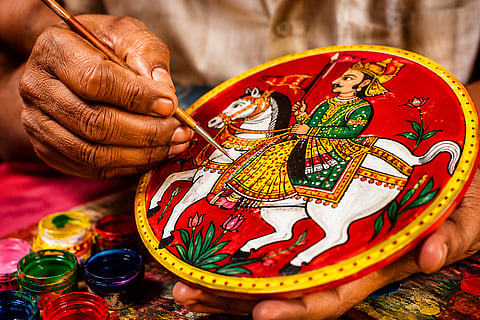
Inside the deck are 12 sets of cards in 10 sets. These cards are round, hand –painted and have the motifs of the ten avatars of Vishnu. These incarnations include Matsay (fish), Kurma (tortoise), Varaha (wild boar), Narsimha (half-man, half-lion), Vamana (dwarf), Parashurama, Rama, Krishna (or Balaram), Buddha, and Kalki. Apart from Vishnu's incarnations there are the Raja and the Mantri cards.
When was the first Dashabtar card deck created?
The origin stories of these decks are many. But the most notable and accepted one is when the Malla King Bir Hambir paid a visit to Emperor Akbar’s court, he chanced upon the Mughal Ganjifa card game. This game, in turn, is inspired by the Persian Ganjifa. Impressed by what he saw, the King decided to adapt the card game in his kingdom and give it a very Bengali essence. Thus, artisans were summoned and the first set of hand-painted cards came about.
How are these cards made?
Creating the cards is an art in itself. At first, three cloth layers are placed on top of each other and glued using tamarind seed paste. Then the surface is coated with chalk powder to that a polished surface is reached. These sheets are then cut into circular discs. The figures are hand-painted on these discs by trained artisans. Once the figures are drawn and coloured, the cards are finished with a coat of lac and vermilion.
How to play the game?
Traditionally, it was played by 5 players where the 120 cards were dealt equally between all five players. This amounted to 24 cards per player. One player starts off the game by showing one of his cards. The other players must follow the same suit. In case, they cannot, they can start off a new one. The highest card rank of each suit becomes the winner. Interesting, the opening card of this game changes as per the time it is played. During daytime, Rama opens the game while evening it is Balaram / Krishna; and at twilight, it is Narsimha. During the rainy days the Kurma card opened the game while on raining nights it was the Matsya.
Today, the Foujdar family is known as the primary artisan family who have been doing this work since generations. Their works have reached museums, galleries and several National and International platforms. Next time you visit Bishnupur, make sure you stop by and pick up a Dashabtar card set collectible for yourself.
For more updates, join/follow our WhatsApp, Telegram and YouTube channels.