
- LIFESTYLE
- FASHION
- FOOD
- ENTERTAINMENT
- EVENTS
- CULTURE
- VIDEOS
- WEB STORIES
- SPORTS
- GADGETS
- CAR & BIKE
- TRAVEL
- SOCIETY
- GALLERIES
- NORTH EAST
- INDULGE CONNECT

Every city has its unofficial record keepers. They’re found on walls where posters are pasted over one another, where slogans fade beneath fresh coats of paint, where graffiti appears overnight and disappears by morning. These surfaces rarely make it into official histories, yet they preserve a running account of conflict, aspiration and everyday life. It is this overlooked archive that Subhakar Tadi returns to in Writings on the Wall.
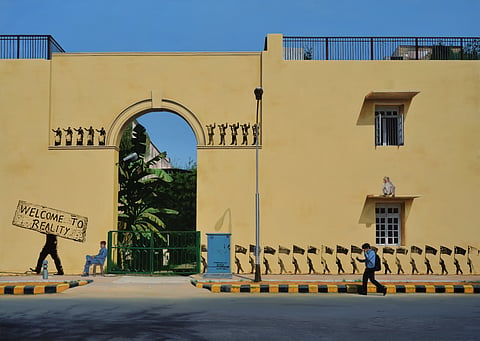
Opening at Akara Contemporary, the exhibition draws on the visual language of the street without attempting to replicate it. Subhakar’s large-scale paintings gather fragments of urban life, torn posters, political slogans, graffiti and fading advertisements, then reconstruct them into imagined landscapes where public history and private experience occupy the same frame. The result feels less like documentation than an act of close reading.
The artist traces this way of seeing back to an experience from his student years. Around 2003, he noticed that sections of a cinema poster had been painted over by municipal authorities, recalling childhood memories of political posters in his village being routinely defaced by rival groups. “A wall isn’t just a physical boundary; it is a living, shifting archive of the public psyche,” he says. “The layers of torn posters, the overlapping political graffiti, the sudden blocks of black paint and the spontaneous commentaries written by random passersby all form a unique literature of the masses.”
Those observations don’t appear on canvas as direct reproductions. Instead, Tadi treats them as starting points. “I don’t directly copy graffiti or specific wall images onto my canvases; rather, they serve as essential ingredients,” he explains. In one painting, a war unfolds across a wall while, beside it, a labourer pauses with his donkey after a day’s work. Political spectacle and the routines of survival exist within the same landscape, each shaping the way the other is understood.
Rather than directing viewers towards a fixed conclusion, Tadi leaves room for ambiguity. “My intention is simply to make the viewer pause, look closer, and introspect,” he says. “The artwork becomes a mirror, inviting people to question how ideology is subtly influencing their own lives.”
That openness drew Akara Contemporary to the exhibition. “Subhakar’s works feel incredibly timely because they aren’t direct statements about any particular event or cause,” say gallery founders Puneet and Meghna Shah. “Rather, they offer something rarer, an invitation to pause, to perceive and comprehend what stands before you.”
At a moment when attention is constantly being redirected, Writings on the Wall returns to a surface most of us have stopped reading. The stories have been there all along, layered beneath fresh paint, waiting to be noticed.
What: Writings on the Wall
When: July 9 – August 14
Where: Akara Contemporary, Colaba
For more updates, join/follow our WhatsApp, Telegram and YouTube channels.