
- LIFESTYLE
- FASHION
- FOOD
- ENTERTAINMENT
- EVENTS
- CULTURE
- VIDEOS
- WEB STORIES
- SPORTS
- GADGETS
- CAR & BIKE
- TRAVEL
- SOCIETY
- GALLERIES
- NORTH EAST
- INDULGE CONNECT

The origin of Madhubani paintings is rooted in an unusual event that happened in 1934 when the state of Bihar was hit by an earthquake. There were beautiful paintings hidden behind the walls of houses in the district of Madhubani, which depicted the rich culture of Mithila. It was discovered by William G. Archer, who was a colonial British officer.
There was an earthquake that caused the destruction of many buildings in Bihar in 1934. While William G. Archer was visiting Madhubani district, he observed that there were paintings on the inner walls of the houses in the villages. He made a collection of such paintings, which had diverse themes and designs.
These paintings initially formed an essential part of daily rituals in Mithila, which is the homeland of Sita. According to legend, the art was invented when King Janak ordered paintings to be made for his daughter's wedding to Lord Rama.
Women have been painting such murals for generations as part of their traditional social practices and festivals. The art was practised by Brahmin and Kayastha women traditionally. But further studies revealed that the Harijan women painted their homes too.
The Brahmins were famous for their ability to create open compositions with vibrant colours. The Kayasthas were skilled at creating line drawings and enclosed scenes.
The introduction of Madhubani painting altered the course of this art form in the coming years. The growing attention from art collectors and recognition within the country in the 70s brought new avenues of earning for the village community. Artists began moving beyond walls and started creating works on paper, canvas and other objects.
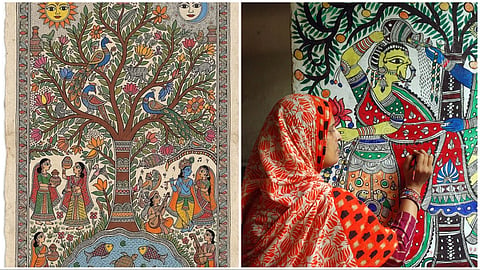
Themes related to Madhubani paintings involve love, fertility and prosperity. Some common images used in the paintings are Hindu gods, weddings, animals, trees, hunting and agricultural practices. Some of the most significant works in the Madhubani painting tradition include Kohbar paintings, which involve various themes such as fish, elephant, parrot, turtle, bamboo tree, sun and moon.
Traditionally, colours were made from natural substances. Black colour was obtained from charred jowar or kajal, yellow from turmeric, orange from palash flower, red from kusum flower, and green from bilva leaves. Now, pre-mixed colours have increased the palette of colours for artists. Today, Madhubani painting can still be seen on saris, scarves, bags, wall hangings, clocks, and other decorative objects.
For more updates, join/follow our WhatsApp, Telegram and YouTube channels.