
- LIFESTYLE
- FASHION
- FOOD
- ENTERTAINMENT
- EVENTS
- CULTURE
- VIDEOS
- WEB STORIES
- SPORTS
- GADGETS
- CAR & BIKE
- TRAVEL
- SOCIETY
- GALLERIES
- NORTH EAST
- INDULGE CONNECT

In Assam, no occasion, festival or celebration is complete without traditional aesthetics. And one such aesthetics is the locally found Jaapi or the conical hats that are often worn by people. From a monsoon saviour to an established symbol of the state tradition, the journey of Jaapi is indeed quite remarkable.
What if we told you that the beautiful, colourful tokou hats that are usually apt for photo-ops, gifting purpose or collectible, actually started out as umbrella alternatives? The Assamese fields have rich soil which is utilized for farming purpose. But during extreme heat and rainfall, these jaapi hats help in protecting the head and body from extreme climates. It light weight, perfect fit, and easy tie kept both the hands free for farming purpose. With time, the plain jaapis started to have decorative elements and motifs, making them a perfect fit for the Ahom royal courts for ceremonies. Thus, these jaapis came to have two co-existing versions- a simpler, practical one for farming and a decorative one for the nobles.
How jaapi are’s made?
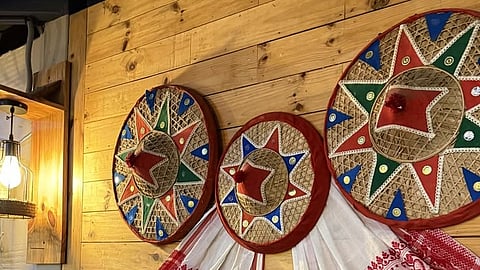
Traditionally, jaapi is handcrafted with care. It is made with dried palm leaves or tokou, cane, bamboo strips and cloth or cotton fabrics, mostly used for the decorative versions. It is a skill and art that has been handed down to families in this field for generations. Today, there are several types of jaapi’s that are available in the market and each of them serves a different purpose. While the Haluwa jaapi is the plain one used by farmers, the Garakhiya jaapi is for the cattle herders. The Varun jaapi is used as an umbrella whereas the Sorudoi Jaapi is the decorated one used on ceremonial occasions. The Bordoi jaapi has been associated with the Royal Courts.
The jaapi is a circular hat which is flat on the base with a conical hollow to fit in the head. On the upper side the conical shape is more structured and the surface has triangular designs in red, blue and white colours. The hat has a red fabric lining throughout its borders.
The epicenter of Jaapi-making
Nalbari district is known as the epicenter of Jaapi making. Artisans from around the area get together to make these intricate jaapis which are sold in the common market, to the travelers and sourced for ceremonial representations. These artisans have kept this bamboo-cane craftsmanship alive for so many years that this Assamese treasure earned itself a GI tag in 2024.
The essence of Jaapi today
If you visit Assam today, Jaapi’s are regular occurrences in state showrooms for tourists and locals to purchase. Right from the original traditional ones in red, green, black, blue or white colours to miniatures replicated in magnets or key chains, one can find them all. These serve as perfect collectibles or gifting items and are often purchased in bulk. One of the greatest advantages of jaapi is that due to a perfect fit, it renders both hands free. This makes it a natural choice for traditional performers to wear it on stage while being able to freely use their hands while performing. Farmers and tea-pickers also use it wisely apart from being an essential part of government gifting and ceremonial purpose.
Jaapi is a testament that authentic craftsmanship can still be kept alive by hand-made products in the age of rapid scientific advancement. Moreover, these handmade products are priceless and irreplaceable. Thus, this artisanship is often applauded and put under the spotlight so that the artisans also have a moment and boost in their livelihood.
For more updates, join/follow our WhatsApp, Telegram and YouTube channels.