
- LIFESTYLE
- FASHION
- FOOD
- ENTERTAINMENT
- EVENTS
- CULTURE
- VIDEOS
- WEB STORIES
- SPORTS
- GADGETS
- CAR & BIKE
- TRAVEL
- SOCIETY
- GALLERIES
- NORTH EAST
- INDULGE CONNECT
From England, Emily Eden, the artist sister of the second governor-general, Lord Auckland (1836-42), carried into 19th-century India her easel, her unshakeable faith in the superiority of the British race, and her sniffiness.
Her measure of the Indians she met — royals and commoners alike — was wealth, social hierarchy, congeniality, resistance (or the degree of it) to the colonial project. Thus, who she painted and what she painted cannot be seen, even now, apart from her brother’s agenda as a top official of the East India Company.
The book, Princes & People of India, Portraits by Emily Eden, published alongside a new exhibition at DAG (till August 1) of her works and her personal correspondence, does not hide this aspect. But it also pitches another way of looking at her – as an intrepid traveller observing royal and ordinary life; a ‘Jane Austen of colonial India’ writing with wit on the shenanigans of big and petty Indian royals; and as a portrait painter of a certain period in British Indian history of which she provides a view—as she saw it

Eden’s paintings certainly would have played their part in influencing and reinforcing colonial bias about a certain kind of subcontinental splendour – where grandeur was thought to be mixed with naivete, and abundance was seen as the excess of rulers unmindful of governance.
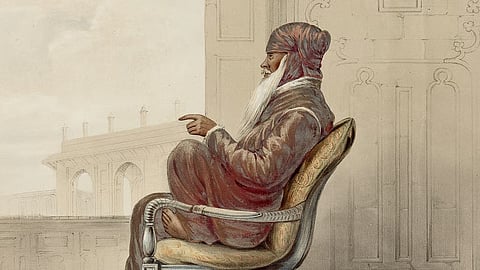
Aware that Ranjit Singh, the ruler of the Punjab, was “the only Indian subject that was interesting at home”, Eden made several paintings of him to feed that curiosity, some of which are part of the exhibition.
From painting Ranjit Singh “like a mouse” in his old age even as she captured his “modesty”, to painting his horses wearing the famous Kohinoor diamond, her paintings were, in fact, visual reports. As Lord Auckland’s sister, she was given access to Singh and enjoyed his hospitality. Her artworks thus also give an idea of where Anglo-Sikh relations stood at the time of Victoria ascending the throne and a decade before the annexation of Punjab.
Photos and politics
Eden put out flattering portraits of people with whom it was beneficial for the Company to have good relations at a given point in time, or those who went out of their way to please her.
The Raja of Nahaun thus got painted in a Durbar setting; Dost Mohammed Khan, the Emir of Kabul – the Afghans were key to her brother Lord Auckland’s ‘foreign policy’ against the Russians – and his sons had their profiles done; and the “gorgeous” Sher Singh, who got the Punjab throne unexpectedly after the death of his father Ranjit Singh and other contenders in between, seems to have been quite a favourite. Raja Hindoo Rao (“plump as a featherbed”) of the Gwalior royal household and the Akalis (“they wear their own dark blue dresses, with quoits of steel hanging all over them, which they fling at anybody and everybody”) clearly were not.
Likes and dislikes, however, were ultimately determined by watching how the wind blew. Towards the end of Ranjit Singh’s life and in the face of impending chaos, she notes in her journal: “The army is attached to our dear friend Shere Singh; but Runjeet [the way she addressed the ‘Lion of Punjab’] has deprived him of most of his income, or it is just possible his dear fat head will be chopped off, unless he crosses to our side of the river.”
Photos as reports
Eden used her ‘soft power’ as her brother’s hostess at official functions. She was his eyes and ears. Her painting sessions were ideal for observing rulers in more informal settings outside the officialdom of court, be privy to the aspirations of members of their households, or assess the real dynamics of their relationship with their people. Her opinions were enjoyed and studied by the most powerful woman of her land, Queen Victoria.
The period between 1838 and 1839 was a time of crucial negotiations between the Sikhs and the British. Eden’s observations in her letters add another dimension—the ‘women’s gaze’ if you like – into the time. They constitute the only other contemporary Indian record, besides Sohan Lal Suri’s court chronicle, the five-volume Umdatut-tawarikh Daftar, from the standpoint of an insider.
Ranjit Singh’s late-life whimsicalities, the absence of a clear line of succession – he, for example, did not in the beginning acknowledge Sher Singh as his son; when he did, he did not acknowledge his twin brother – went into her journals and no doubt informed how the English could proceed, both vis-à-vis him in his last days and in a post-Ranjit Singh scenario.
Curator Mary Ann Prior, who was in Delhi for a walkthrough of the DAG exhibition, points out in the book that Eden’s output differed from that of other amateur artists of her time “in the frequency and persistence of her practice”.
Crowd scenes were not her forte; most of her portraits had one or two subjects to whom she gave her full focus. Fabrics, jewellery, drapes and turbans seem to have fascinated her.
Eden was also not someone satisfied doing just one thing. She wrote two novels from her stay in India – The Semi-Detached House and The Semi-Attached Couple – of which she made a packet. And though the Edens returned to England in disgrace – due to the catastrophic failure of the First Anglo-Afghan War set off by Auckland’s decision to depose Dost Mohammed Khan – Emily Eden picked up her brush, one assumes, to paint other vistas.