
- LIFESTYLE
- FASHION
- FOOD
- ENTERTAINMENT
- EVENTS
- CULTURE
- VIDEOS
- WEB STORIES
- SPORTS
- GADGETS
- CAR & BIKE
- TRAVEL
- SOCIETY
- GALLERIES
- NORTH EAST
- INDULGE CONNECT

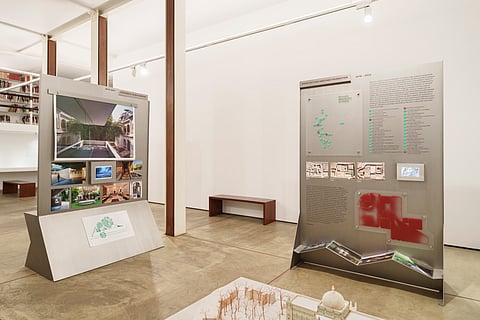
Contextures, curated by Ranjit Hoskote, reconsiders Rahul Mehrotra's work through six institutional projects that place landscape, history and public life at the centre of architecture.
For much of the past three decades, Rahul Mehrotra's work has been discussed through the many roles he occupies: architect, urbanist, educator, conservationist and public intellectual. Contextures, curated by Ranjit Hoskote, shifts the conversation elsewhere. Rather than presenting a survey of completed buildings, the exhibition asks how architecture comes into being through its relationship with a site, its ecology and the people who inhabit it.
Hoskote calls this idea "embedded architecture", a way of thinking that resists treating buildings as autonomous objects. "Embedded architecture refuses to draw attention to itself as a visual and spatial statement imposed on a site," he says. "Rather, it emphasises and makes visible a close and dynamic interrelationship with its immediate environment." The phrase extends beyond aesthetics. It describes an architecture that pays attention to gradients, water bodies, neighbourhoods, patterns of light and the accumulated histories of a place before proposing an intervention.
The exhibition brings together six institutional projects spanning museums and university campuses, from the CSMVS Museum estate and the Kasturbhai Lalbhai Museum to the Lilavati Lalbhai Library at CEPT University and the JSW School of Public Policy at IIM Ahmedabad. Instead of organising them as milestones in a career, Contextures reveals the continuity that runs through them. Each project responds differently to its surroundings, yet all share a belief that architecture gains meaning through dialogue with its environment rather than distance from it.
Hoskote arrives at this reading through biography as much as criticism. He traces Mehrotra's formative travels across Europe, the United States and North India, suggesting that these journeys continue to surface in the work as instincts rather than direct references. Sightlines evoke Fatehpur Sikri, while the structural use of wood alongside steel and concrete recalls Nordic modernism. Hoskote describes these recurring influences as "intuitions of form", ideas that emerge through making rather than declaration.
The exhibition ultimately asks a larger question about institutions themselves. "The institutional buildings that will remain culturally significant in the long run are those in which the architecture itself embodies and proposes the ideals of dialogue, confluence, cooperative effort and the potentiality rather than fixity of outcomes," Hoskote says. In Mehrotra's work, terraces become places for gathering, glass pavilions frame existing trees instead of replacing them, and campuses encourage encounters that spill beyond classrooms. Architecture shapes public life through use rather than spectacle.
At a time when buildings are often judged by the image they produce, Contextures argues for another measure of significance. It lies in the conversations a building sustains with its surroundings, and in the lives that continue to unfold within it long after construction has ended.
What: Contextures: RMA and The Practice of Embedded Architecture
When: On show till 21st August 2026
Where: TARQ
For more updates, join/follow our WhatsApp, Telegram and YouTube channels.