
- LIFESTYLE
- FASHION
- FOOD
- ENTERTAINMENT
- EVENTS
- CULTURE
- VIDEOS
- WEB STORIES
- SPORTS
- GADGETS
- CAR & BIKE
- TRAVEL
- SOCIETY
- GALLERIES
- NORTH EAST
- INDULGE CONNECT

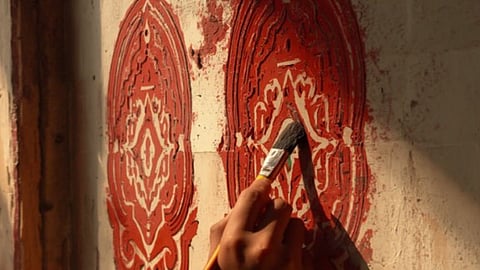
While you are visiting the cosmopolitan beauty of Goa, you tend to lose yourself in the vibrant Cuba-like colourful alleys of Fontainhas or stand in awe in front of the intricate Azulejo tiles. But did you know about the Kaavi art? Similar to the tiles, these are beautiful red and white mural, usually seen etched onto architectural wonders or people’s homes in rural areas. Kaavi also forms an important aspect of the region’s heritage.
Like Bengal’s Ranga maati which is available in abundance in Bolpur, Goa has its own version of reddish pigment derived from the laterite soil. This, in the Konkan dialect is called the Kaav. A pigment, with over 300-400 years of history, flourished due to the humid and heavy monsoons experienced in that part of the Western coast. This pigment is used to etch designed on temples, churches, shrines, and local houses to decorate them, and the practice came to be known as Kaavi art.
What is the process involved?
Remember as a child when you used to work with wax crayons? Filling margins with colours and then putting a coat of black on top to expose the vibrant colours underneath. Kaavi art is somewhat similar. One needs to first prepare a smooth mixture of lime, sand, natural binders and red laterite pigment. This is then applied symmetrically on top of a white washed surface. While the mixture is moist, intricate designs are carved on it, exposing the white wash underneath. Traditionally, this technique which is considered quite similar to the sgraffito method is used to etch floral designs, geometric shapes, and scenes from daily life or mythology. In fact, if you visit Morjim, Sattari, Pernem or Ponda, you can still see public monuments or local houses with Kaavi art on the walls.
Decline and revival of Kaavi art
However, the trajectory of the once flourishing Kaavi art, suffered a setback in the last century when the traditional artists started vanishing. Moreover, many heritage or local spaces started being renovated without proper knowledge of architectural preservation methods. While this definitely led to a decline in the craftsmanship, contemporary efforts at reviving the art cannot be overlooked either. Kaavi as an art form has been documented and efforts are being made to train new artists in this creative field. In fact, it has also been introduced in educational institutions so that the new generation is aware of their cultural heritage.
For more updates, join/follow our WhatsApp, Telegram and YouTube channels