
- LIFESTYLE
- FASHION
- FOOD
- ENTERTAINMENT
- EVENTS
- CULTURE
- VIDEOS
- WEB STORIES
- SPORTS
- GADGETS
- CAR & BIKE
- TRAVEL
- SOCIETY
- GALLERIES
- NORTH EAST
- INDULGE CONNECT

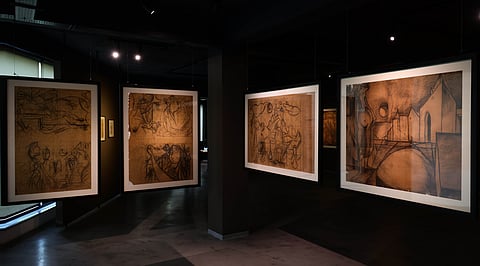
When it comes to having a dialogue about Indian modernist painters, one cannot leave out the name of Abdul Aziz Raiba, popularly known as A.A. Raiba. Displaying his repertoire of works, especially the ones from 1950s and 60s is the ongoing exhibition, Master Artist A.A. Raiba: a Unilateral Eclectic at Thapar Gallery, New Delhi. The displays highlight his body of works which depict a nuanced visual language, a result of imbibing different artistic traditions.
Those visiting the exhibition can clearly see the versatility of his medium usage. From working on murals to painting on jute, large drawings to reverse glass paintings and even calligraphy and serigraphs find a space in his career trajectory. Historian Shivaji K Panikkar notes, “The art of Master Raiba emblematically reveals this historical context of the multistranded synthesis within the Indian modernism where the unique fusion of Indo-Islamic traditions, European academic naturalism, the Bengal School and European modernity lent an amazing richness and depth”.
One of the most notable things about Raiba’s art is his command over the use of lines. His artworks are strong and bold, with outlines that give the canvas a structural precision and lingual clarity. In fact, lines give a distinct identity to Raiba’s narratives. While the basic yet intricate line is a remnant of miniature artistic traditions, the more complex ones are a reflection of newer styles in Indian modernism. In contrast to his structured compositions, a series of landscapes depicting his travels in Kashmir between 1957 and 1959 lends his works a fluidity of language. Ashish thapar, director, Thapar Art Gallery also mentions, “What makes his practice compelling is the seamless synthesis of diverse traditions alongside a deeply individual approach to line and form. This exhibition brings that legacy into focus while allowing contemporary audiences to engage with its enduring relevance.”
Another aspect of his works is the use of underlying grid. As pointed by out Panikkar, “Raiba’s use of grids in the drawings are exemplary since he used the gridded layouts to meticulously plan compositions on paper and then transferred them on to the surface prepared for painting to ensure precise proportions from small sketches to large surfaces of the murals/paintings.” His use of grids to attain proportionality only points out to how attentive he was towards little nuances of art.
What: Master Artist A.A. Raiba: A Unilateral Eclectic
Where: Thapar Gallery, Delhi
When: till June 21, 2026
Timings: 11 am – 7 pm (Sundays closed)
For more updates, join/follow our WhatsApp, Telegram and YouTube channels