
- LIFESTYLE
- FASHION
- FOOD
- ENTERTAINMENT
- EVENTS
- CULTURE
- VIDEOS
- WEB STORIES
- SPORTS
- GADGETS
- CAR & BIKE
- TRAVEL
- SOCIETY
- GALLERIES
- NORTH EAST
- INDULGE CONNECT

The journey of a painting used to be predictable. A Pichwai travelled from the artist’s studio to a temple wall. A miniature painting left a court atelier and entered a royal archive. Their worlds were contained, devotional or aristocratic, their audiences small and defined. That geography has shifted.
In Mumbai apartments, large Pichwai panels now hang behind dining tables and along staircases. Miniatures sit in clusters on gallery walls. Sacred images once intended for ritual have entered the broader life of the city, where collectors, designers and architects look to them for depth, symbolism and visual weight.
Cloth & Canvas, a young gallery founded by Pushpa Sharma and her daughter Shreya Sharma Joysher, enters this moment with its first exhibition, Hands That Paint Heritage, opening 14–15 March at the Art House inside the Nita Mukesh Ambani Cultural Centre.
The show is dense. Nearly a thousand works appear across the space, spanning Pichwai painting, miniature traditions and contemporary interpretations of sacred iconography. For a gallery debut, the scale is striking, though the foundations were laid long before the exhibition was conceived.
Pushpa Sharma spent years travelling through artisan communities, meeting painters whose practices remain rooted in inherited discipline. These encounters began informally, driven by curiosity and admiration. Over time, the reality surrounding those traditions became difficult to ignore.
“What began as a personal connection with artisans gradually revealed a larger reality, these traditions were fragile despite their richness,” she says. “At that point it stopped feeling like individual engagement and began to feel like responsibility. Cloth & Canvas became a way to create continuity, visibility, and protection for the ecosystem around the art.”
The gallery grew out of that impulse. Rather than functioning purely as a marketplace, it positions itself as a conduit between artists and collectors, one that keeps the artisans themselves visible within the conversation.
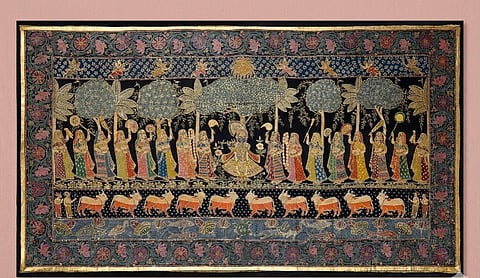
Inside the exhibition, Pichwai works anchor the visual field. Traditionally painted for temples in Nathdwara, these cloths depict episodes from the life of Krishna. Lotus ponds stretch across indigo grounds. Cows cluster beneath stylised trees. The compositions carry the clarity of ritual imagery yet reveal an extraordinary level of painterly control when seen up close.
Nearby, miniature paintings present a different rhythm. Their surfaces demand patience. A face no larger than a fingernail may hold dozens of brushstrokes. The scenes move from courtly gardens to mythological encounters, each detail laid down with the careful precision that defines the form.
For Sharma, the question of change within these traditions is constant. Collectors want works that live comfortably within contemporary interiors, yet the underlying discipline must remain intact.
“Traditions like Pichwai and miniature painting have always evolved,” she says. “For me, the question is simple: does the change still respect the language, discipline, and spirit of the form? If the integrity remains, it is evolution; if the essence is lost, it becomes erosion.”
An artwork at the exhibitionThe exhibition reflects that belief in gradual transformation rather than abrupt reinvention. Cloth, thread and pigment appear together across the show, echoing the way these practices historically intersected.
Shreya Sharma Joysher shaped that curatorial direction. She views Indian artistic traditions less as separate categories and more as interconnected systems.
“Bringing loom, needle, and brush together allowed the exhibition to speak about tradition as a continuum rather than separate disciplines,” she says. “It reflects how Indian artistic practices have historically coexisted, textile, painting, and craft informing one another.”
That conversation reaches its most elaborate form through a collaboration with the textile designer Gaurang Shah. Shah’s contribution, titled Vignaharta, centres on the image of Lord Ganpati.
The works merge several regional techniques. Jamdani weaving sits beside Paithan silk. Painted elements drawn from Cheriyal traditions surface across the compositions. The Ganpati figures emerge slowly from this layered material language, part textile, part painting.
For collectors, such works carry a dual appeal. They possess devotional resonance yet operate convincingly within contemporary design environments. This overlap has helped traditional art forms find new audiences in recent years.
Joysher sees that visibility as necessary but complicated. Sacred imagery holds emotional and cultural significance that cannot be treated casually.
“Visibility is essential for survival, but it must come with sensitivity,” she says. “Sacred iconography cannot be treated purely as aesthetic material; it carries devotion and cultural memory. The role is to create platforms that expand appreciation while protecting the dignity and context of the tradition.”
The exhibition acknowledges that responsibility by foregrounding the artists behind the works. Many come from families where painting has passed from one generation to the next through apprenticeship rather than formal training. Techniques are learned slowly. Pigments are mixed by memory. Compositions are refined through repetition and correction.
Visitors may arrive for the spectacle of colour and scale. They tend to leave thinking about the hands that produced it.
Pushpa Sharma hopes that recognition lingers.
“Beyond the works themselves, I hope audiences sense the living lineage behind them,” she says.
For two days at the Art House, that lineage will be visible across walls filled with pigment, silk and patient craft. The images remain ancient in their symbolism. Their setting feels unmistakably modern.
What: “Hands That Paint Heritage”
Where: Art House, Nita Mukesh Ambani Cultural Centre (NMACC), Mumbai
Exhibition Dates: March 14-15, 2026
Timings: 11 am – 8 pm
For more updates, join/follow our WhatsApp, Telegram and YouTube channels.