
- LIFESTYLE
- FASHION
- FOOD
- ENTERTAINMENT
- EVENTS
- CULTURE
- VIDEOS
- WEB STORIES
- SPORTS
- GADGETS
- CAR & BIKE
- TRAVEL
- SOCIETY
- GALLERIES
- NORTH EAST
- INDULGE CONNECT

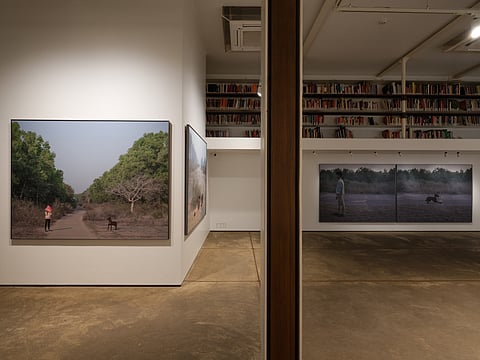
In the opening pages of the narrative that anchors The Sun Rises in the East, winter arrives harshly in Bengal in 2045. Climate systems have tipped into erratic behaviour. Artificial intelligence circulates through criminal networks. Somewhere across the ruins of former military installations, a wooden dog moves through the landscape beside a teenage boy. The premise is disquieting in its restraint. Yet the story unfolds through still images.
The exhibition begins with a call from a Western photo editor, sending the artist in search of a peculiar relic: an analogue learning machine built in the 1940s as a covert wartime system. Designed in the form of a dog, the prototype was meant to survive in the aftermath of a hypothetical catastrophe. It would learn from its surroundings and assist survivors of what wartime strategists once imagined as the “free world”.
The aircraft that would later carry nuclear bombs across the Pacific had already passed through airfields in eastern India. During the Second World War, the region formed part of a vast logistical corridor for the United States Army Air Forces and the Royal Air Force. Those installations now exist as silent stretches of land, slowly absorbed by weather and vegetation. Sen travelled to several such sites while developing the project. In the photographs, they appear almost emptied of chronology: runways dissolve into fields, watchtowers tilt against vast skies.
The story proposes that one prototype machine survived. More than a century later it has found a companion in a sixteen-year-old boy who lives among the remnants of those airfields. What has the machine absorbed across decades of observation? And what kind of knowledge could pass between a boy and a device that once belonged to a military experiment?
Sen approaches the scenario through the peculiar authority of the photograph. “Photography stops the world and shows a fragment and calls it evidence,” he says. “The historical function of photography has been to verify.” His project inserts fiction into that evidentiary structure, allowing the image to oscillate between documentation and invention.
The strategy draws attention to the institutional habits attached to photographs. Police archives, colonial surveys and military inventories once relied on the camera as a tool of classification. The image certified that something existed or that an event had taken place. Sen’s pictures retain the appearance of such records. Their surfaces offer expansive landscapes, weathered infrastructure and small figures placed at a distance. Yet the certainty that usually accompanies documentary imagery begins to slip.
“When an image resembles evidence yet refuses to resolve into certainty, it exposes the instability of the guarantee that photographs are often assumed to provide,” Sen explains. Rather than encouraging viewers to assemble a coherent fictional plot, he pushes them to recognise how interpretation takes shape through expectation and habit.
Scale plays a central role in that encounter. Sen’s previous exhibition at the gallery, Fire Continuum in 2018, presented a series of small vertical landscapes. Those prints measured barely six by nine inches, drawing viewers into close proximity with the surface. The new works move in the opposite direction. The prints are large, opening wide perspectives across abandoned airfields where fragments of wartime architecture punctuate the horizon.
“The scale allows the viewer to feel the distance first, the expanse, and only then to notice the presence within it,” Sen says. A human figure, a structure or the outline of the dog emerges slowly against the landscape. The experience begins with the sensation of standing before territory rather than narrative.
Although Sen is widely recognised as a filmmaker, the absence of cinematic tools forms part of the exhibition’s logic. Photography removes sound, duration and movement. What remains is the arrangement of images in space. “Photography has always relied on implied montage,” Sen notes. “The sequence, the caption, the archive, these are its narrative engines.” Meaning develops through adjacency and rhythm, through the way one image calls to another across the gallery.
The speculative premise gains weight from the project’s historical grounding. Artificial intelligence appears frequently in contemporary fiction as a technology of the future. Sen relocates it within older systems of power. Colonial administrations depended on vast structures of data gathering and classification, while wartime infrastructures refined methods of surveillance and prediction.
“Technological systems do not emerge in a vacuum,” he says. “They inherit logics of governance, extraction and control.” In the abandoned airfields of eastern India, the distance between the 1940s and the present appears surprisingly narrow. What seems like a futuristic machine begins to resemble an extension of earlier strategies for organising knowledge and territory.
Research feeds directly into the exhibition’s fictional architecture. Archival traces of wartime infrastructure mingle with imagined fragments from the future. Sen approaches the archive with scepticism. “Evidence is never neutral,” he says. “It is always framed by institutions, by states, by markets.” Once research enters an artistic context, its status shifts. Documents become materials that can be rearranged and reconsidered.
Fiction enters at the moment where those documents fall silent. It proposes possibilities that the archive cannot record. In The Sun Rises in the East, the analogue dog stands precisely in that gap between fact and conjecture.
The exhibition closes without resolving the story. The boy remains beside the machine in a landscape shaped by history and climate. The dog continues to observe. What it has learned across a century remains unclear. The photographs leave viewers in that uncertainty, where evidence appears convincing yet something about it refuses to settle.
What: The Sun Rises in the East by Ronny Sen
When: 13th March 2026 to 18th April 2026
Where: TARQ, Mumbai
For more updates, join/follow our WhatsApp, Telegram and YouTube channels.