
- LIFESTYLE
- FASHION
- FOOD
- ENTERTAINMENT
- EVENTS
- CULTURE
- VIDEOS
- WEB STORIES
- SPORTS
- GADGETS
- CAR & BIKE
- TRAVEL
- SOCIETY
- GALLERIES
- NORTH EAST
- INDULGE CONNECT

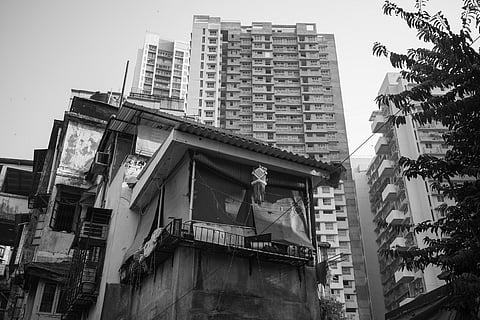
Heritage neighbourhoods in Mumbai often survive in a fragile balance. A few restored houses here, a freshly plastered façade there, and suddenly a century of architectural detail disappears beneath modern repair. Walk through Khotachi Wadi and the tension becomes visible. Wooden balconies lean over narrow lanes; pastel homes recall a Portuguese and British past. Yet many of those houses stand within a city moving at a far faster pace.
Beginning March 21 at Sril of 47A, the exhibition Shadows of Empire looks closely at that tension. The show brings together two artists whose practices approach the village from different directions. Jit Chowdhury arrives from Kolkata with a material language shaped by Bengal’s craft traditions. Kaushal Parikh approaches from within the city itself, documenting a neighbourhood he has watched change over decades.
Their works circle a shared question. What remains of colonial history once it settles into daily life.
For Jit, the answer begins with materials. His collages use shola pith and indigo, two substances that carry long associations with colonial trade and labour. In Bengal, shola pith has long been used to make ceremonial objects. During the colonial era it also formed the core of the pith helmet worn by British officers in tropical climates. Indigo plantations, meanwhile, shaped entire agricultural economies across eastern India.
Jit did not leave those histories behind when he travelled west.
“Much like how we carry our accent wherever we go, I took my visual language and materials to Khotachi Wadi,” he says. “I have been portraying Calcutta in my artworks for a long time, so bringing these materials into another city became an interesting exploration.”
The materials shape the work before the imagery even begins. Sheets of indigo introduce deep blues that echo water and shadow. Carved fragments of shola pith create relief across the surface. Within those layers, figures from the neighbourhood emerge alongside fragments of its architecture.
The materials themselves carry the story.
“As shola and indigo both have a link to colonialism, whether through indigo plantations or the pith hats worn by the British, I tried to vocalise the current situation of Khotachi Wadi through them,” Jit explains. “There is a growing threat from outsiders and redevelopment.”
Walking through the neighbourhood for the first time, Jit paid close attention to the buildings. He had seen a similar transformation in Kolkata, where older houses gradually lost their decorative features during renovation.
“What caught my attention most was the rapidly fading architectural details,” he says. “The new repairs often don’t try to restore the old designs. Broken sections are simply plastered over. Once those details disappear, they are gone forever.”
His collages respond by preserving those details in another form. Window grilles, carved wood patterns and fragments of balconies appear within layered compositions. Faces of residents enter the frame as well, turning the works into portraits of a living neighbourhood rather than a static architectural study.
Parikh arrives at Khotachi Wadi from the opposite direction. He grew up in Mumbai and spent years working in banking before moving fully into photography and painting. That shift in profession altered how he sees the city.
“Growing up in Mumbai means I’ve watched the city change before my eyes,” Parikh says. “From the beauty of old neighbourhoods to the louder pace of modern development.”
Earlier in his career, redevelopment signalled growth and opportunity. Districts such as Lower Parel transformed from mill land into commercial towers. For someone working in finance, that transformation carried its own logic.
Art introduced another perspective.
“Coming from banking, I once saw the city mainly through growth, finance and redevelopment,” he says. “When I began pursuing art, I became more interested in the small human moments that survive within older parts of the city.”
In his photographs of Khotachi Wadi, those moments take centre stage. A resident leans from a balcony to talk with a neighbour. Laundry stretches across railings painted turquoise and coral. Afternoon light falls across wooden beams that have weathered decades of monsoon seasons.
“The colonial-style houses and balconies reflect an older Mumbai,” Parikh says. “Inside them you still see daily routines continuing, people talking in the lanes and life unfolding at its own rhythm.”
Photography records those scenes with documentary clarity. Painting moves somewhere else entirely.
“When I photograph a place like Khotachi Wadi, I’m trying to preserve the reality of the moment,” he explains. “Light, shadow and composition carry the emotion.”
Painting begins without those constraints.
“It starts with a blank canvas,” he says. “That allows me to introduce movement, abstraction and emotion that go beyond what is physically there.”
In one painting, the architecture dissolves into layered colour. Brushstrokes break apart balconies and rooftops until the scene begins to resemble memory more than documentation. A solitary figure walks through the composition.
“Cities evolve and nothing stays the same,” Parikh says. “The person walking through the painting represents that movement into the future.”
Seen together, the works in Shadows of Empire form a conversation about how cities remember their past. Jit approaches Khotachi Wadi through the materials and histories of another region. Parikh documents a neighbourhood that has existed within his own city for generations.
Both perspectives arrive at the same point. Heritage does not exist in isolation. It lives within streets where people still cook, argue, repair roofs and hang out laundry.
In a city where development rarely slows down, that continuity can feel precarious. Khotachi Wadi remains standing for now. Its balconies still face the lanes. Its houses still hold families who have lived there for decades.
The exhibition pauses long enough to look closely. Within these works, architecture, craft and daily life sit side by side, carrying traces of histories that continue to shape the present.
What: Shadows of Empire
When: March 21 to April 19 | 11 am–7 pm |All days, except Mondays
For more updates, join/follow our WhatsApp, Telegram and YouTube channels.