
- LIFESTYLE
- FASHION
- FOOD
- ENTERTAINMENT
- EVENTS
- CULTURE
- VIDEOS
- WEB STORIES
- SPORTS
- GADGETS
- CAR & BIKE
- TRAVEL
- SOCIETY
- GALLERIES
- NORTH EAST
- INDULGE CONNECT

Somewhere in the archive, there is a plant named Primula Inayatii. It was discovered in the north-west Himalayan region — present-day Pakistan — by a man called Inayat Khan, who led the expedition as head plant collector. His name survives, just barely, folded into the Latin bino - mial of the species he found. It is, as curator Shrey Maurya notes, a rare exception. “Rarely named, seems to be the theme,” she says of the local collectors, gardeners and artists who made colonial bota - ny possible in the bygone era.
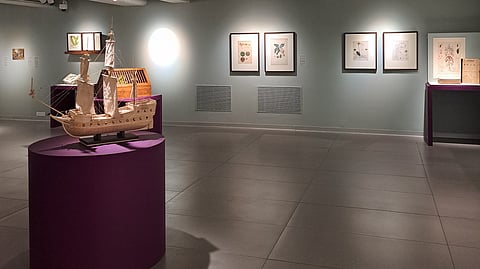
That theme — of labour rendered invisible, of knowledge extracted and unacknowledged — sits at the heart of Paper Gardens: Art, Botany and Empire, a new exhibition at the Museum of Art & Photography (MAP) in Bengaluru. Spread across two rooms and featuring over a hundred botanical illustrations from the 17th to 20th centuries, the show traces the intense scientific activity that unfolded across the Indian subcontinent at the height of British rule.
It is a story about plants. But it is also a tale about power and about who gets to sign their name, showcasing to the world that they helped build botany to what it has become today. The exhibition is the first Indian institutional survey of botanical illustration from the Indian subcontinent at this scale. On display are artworks from the collections of the Linnean Society ( UK), Wellcome Collection ( UK), Oak Spring Garden (USA) and the Missouri Botanical Garden (USA) alongside works from the MAP collection.
“You cannot separate science from colonialism, from new conquest, new territorial conquest — at the baseline, that is what it is. There was a science race on and the British wanted to be at the forefront of every race,” she says. India, one of the most biodiverse regions on earth, became a prime destination for that ambition.
However, this scientific ambition ran into a practical problem: plants refused to cooperate. Transporting living specimens across continents was unreliable — seasonal, fragile, ungovernable. The solution, as Paper Gardens illustrates, was the image. “ The image offers the perfect solution. Volume, shape, vividness, colour, scale — you can magnify it, break it down and most importantly, compress a great deal onto a single image. The image quickly becomes integral to scientific botanical study. The image is portable in a way that the plant itself is not,” the curator explains.
To make those images, British botanists turned to local artists — chintz artistes, miniature painters, sandalwood carvers, stone sculptors — whose existing fluency with plant forms made them ideally suited to the task.
“What they produced was, technically speaking, impossible. Naturally, a plant does not flower and fruit at the same time and yet in these draw - ings, you will see both — because the entire life cycle is compressed into one image. They were likely looking at multiple cuttings and live specimens, pulling the best attributes from each and creating one image that would become a proxy for the actual plant,” Shrey observes. Paper Gardens examines botanical images as both scientific instruments and products of colonial knowledge systems, foregrounding their role in taxonomy, circulation and visual authority.
The erasure extended beyond authorship into nomenclature itself. The third section of the exhibition addresses the Linnaean system — the taxonomic framework adopted globally in the 18th century that gave every plant a standardised two-part Latin name. In theory, a universal language for science. In practice, another instrument of colonial overwriting.
“Despite relying on local plant collectors, despite drawing on local knowledge systems, the local names are put aside and a new name was given. Plants are rechristened and codified into a global knowledge system. They stop being local, indigenous, Indian as they became part of this great British corpus of scientific knowledge,” she tells us.
Thousands of species from the subcontinent —were named after prominent British figures. “Another form of colonisation,” she says flatly. The case of Joseph Dalton Hooker, who travelled to Sikkim in the 19th century and returned to Kew with thirty-three newly classified species of rhododendron, becomes a prime example. He was guided throughout by members of the Lepcha and Bhutia communities. But ended naming one of the flowers Rhododendron Dalhousiae — after the Dalhousies.
Paper Gardens also brings together historical photographs of Lalbagh Botanical Garden, once a Mughal-esque landscape belonging to Hyder Ali and his son Tipu, but overtaken by the colonial administration in the 19th century and operated in the vein of other British botanical gardens — becoming a key node in the circuit of global botanical exchange. The exhibition addresses the collab - orative yet unequal structures that underpinned colonial botany.
On till July 5. At Kasturba Road.
For more updates, join/follow our WhatsApp, Telegram and YouTube channels.