
- LIFESTYLE
- FASHION
- FOOD
- ENTERTAINMENT
- EVENTS
- CULTURE
- VIDEOS
- WEB STORIES
- SPORTS
- GADGETS
- CAR & BIKE
- TRAVEL
- SOCIETY
- GALLERIES
- NORTH EAST
- INDULGE CONNECT

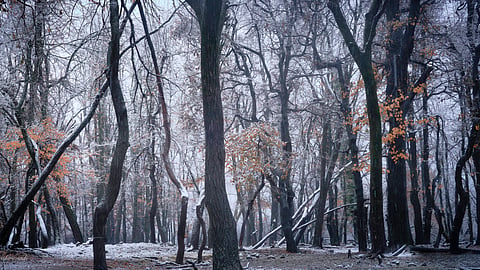
At 10.15 on a cold morning in Dachigam National Park, photographer Srinivasan Periathiruvadi was standing at the tail end of autumn, pointing his lens at oak trees and chinar branches holding on to their last orange leaves. The ground was bare. The light was flat. And then it started to snow. Thirty minutes later, he was looking at a completely different world.
“In about 30 minutes, the landscape changed from barren land with a few orange leaves to a snow-covered ground dotted with the last hints of orange,” he says, and there is still something in his voice—the particular quiet of a man who has spent years waiting for moments and knows, when one arrives, exactly what it cost to be standing in the right place.
That image is one of 39 large prints that will go up on the walls of Lalit Kala Akademi this weekend, in an exhibition called Kashmir: A Visual Poetry. Six years of returning to the valley, season after season, with a camera and the kind of patience that most people talk about and very few actually practice. Thirty-nine images selected from several thousand. And alongside each one, a short poem written by his 12-year-old granddaughter Maya Anupama Koushik, who looked at the finished photographs and decided she had something to say about them. Nobody asked her to. That matters.
“When I read them, I was truly impressed, not because she is my granddaughter,” Srinivasan says, simply. He asked her to write for all 39. She agreed without hesitation. The title of the exhibition came after that conversation.
There is something worth sitting with in that collaboration. A man in his late 60s, climbing moraines and waiting out snowstorms, building a body of work over half a decade, and a child encountering those images for the first time and finding language for them. Two entirely different relationships with the same valley, one earned through repeated physical presence, the other through imagination and instinct, arriving at the same walls at the same time. Photography has always been about the gap between what the eye sees and what the heart understands. Rarely does that gap get bridged quite so literally.
Srinivasan came to Kashmir the way most South Indians do: passing through. Born and raised in a part of the country where, as he puts it, the only seasons are “hot and hotter and hottest,” he found himself increasingly drawn to the valley’s relentless transformation. He started making dedicated trips to document it. Then more trips. Then more. By his count, six or seven visits across different seasons, each one producing thousands of frames, each one showing him something the previous one had not.
The exhibition is divided by season—autumn, winter, spring, and the daily life of ordinary Kashmiris woven through all of it. The curation, he admits, was not easy. What makes the final selection coherent is not just visual quality but a consistent philosophy: intimacy over spectacle, the personal over the postcard. “My work has always been trying to be different, even when documenting or capturing the changing landscape, and making it a more personal visualisation of what is in front of everybody.”
Two images anchor the show in his mind. The first is the Nagin Lake shot, autumn colours framing the water, a boatman rowing away from the camera, the light doing something unrepeatable. “One in a million opportunity,” he says, “to be there at the right time, at the right place.” The second is quieter: a bench in the snow, empty, inviting, saying nothing and everything at once about stillness and waiting, and the particular invitation that winter extends to anyone willing to accept it.
To get these images, he went places most tourists do not. He credits two friends, Rahul Ogra and Tariq Ahmad Dar, without whom the corners of the valley he documented would have remained unvisited. “Those two were willing to take me to the corners, which normally tourists will not go.” His Hindi, he admits cheerfully, is “just enough to survive.” The hospitality did the rest.
He hopes the exhibition will make people from Chennai and the South want to visit Kashmir. Not the Kashmir of headlines, not the Kashmir of political shorthand, but the one with the Nagin Lake at sunrise and the chinar trees in October, and the bench that sits quietly in the snow waiting for someone to come and sit in it.
He shares that his next work in the Northeast is still only just in its beginning. “I’ve been working there for the past three years, and I haven’t even covered 10 per cent of the region,” he says, adding that he hopes to make as many trips as possible over the next five to seven years to document its beauty before he puts his camera down.
Free for all. May 1 to 7. From 11 am to 7 pm. At Lalit Kala Akademi, Thousand Lights.
Email: shivani@newindianexpress.com
X: @ShivaniIllakiya
For more updates, join/follow our WhatsApp, Telegram and YouTube channels