
- LIFESTYLE
- FASHION
- FOOD
- ENTERTAINMENT
- EVENTS
- CULTURE
- VIDEOS
- WEB STORIES
- SPORTS
- GADGETS
- CAR & BIKE
- TRAVEL
- SOCIETY
- GALLERIES
- NORTH EAST
- INDULGE CONNECT

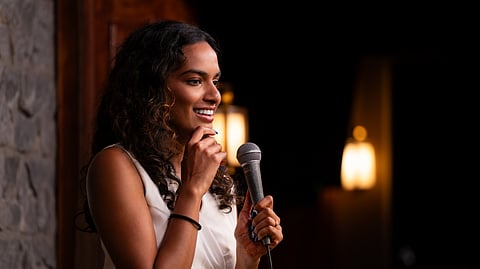
“A lot of cultural expectations thrive on secrecy. People don’t talk openly about feeling insecure about their relationship status or being pressured to get married.” Abby Govindan has built a career out of turning those silences into clarity. Drawing from family expectations, dating anxieties, and the incessant panic of not becoming who you were told to be, her comedy sits in the uneasy, hilarious space between rebellion and reconciliation. She speaks about immigrant parents without vilifying them, and about adulthood without romanticising it.
From viral internet beginnings to sold-out shows across the US, UK, and beyond, Abby has evolved into a storyteller who can hold a room in both laughter and silence. Her breakout show, How to Embarrass Your Immigrant Parents, reframed familiar narratives with empathy. Now, with Pushing 30, she arrives in Chennai, her parents’ hometown, turning inward to examine identity, inheritance, and the messy process of growing into herself. She speaks with Indulge about the set, her influences, and more. Excerpts:
Tell us about the premise of Pushing 30. What sparked this body of work, and how different is this show from your previous specials in terms of tone and structure?
What inspired Pushing 30 was how I felt kind of backed into a corner every time people asked me about my relationship and marital status, when I felt like I had achieved so much outside of my relationship to men. When I spoke about it with my friends, I realised it was a pretty universal experience, especially for Indian women.
My previous show was about my relationship with my parents and how we rebuilt it together. This one is different because it focuses more on my relationship with myself, although my parents are still a part of it. I talk about how my grandmother was arranged to be married at the age of 14, how my parents had an arranged marriage, and how my mother had slightly more agency because she was educated. Reconciling all of this, and the fact that it exists within my lineage, has been really interesting to approach comedically.
Seeing how it resonates across the US, Canada, the EU, the UK, and India has been incredibly moving. It’s emotional, but also just a lot of fun.
Is there a recurring idea or thread in the show that audiences might not immediately notice but is important to you?
There’s a theme of men making observations about my life that they shouldn’t feel comfortable making. Whether it’s Indian incels criticising my jokes about interracial relationships, a random uncle at the TSA line asking if I’m a porn star, or online commenters saying really mean things, there’s this sense of entitlement.
It feels like some South Asian men feel entitled to South Asian women’s bodies, time, and personal choices. By shining a light on it, I hope to make people more aware of this pattern.
Without giving too much away, can you share a premise or a joke from the set that audiences can look forward to?
This hour is definitely edgier than my previous one. I make what I call “post-woke” jokes, where I ask the audience to trust that I’m leading them somewhere meaningful, even if what I’m saying in the moment feels a little uncomfortable.
And I really cherish this journey that I’ve been able to be on with my own comedy, because I think five or six years ago, if you asked me, I would have been like, no, comedy can only ever punch up. Comedy can never be offensive. Comedy can never be edgy.
But my own evolution as a comedic performer, I found that as long as something is funny, it is for the most part not off limits. And also, as long as you can be creative and innovative with what you’re trying to say. And I think it’s been really fun for me to take a lot more creative risks and watch the audience trust me, because I’ve cultivated this audience over the course of the last, what, seven or eight years that I’ve been doing stand-up comedy and been a public figure online.
And so it’s really, really beautiful to have this evolving relationship with my audience as well.
Who are the comedians who have shaped you? What do you borrow from them, and what do you consciously resist becoming?
In terms of structure, John Mulaney has had the biggest influence on me.
I also have to credit All India Bakchod and East India Comedy. I grew up watching their sketches, and they were very formative. I’m a huge fan of Kanan Gill, I often call him the John Mulaney of India, and performers like Sumukhi Suresh and Kenny Sebastian who helped shape the scene.
What I resist is falling into clichés. I started stand-up because I felt there was space for comedy that didn’t reduce South Asian identity to stereotypes. Every sold-out show reinforces that instinct.
When you look at comics like Hasan Minhaj or Daniel Sloss, do you see yourself in that lineage, or are you trying to push it somewhere else?
I wouldn’t exist without people like Hasan Minhaj and Daniel Sloss. Daniel Sloss, in particular, showed me that you can take audiences to very dark places as long as you can bring them back.
Hasan Minhaj’s Homecoming King changed how I thought about storytelling in comedy, that it can evoke emotion, not just laughter.
I do see myself in that lineage, but I also want to push it further. I’m talking about arranged marriages, identity, and even deeply personal experiences. I hope I’m building on what they’ve done while creating something new.
A lot of immigrant comedy relies on exaggeration or mockery, but your work leans towards empathy. Was that a conscious choice?
It was, in part. Growing up, I noticed that a lot of Indian comics in the West relied on similar tropes about immigrant life. But when I watched comedians in India, their material felt much more specific and original.
That pushed me to hold myself to a higher standard. Comics like Urooj Ashfaq, Shamik Chakraborty, and Nirmal Pillai have such distinct voices. Their work made me realise I didn’t want to rely on clichés.
At the same time, I deeply admire performers like Ali Wong, whose style feels like you’re listening to a friend vent. That’s the tone I want to preserve, even as the rooms get bigger.
Is there a side of your humour that audiences haven’t fully seen yet?
I’d love to explore musical comedy. I actually want to write a musical, even though I can’t sing. I’m really inspired by Alexander Babu. He experiments with so many styles, and has built such a global audience. That kind of versatility is something I aspire to.
If someone walks into Pushing 30 expecting just a comedy show, what do you hope they walk out carrying with them instead?
I hope they walk out feeling empowered. A lot of cultural expectations thrive on secrecy. People don’t talk openly about feeling insecure about their relationship status or being pressured to get married.
After one of my London shows, a woman in her 40s told me she wished she had someone like me when she was younger. She got married at 25 because it was expected, and now she’s divorced. She said she wished someone had validated that voice in her head that told her something didn’t feel right.
That stayed with me. I hope people feel validated, less alone, and able to recognise that not living up to expectations, whether their own or society’s, is something we all experience.
Performing in Chennai, a city tied to your family’s history, does it feel like a homecoming or a new kind of pressure?
It feels like both. I saved Chennai for last because I wanted to end on something special. Being Tamil is a huge part of who I am. At the same time, I’m aware that Chennai is culturally different from where I grew up, especially when it comes to dating and relationships. I don’t quite know what to expect, but I’m excited to find out.
At its core, the show is about not being bound by expectations, whether that’s around marriage or life choices. If it resonates with even one person, that’s enough.
Lastly, is there any food, cultural tradition, or place in Chennai that you’re looking forward to?
I love the beach, so I’m really excited about that. And food-wise, I love a really good idli, sambar. I think sambar tastes better in Chennai than anywhere else in the world. I can’t wait to touch down in Chennai and get a nice dosa with sambar and tomato chutney. I’m just so beyond excited to make my comedy debut in Chennai. It’s my favourite city. I love that my parents are from there and I’m being able to carry the Tamil legacy within me. And I hope I make Chennai proud.
Rs 499 onwards. On March 27. Shows at 6 pm and 8 pm. At Punch - Unpaid Therapist, Alwarpet.
Email: shivani@newindianexpress.com
X: @ShivaniIllakiya
For more updates, join/follow our WhatsApp, Telegram and YouTube channels