
- LIFESTYLE
- FASHION
- FOOD
- ENTERTAINMENT
- EVENTS
- CULTURE
- VIDEOS
- WEB STORIES
- SPORTS
- GADGETS
- CAR & BIKE
- TRAVEL
- SOCIETY
- GALLERIES
- NORTH EAST
- INDULGE CONNECT

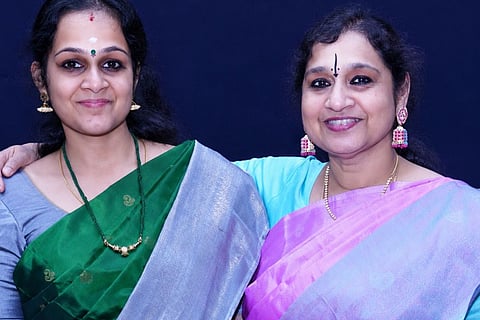
This weekend, Bharatanatyam will celebrate not just tradition, but the transformative power of art. Kala Rasa Parampara Vaibhava brings together generations of disciples to honour 55 years of artistic excellence and four decades of Bharatanatyam exponent and Sirappu Kalaimamani Ambika Kameshwar's journey as a Natyacharya. The celebration will culminate in a series of performances that reflect her creative legacy, with one of the most moving highlights being recitals by visually challenged and intellectually disabled dancers trained by Ambika and her daughter, dancer Vaishnavi Poorna.
Explaining the concept behind the event, Poorna tells Indulge, “This weekend is a tribute to Dr Ambika Kameshwar's work as a choreographer, as a performer, as a music composer, and also as a lyrical composer. We, her students, as well as her students' students, are coming together to perform her compositions.”
The programme follows the traditional Bharatanatyam margam, beginning with pieces such as the Alarippu, Anjali, Shabdam and Varnam before moving into thematic compositions. “The visually challenged students are presenting Anbu, exploring the idea that God is love and love is God. The specially abled students are performing the greatness of the Margazhi season through a poetic representation written by her. Fourteen students will express what Margazhi is through movement,” she explains.
Poorna has been associated with the organisation, founded by Ambika in 1985 for visually challenged students and registered in 1989, since childhood. “I stepped into the organisation 20 years ago, first as an intern and then as an assistant. I loved spending time with those children and learning along with them.”
She explains that Bharatanatyam lessons are thoughtfully adapted to suit each student's abilities. “For intellectually challenged students, we adapt Bharatanatyam to suit their bodies and movement expression. We use props like dupattas and focus on expressive, communicative songs where they can do abhinaya. Their biggest strength is their ability to imitate. What helps them become experts is repetitive practice and reinforcement for memory.”
One of the performers, R Deepa, who has an intellectual disability, has been preparing for the Margazhi piece for two weeks. Speaking about the performance, she says, “Margazhi means light,” as she excitedly describes dancing with a dupatta to represent the beauty and spirit of the season.
Reflecting on her experience as a teacher, Poorna adds, “The challenges are actually lesser than teaching normal students because the students with special abilities have a total level of surrender to the Guru and to the art.”
Ambika, meanwhile, explains how Bharatanatyam is taught to visually challenged dancers without visual demonstration. “We do that through tactile training. They feel the mudra, the movement and the posture through touch, and then they replicate it. Their attention is extremely sharp. Spatial awareness is taught by physically guiding students across the stage. We take them around the stage, diagonally and in circles, so the space gets registered in their minds.”
Expression, an integral part of Bharatanatyam, is also taught through touch. “We first tell them to feel the expression. Then I touch the muscles around the eyes and face to help them understand how the expression changes,” she adds.
Asked how dance contributes to their emotional wellbeing, Poorna says, “Dance definitely improves their emotional understanding. They relate to characters and slowly connect them to real life. Strength immediately reminds them of Hanuman, and they begin to understand values through those characters.”
July 5, 4 pm onwards
At Rukmini Arangam, Kalakshetra Foundation, Thiruvanmiyur
For more updates, join/follow our
https://www.whatsapp.com/channel/0029Vb677uz60eBXiDYheb0n