
- LIFESTYLE
- FASHION
- FOOD
- ENTERTAINMENT
- EVENTS
- CULTURE
- VIDEOS
- WEB STORIES
- GALLERIES
- GADGETS
- CAR & BIKE
- SOCIETY
- TRAVEL
- NORTH EAST
- INDULGE CONNECT

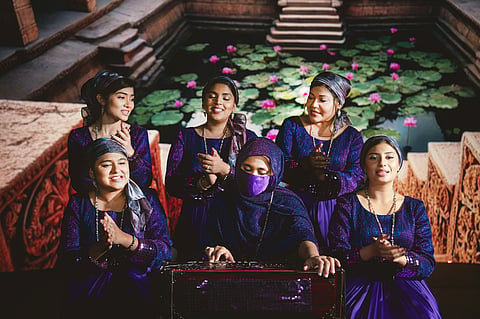
AR Rahman and Sufi music are bound by a mystical rhythm, one that transcends listeners into realms beyond the ordinary. So, when the Academy Award-winning composer recently unveiled Rooh-e-Noor, his all-women ensemble under the KM Musiq label, the announcement reverberated like a sacred call across the internet. The musician called it ‘a light that connects hearts’. Fitting words for a group born from the spirit of Sufi tradition—where music becomes devotion, healing, and transcendence. Rooh-e-Noor carries forward this mystical lineage, ignited with fresh feminine fire.
Featuring six vocalists—Khatija Rahman, Pooja Tiwari, Sana Aziz, Shaoni, Amina Rafiq, and Shifa Ruby—the collective is built on the belief that women’s voices carry a rare, transformative power to heal, to elevate, and to awaken. With Kannika Urs steering the vision as strategic head and Sarthak Kalyani, Sana Aziz, and Nakul Abhyankar sculpting the sound, Rooh-e-Noor introduces an intriguing blend of spiritual pop and contemporary music to the Indian soundscape.
As they prepare to take the world by storm with their debut at the Tanweer Festival in Sharjah today, opening for AR Rahman’s KM Sufi Ensemble, Rooh-e-Noor shares with Indulge the spiritual pulse, vision, and collective energy behind their music.
From vision to manifestation
We begin by asking how the ensemble channelled AR Rahman’s vision into living, breathing music, and an excited Kannika Urs tells us, “Though announced recently, the concept has been evolving for over two years now. When I first heard about Rooh-e-Noor, I felt deeply moved. The idea of an all-women ensemble under AR Rahman sir’s KM Musiq felt both powerful and necessary. I feel lucky and blessed to translate his vision into reality. Every element, be it choosing the artistes, the songs, the roles, or the artistic direction, was carefully shaped. Aligning six unique voices into a shared spiritual-contemporary sound took patience, dialogue, and care.”
The six luminous voices
Shedding light on how the six voices joined forces and intertwined to form Rooh-e-Noor, Khatija Rahman tells Indulge, “My father, AR Rahman, who is also the mentor of this band, handpicked all the artistes while we were jamming. Each member brings something valuable to the ensemble. While Sana has a soulful voice, she also plays a major role in production. Shifa has powerful vocals and co-leads music supervision. Shaoni, on the other hand, has a lot of depth and sensitivity, and she supports vocal training. Amina has a divine, ethereal texture and is part of our music supervision team. And Pooja is a powerhouse presence; she contributes as a vocal trainer too.”
The meaning behind Rooh-e-Noor
What does Rooh-e-Noor (which translates to Soul of Light) mean to each of them on a personal level? “The name was coined one afternoon while our team was brainstorming, and it instantly felt right. For us, it represents soul, spirituality, faith, togetherness, diversity, and acceptance,” says Khatija.
A circle of collaboration
Given that each singer brings her unique musical flame, how does Rooh-e-Noor shape its collective sound and choices? “We work as a collaborative circle rather than a hierarchy,” discloses Khatija. “Everyone’s ideas are heard, whether they relate to arrangements, interpretation, or emotional direction. Our shared intention to create sincere, meaningful music keeps us aligned and makes decision-making smoother. Even when opinions differ, the final call is always based on what serves the song best,” she explains, a philosophy that also reflects why Khatija chooses not to position herself as the lead singer.
The challenges and blessings
When quizzed about the challenges of uniting this all-women ensemble, Kannika Urs reveals, “The challenges were, in fact, enriching. Leading this team taught me that listening is the heart of leadership. Creating a space where six talented young women feel heard and supported allowed creativity to flow naturally. Clear communication and transparent processes kept us aligned.” She describes working on Rooh-e-Noor as a journey packed with lessons at every turn. “My greatest lesson has been humility. The most beautiful ideas emerged when I stepped back and let the collective energy lead.”
AR Rahman’s guiding light
So, how did AR Rahman, as mentor and guiding light, shape the concept, sound, soul, and direction of Rooh-e-Noor? Khatija explains, “His belief in women artistes and his guidance through KM Musiq helped shape the foundation of Rooh-e-Noor, while still giving us the freedom to grow into our own voices. He encourages us to explore a sound that is modern, traditional, emotionally deep, and contemporary at the same time. Although we use traditional instruments, each of us is also learning modern technology, how to modulate our voices, and how to work with newer tools so that the performance becomes a live, augmented experience — not just singing and playing.”
The soul of their music
And how would Khatija capture the soul of Rooh-e-Noor’s music? “The world is full of pop bands, but our minds are naturally drawn to peace, transcendence, and higher ideas. With Rooh-e-Noor, all six of us come together to create an extraordinary rhapsody of voices that are powerful, harmonious, and healing. While many folk and Punjabi artistes stay rooted in their traditions, we aim to offer songs that are gentler, more ear candy, and accessible, allowing us to connect with audiences across cultures.”
The debut experience
As the band gears up for its world premiere at the Tanweer Festival in Sharjah, what can the audience expect from their maiden show? And are they excited or nervous? “A little bit of both,” says Khatija. “It’s an honour to debut in Sharjah, especially at an international festival. The audience can expect a journey—reimagined classics, evergreen film pieces, and a few spiritual songs. But beyond the repertoire, they will feel the combined energy of six young women singing with sincerity and unity. We hope the performance leaves people feeling lighter, calmer, and more connected.”
The journey beyond
Finally, what steps is the band taking to ensure that this initiative continues to grow beyond the debut? “Opening for AR Rahman sir’s Sufi ensemble at the Tanweer Festival in Sharjah is a milestone; we are truly honoured. However, Rooh-e-Noor is a long-term vision. After our premiere, we aim to expand through more live shows and deeper musical explorations, incorporating modern technology and new tools. We want our music to reach wider audiences who appreciate a live, augmented experience. We are simply following the light of the music—its healing power—and are excited for what lies ahead,” sums up Kannika.
sangeetha.p@newindianexpress.com
X-@psangeetha2112
For more updates, join/follow our
https://www.whatsapp.com/channel/0029Vb677uz60eBXiDYheb0n