
- LIFESTYLE
- FASHION
- FOOD
- ENTERTAINMENT
- EVENTS
- CULTURE
- VIDEOS
- WEB STORIES
- GALLERIES
- GADGETS
- CAR & BIKE
- SOCIETY
- TRAVEL
- NORTH EAST
- INDULGE CONNECT
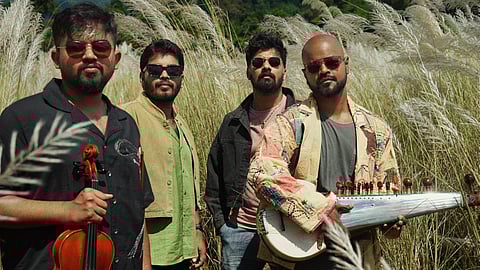
At the heart of Travellers lies sarod artiste and composer Soumik Datta’s conviction that while text asks you to understand and images ask you to look, sound asks you to internalise. It is a philosophy he brings to Chennai as part of Sahaj, a two-day dance and music festival presented by Aalaap and Amethyst.
The show moves through fractured geographies and uneasy histories. The sarod threads through recordings of war and displacement, while tabla and violin unsettle, disrupt and respond. Cries of refugees, audio reportage from Gaza and the grave warnings of Oppenheimer surface between echoes of missiles, countered by the pull of strings and rhythm. Layering immersive field recordings with a live band, the work approaches ideas of nation and land through sound, carrying audiences across invisible borders.
For the performance, Soumik is joined by violinist Sayee Rakshith, tabla player Debjit Patitundi and percussionist Sumesh Narayanan. Each negotiates their instrument’s traditional role within a fractured sonic terrain. “I didn't want the sarod to sit above the noise; I wanted it to be inside it and part of it. Travellers was born from a place of raw helplessness and the grief of watching the images coming out of Gaza. The sarod acts as the human spirit trying to maintain its melody while the world around it is jarring and discordant,” says Soumik. “I’ve always been captivated by the ‘aural space’ of film, the way foley and score can bypass the intellect and go straight to the nervous system. In Travellers, we lean into that.”

Performed in near-darkness, Travellers resists spectacle. It removes distraction and asks the audience to imagine rather than simply consume, inviting listeners to sit with discomfort and bear witness to a world in pain.
Integrating field recordings was not an easy decision. “Every time I integrated the field recordings, I stopped, deleted it and then pressed undo,” Soumik admits. “There were moments when hearing the unfiltered cries of people in Gaza felt almost intrusive, as if we were trespassing on their private agony. I had to ask myself: ‘Is this aestheticising pain?’ But I realised that the discomfort I felt was exactly the point. If we sanitise the sound to make it more ‘listenable’, we contribute to the very silence and erasure we are trying to break.”
For Sumesh, tension is a deliberate compositional choice. “It’s a very conscious choice to keep in mind the tension of war and the harsh consequences that follow. I try my best to invoke a sense of utter unsettledness and disturbance to be able to express along.”
When real-world audio such as missiles or reportage enters the mix, restraint becomes key. “The percussion is present to the extent where the sounds do not get overshadowed,” he says. “Music and soundscape are still two elements conveying one story. It’s a tricky place to be but, when done with intent, it conveys a true feeling.”
The idea of erasure also connects Travellers to another of his touring works, Mone Rekho, a project centred on memory and dementia. “Absolutely. Both projects are, at their core, about erasure. In Mone Rekho, we explore the internal erasure of the self through the loss of memory, the tragedy of a mind losing its map. In Travellers, we explore the external erasure of people, homes, and histories through conflict and displacement. Both pieces ask the same fundamental question: What remains when everything familiar is stripped away? Whether it’s a grandfather losing his sense of home to dementia or a refugee losing their physical home to war, the thread is the human struggle to be remembered, to be seen, and to belong.”
For Debjit, rhythm becomes an expression of unrest. “ Tabla expresses the woven pictures of the unrest and chaos in the pieces in its own manner. The variety of sound production, uneven calculations and usage of different syllables go hand in hand with the theme,” he says, adding that silence is as important as sound. “The restraint lets the fire of urgency burn even brighter.”
Silence, he adds, becomes equally crucial. “Silence speaks a thousand words. The silence of the tabla wraps the overall emotions of the pieces within itself and the restraint lets the fire of urgency burn even brighter through the rest of the band. I feel this responsibility is even more crucial.”
Sayee sees the instrument as a channel for personal response. “There is a huge amount of abstractness in how we feel about everything that is happening, and through the instrument, it feels like an expression of my own mindspace and vulnerabilities about it.”
At its core, Travellers proposes that art can hold space for grief, memory and contradiction without smoothing their edges. As Soumik puts it, “I hope they carry a sense of ‘heavy lightness’. Heavy, because they have spent that time bearing witness to the world’s most difficult truths, but light, because they didn’t have to carry that weight alone. I want them to leave the darkness of the hall feeling more awake, not just to the news on their screens, but to their own capacity for empathy.”
Travellers will be performed on February 13, from 7 pm, at The Folly, Amethyst, Royapettah. Tickets are priced at Rs 600.
Email: shivani@newindianexpress.com
X: @ShivaniIllakiya
For more updates, join/follow our WhatsApp, Telegram and YouTube channels