
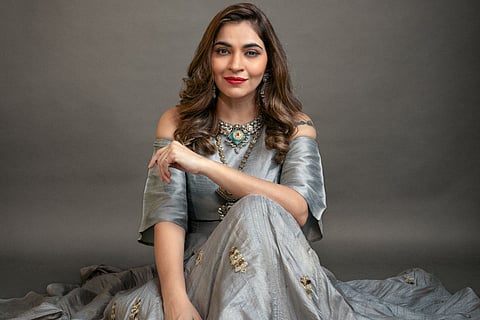
Shruti Pathak on her latest track Hum Dono, live music, changing attention spans, and AI in songs

Popular singer Shruti Pathak, known for chartbusters like Mar Jawaan (Fashion), Shubhaarambh (Kai Po Che!), Criminal (Ra.One), and Tujhe Bhula Diya (Anjaana Anjaani), is back with her latest track, Hum Dono, from the recently released Tu Meri Main Tera Main Tera Tu Meri, starring Kartik Aaryan and Ananya Panday. The song evokes a nostalgic charm, and for Shruti, collaborating with Vishal–Shekhar once again felt like revisiting a golden era of music that left a lasting impact on audiences.
Shruti Pathak on her new song Hum Dono and the future of music
Tell us about Hum Dono from Tu Meri Main Tera Main Tera Tu Meri.
The song was written by Anvita Dutt, and one day I received a call saying they had a track they wanted me to sing, as they felt my voice would really suit it. I went in for the recording, and it turned out to be a wonderful experience. I’ve worked extensively with Vishal–Shekhar in the past, so coming together with them once again, this time with Anvita, for such a high-energy song was truly exciting.
During the session, they also told me that Kartik Aaryan and Ananya Panday are part of the film. The entire production team was present at the recording, which made the experience even more enjoyable.
What made it particularly special was the sense of nostalgia it carried. Film music today feels very different from what it was five or 10 years ago, and this track really brought back that old charm. Vishal–Shekhar have such a distinctive musical signature, and after a long time, it felt like that era was returning.
What is the biggest change you’ve noticed in the music scene?
Whether it’s music or any other content we consume on social media, the target audience today is very different. The duration of songs has also changed significantly. Earlier, songs would have multiple verses and extended sections, whereas now they are far more hook-driven, catering to audiences who mainly consume content on social platforms.
In the past, music and films were promoted through more traditional marketing methods. Today, marketing strategies have evolved into largely digital campaigns, with people constantly engaged on social media. This shift has had a huge influence, and it’s reflected in the kind of content being created.
Do you also think this is due to a decline in attention spans?
I think the reduced attention span is actually an after-effect of the changes that have already taken place over the last 10 years, particularly in the past five or six. Even six years ago, it wasn’t quite like this. Now everything revolves around social media.
Whether people are from metropolitan cities, small towns, or even villages, internet access is everywhere, and most consumption happens through social platforms. This has had a huge impact, and as a result, we’re seeing a noticeable decline in attention spans.
Does that make live performances more of a challenge?
Not really. Live performances are a completely different experience altogether. When you’re scrolling on your phone, you have endless choices and the freedom to move away from content at any moment.
A live performance, however, is immersive. Especially for people who don’t attend concerts very often, it can feel like a once-in-a-lifetime experience. From an artiste’s perspective, it’s equally different. When we create a song, we hope it reaches as many people as possible, and then it depends on how listeners receive it and connect with it emotionally.
In a live performance, though, you’re right there in front of the audience. The connection is immediate and direct, and I think that leaves a very powerful and lasting impact.
Which do you prefer — performing live or working in the studio?
I think it’s a very difficult choice, because the two are closely intertwined and interdependent. You want to create good music, you want people to listen to it and connect with it, and then you want to take that music to a live stage and experience that energy directly from the audience, one on one. Both are equally important, and I honestly couldn’t choose one over the other.
How different is your creative mindset across the various roles you play — as a singer, a composer, and a lyricist? How do you switch between the three?
I think that’s just how art works; you can’t really schedule it like a regular nine-to-five job. With technical work, you can say, “I have to do this task at this time.” Art doesn’t function like that. It’s a very natural, emotion-driven process. You have to feel the music deeply to connect with it and convey the exact thought or feeling you want through a song.
The same applies to composing, which I think is hugely underrated. Composing is one of the most challenging aspects of creating music. From coming up with a tune to exploring it from different perspectives, it requires a lot of creativity and insight. It’s a beautiful process, but also a difficult one. Hats off to all the composers who do such brilliant work — I would say composing is truly one of the most challenging roles in music.
When you approach a new song, what’s the first thing you try to understand — the character, the melody, or the emotion?
I think the most important aspect is conveying the emotion of the song. Of course, as singers, we are trained in music and technique to deliver a good vocal performance, but emotion is something deeply individual. For example, if the same song is given to three different singers, they might all sing the tune and lyrics perfectly, but the emotion each one brings will be different. I believe it’s that emotional expression that makes each rendition unique and truly stand out.
AI is now playing an important role in music. How do you see its impact shaping the future?
I think AI is definitely here to stay, and while it has many benefits, there are also adverse effects and instances of misuse. It’s being used to create content, and people are responding well to it, but I don’t think it can ever replace the human experience. You can use an AI-generated version of an artiste’s voice or even create an AI rendition of a song, but the creativity and emotional depth that a human brings, whether as a singer, lyricist, or composer, is something AI cannot replicate.
You’re also an avid traveller. Has any of your music been inspired by your journeys?
Oh yes, definitely! Most of the time, travelling is such a beautiful experience, and it allows you to connect with yourself on a much deeper level. That’s when the creative process really flows. There have been many occasions when I’ve written songs while travelling. Experiencing a new place, a different culture, or a unique landscape is always inspiring. Nature, in particular, has always been a huge source of creative inspiration.
Are there any composers or directors you’re particularly eager to collaborate with in the future?
Definitely! I’ve worked extensively with Vishal–Shekhar, Salim-Sulaiman, Amit Trivedi, and, of course, Sachin–Jigar, among others. But I would absolutely love to sing for AR Rahman.
I’ve sung primarily for Bollywood, but I’ve also done quite a few songs for Gujarati films, as I’m Gujarati myself. Not many people know this, but I’ve also lent my vocals to Telugu and even Bengali songs. It’s a very unique and interesting experience because, even if you don’t know the language, you still have to convey the emotion of the lyrics. Thankfully, lyricists are always present at the recording to guide you, explaining the meaning and the emotion behind each song. It’s a lot of fun to explore new languages in music. As for upcoming projects, I have a couple more film songs lined up.
For more updates, join/follow our
https://www.whatsapp.com/channel/0029Vb677uz60eBXiDYheb0n