
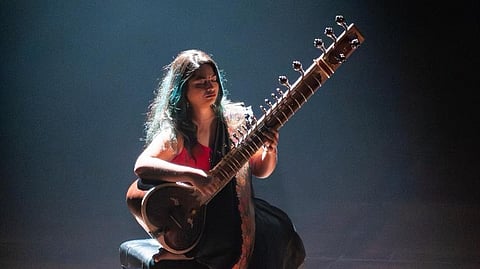
The Mishra Brothers and Megha Rawoot highlight the evolution of Indian classical music

At UTSAAH 2026, the spotlight shines on rising talents The Mishra Brothers (Abhishek Mishra and Shivang Mishra) and Megha Rawoot, two artistes who are redefining Indian classical music for a new generation. Under the mentorship of sitar maestro Purbayan Chatterjee, they explore the delicate balance between tradition and innovation, blending the depth of classical ragas with contemporary textures and collaborative experimentation.
For The Mishra Brothers, their jugalbandi performances are a musical conversation, constantly evolving in tone and expression, while Megha Rawoot brings a global sensibility that sharpens her classical grounding without compromising its integrity. Together, they embody the spirit of UTSAAH — a platform where learning, performance and intergenerational dialogue coexist. Both performers get chatty with us, talking about the importance of mentorship, the responsibility of young artistes in shaping the future of Indian classical music and the need to preserve tradition while embracing exploration and collaboration.
The Mishra Brothers (Abhishek Mishra & Shivang Mishra)
You mix classical sitar with modern sounds. How do you decide how much to experiment?
Abhishek Mishra: The foremost and most important credit goes to our guruji, Purbayan Chatterjee, who introduced us to these new sounds. Under his guidance, we learned how to shape and refine them to achieve the desired expression. Another key reason is that we usually perform together and over time we have consistently presented our music as a duet or jugalbandi — a musical conversation between two brothers on stage through our instruments. We have consciously continued to experiment to explore new textures and tonal possibilities, allowing the same idea to be expressed in evolving ways.
How has your training shaped the way you perform today?
Shivang Mishra: The training we receive under PAAMF is truly exceptional, largely because guruji Purbayan Chatterjee follows the guru–shishya parampara with great rigour. Along with developing a deep understanding of traditional Indian ragas and their nuances, he ensures that we are fully stage-ready, focusing on authentic expression and clear communication with the audience while keeping the presentation fresh. An equally important part of our training has been travelling and performing with guruji. Observing him on stage, as well as learning from off-stage preparations and interactions, has been invaluable in shaping our professionalism. This experience greatly helps when we perform independently, and especially when we accompany guruji, as we will at UTSAAH this year, preparing us to sensitively support and enhance the musical dialogue on stage.
Why are platforms like UTSAAH important for young musicians?
Abhishek: Platforms like UTSAAH are extremely important because some of the most meaningful learning happens on stage. While formal training is essential, presenting music on platforms like these allows students to learn directly from maestros. Sharing the stage with them offers invaluable insights and often answers questions that students grapple with during their journey. Our fraternity functions like a family — students look up to their seniors and gurus and sharing the stage with them becomes a dream come true. It brings a strong sense of validation along with deep respect for the maestro. This tradition has existed for generations and through PAAMF, envisioned by guruji Purbayan Chatterjee and Gayatri Asokan didi, this legacy is being thoughtfully carried forward through initiatives like UTSAAH.
What role do young artistes play in the future of Indian classical music?
Shivang: We strongly believe that carrying forward a legacy that is thousands of years old is both a privilege and a responsibility for every student of Indian classical music. At the same time, as the world evolves, the music must also evolve — while firmly preserving its fundamentals. Artistes such as pandit Ravi Shankar, ustad Zakir Hussain and, in the present generation, guruji Purbayan Chatterjee, along with contemporaries like Rakesh Chaurasia, have clearly demonstrated that Indian classical music has the depth and versatility to engage globally and embrace other genres through collaboration.
What do you hope audiences feel after hearing your music?
Abhishek: We hope the audience experiences the same emotions that we feel on stage, because the expressions we aim to convey are only successful when that connection is shared. Seeing smiling faces reassures us that the music is being received as intended. For us, a successful performance is one where the audience leaves feeling content and fulfilled. We understand that a diverse audience brings varied tastes and expectations and our intention is to offer each listener something that resonates personally with them. Above all, we strive to ensure the performance becomes a holistic and memorable experience of The Mishra Brothers Collective.
INR 500 onwards. January 23, 7 pm onwards. At Nehru Centre, Worli.
Megha Rawoot
You work in Indian classical music and also perform globally. How do you balance both worlds?
I don’t consciously try to ‘balance’ two worlds anymore. Indian classical music is the lens through which I experience everything. Whether I perform in India or abroad, I carry the same riyaaz, discipline and emotional honesty with me. At the same time, performing internationally — whether through collaborative projects in Riyadh or sharing space with artistes from very different musical backgrounds — has taught me to listen more deeply and respond instinctively. These experiences don’t dilute my classical grounding; they sharpen it.
What changes for you when you perform for new or international audiences?
With new or international audiences, I become more attentive to how the music unfolds in the first few minutes. I focus on creating an emotional entry point through the raga rather than complexity. I’ve often seen listeners unfamiliar with Indian classical music respond very intuitively, which reminds me that sincerity in music travels beyond language or form.
How important has mentorship been in your own journey?
Mentorship has been central to my journey. I have been a student of Purbayan Chatterjee for nearly nine years and much of my learning has come from observing — watching rehearsals, performances and the way he approaches music with depth and integrity. I have also learned immensely by observing Gayatri Asokan, particularly in how sensitivity and discipline coexist in performance. Being part of PAAMF brings these experiences together; it allows me to remain a student while sharing what I have received, which for me is the essence of true mentorship.
What does performing at UTSAAH mean to you?
UTSAAH is more than an event for me; it is a celebration of learning. PAAMF functions as a family, where the focus is always on shared growth rather than individual presence. I have seen Purbayan Chatterjee and Gayatri Asokan build PAAMF together — from teaching a single student at home to creating a dedicated space where many students have come to Mumbai to learn, grow and shape their musical journeys. Being part of UTSAAH reflects that spirit of trust, discipline and collective effort.
How do you see Indian classical music changing for the next generation?
I see a very hopeful shift. The next generation is deeply curious — eager to understand the roots while remaining unafraid to explore new contexts. Many young musicians today listen widely, collaborate globally and find their own voice without compromising the integrity of the tradition. As someone who is both a performer and a mentor, I feel responsible for helping them stay anchored while encouraging exploration. Indian classical music has always evolved and I believe it will continue to do so with honesty and depth.
INR 500 onwards. January 24, 7 pm onwards. At Nehru Centre, Worli.
Email: alwin@newindianexpress.com
X: @al_ben_so