
- LIFESTYLE
- FASHION
- FOOD
- ENTERTAINMENT
- EVENTS
- CULTURE
- VIDEOS
- WEB STORIES
- SPORTS
- GADGETS
- CAR & BIKE
- TRAVEL
- SOCIETY
- GALLERIES
- NORTH EAST
- INDULGE CONNECT
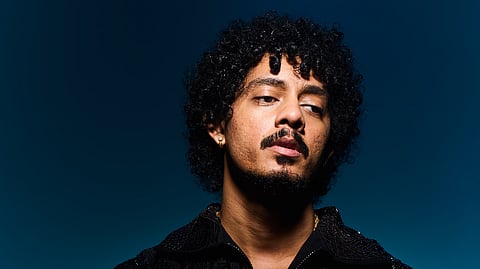
As Hanumankind brings his Home Run tour to Bengaluru, the city becomes more than just another stop on a packed performance calendar. It becomes a point of return — a place where movement pauses long enough to look back. Few artistes wear that sense of motion as instinctively as he does. Sooraj means ‘sun’ in Hindi and that word is a fitting place to begin for an artiste whose life has unfolded across borders, time zones and soundscapes.
Born in Malappuram’s Kondotty, Kerala; Sooraj Cherukat grew up as what he casually calls an, “oil baby” (the child of a father working in the oil industry, moving wherever the job demanded. Nigeria, Saudi Arabia, Dubai, Egypt, Qatar, Italy). By the time he settled in Houston, Texas, in second grade, movement was not disruption but normalcy. That early itinerance shaped more than geography; it shaped instinct.
Houston, in particular, proved formative. A city steeped in Southern rap traditions, it offered Sooraj a sound that felt as fluid and uncontained as his own life. The slowed-down cadences of DJ Screw, the grounded authority of UGK and the dark, immersive textures of Three 6 Mafia seeped into his everyday listening, shaping how he understood rhythm, storytelling and presence long before music became a pursuit.
That pull towards rap, however, was never romanticised. Even as he earned a business degree and went on to work at Goldman Sachs, music existed largely as a private obsession — pursued in stolen hours, open mics and quiet practice rather than as a career plan. The structure of corporate life offered stability, but it could not contain the instinct that had been forming over years of listening and immersion.

In 2019, that tension reached a breaking point. Sooraj quit his job and re-emerged as Hanumankind, releasing Kalari, an EP that marked his formal arrival as an artiste. Looking back now — on the cusp of a homecoming performance — he describes rap not simply as a genre, but as a process of self-examination that continues to shape both his art and his inner life.
“Rap was the music I connected to most growing up. It was around me all the time, alongside other kinds of music, but hip-hop spoke to me in a very direct way. The more I push myself in the craft, the more it forces me to look inward. That process makes me examine myself, my environment, relationships, patterns and our flaws. That reflection shows up in the art and it’s helped me grow not just as an artiste but as a person,” he tells us.
The years that followed only sharpened that voice. He achieved his big break with Big Dawgs. For many listeners, Big Dawgs appeared to arrive fully formed — a breakout moment that seemed to snap neatly into place. Released in 2024, the track catapulted Hanumankind into a new orbit, debuting at number 57 on the Billboard Hot 100 and eventually crossing 400 million streams worldwide. It was the kind of success that invites shorthand explanations: a viral moment, a sudden discovery, a phenomenon. But those narratives flatten time.
Long before Big Dawgs became a cultural marker, Hanumankind was navigating a far more fragmented ecosystem. “There weren’t a lot of structured opportunities back then,” he recalls. “Gigs were happening, but the infrastructure was pretty scattered,” he adds.
What sustained him through that period was community. Bengaluru, in particular, emerged not just as a performance circuit but as a place of belonging. “Rapping in English could feel alienating in the indie space at times,” he says adding, “but Bengaluru welcomed me, gave me a home and genuinely championed what I was doing. I love Bengaluru.”
Perhaps that is why performing Home Run in Bengaluru — a city he often describes as home — carries a different kind of weight. It is both comfort and pressure, familiarity and expectation. “A hundred and fifty thousand percent,” he says with a smile.
As his career expanded and led him to some of the world’s biggest stages — making his explosive US debut at Coachella in 2025, opening the Netflix Tudum show and appearing as a featured artiste with Rolling Loud 2025 — the energy Hanumankind finds himself chasing remains surprisingly intimate.
“I really miss the smaller rooms,” he admits. “That energy is why I do this. Big stages are incredible and I’m grateful for them, but the shows in small venues were so special,” he reveals. What made them different, he explains, was intention. “People came to see something unpolished and raw, to discover something new because they heard it from a friend or because they were trying to convince their friends about an artiste they believed in. Not because of hype,” he tells us.
Those early audiences, he says, found the music when it was still unknown and that discovery created a bond that felt immediate and real. “That connection felt very genuine,” he reflects, adding, “I try to hold onto that feeling, no matter the stage size.” Before stepping into that energy, Hanumankind turns inward. Asked about a ritual that grounds him before going on stage, his answer is simple and unembellished. “I do about ten minutes of breathwork,” he tells us.
That inward attention doesn’t end at the body. It extends into how he thinks about language, culture and the histories embedded within hip-hop itself. Having grown up absorbing the genre across geographies and now working within it as a global artiste, Hanumankind is acutely aware of the tensions between freedom of expression and cultural responsibility— especially in a form so deeply tied to identity, where these questions cease to be abstract and become personal.
When asked about being mindful of language in rap, particularly around who gets to use certain words, he says, “I think people should be free to express themselves in ways that feel honest to them. At the same time, if certain words are tied to history that you’re not part of, or were historically used to subjugate a community, it’s important to educate yourself and respect that.”
Hip-hop, for him, is inseparable from identity and self-expression. “Find your own while being a part of the culture as a whole. The roots of hip-hop come from a place of truth and freedom is a big part of the culture,” he explains. Responsibility, he believes, cannot be imposed uniformly. “Responsibility looks different for different people and I think it shouldn’t be forced on anyone. If someone wants to make carefree music, they should be free to do so. Because, I think, responsibility is what a person decides to take. Change comes from mindfulness, not force. I see things differently and how I take responsibility will reflect that,” he avers.
Even with all the reflection and mindfulness he carries into his craft, touring comes with its own unpredictability. For Hanumankind, that unpredictability hit hard during his last European tour performance in London in 2025 when an ACL injury forced him off stage. Suddenly, he was stripped of the very physicality that had always been central to his performance. Asked about how that period affected his mental health and what role music played in his recovery, he candidly tells us, “Initially, it was tough because so much of my mental health was tied to being physical and active. Over time, I learned to separate the two. I accepted that something had happened and that I had to sit with it. I was finally given time to sit with my thoughts after so many months of mayhem. In a strange way, I’m grateful for that phase.”
As our conversation draws to a close, we asked one last, casual question: what’s inspiring him outside of music — books, films or the everyday rhythms of city life? “I’ve been reading As A Man Thinketh by James Allen,” he concludes.
INR 799 onwards. February 1, 6 pm onwards. At Phoenix Marketcity, Whitefield Main Road.
Written by: Prishita Tahilramani
Email: indulge@newindianexpress.com
X: @indulgexpress
For more updates, join/follow our WhatsApp, Telegram and YouTube channels.