
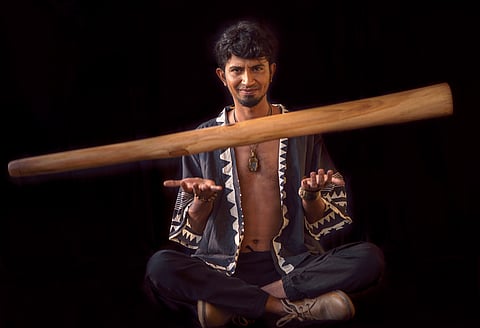
From engineer to didgeridoo: Brandon Colaco’s Two Eyed Wizard brings a new sound to Bengaluru

Brandon Colaco’s journey has been anything but ordinary. He spent 10 years working as a mechanical engineer with some of the biggest names before leaving the corporate world to help run his family’s coffee plantation in Chikkamagaluru. It was there, in a small studio he built inside an old house on the plantation, that Two Eyed Wizard was born. Today, Brandon is on a mission to introduce more people to the didgeridoo by blending it with electronic music and Indian rhythms. Ahead of his Bengaluru performance, he talks about his unique musical journey, his new band and his plans for the future.
Two Eyed Wizard is a very unusual name. What does it represent?
Basically, I first had this idea called Third-Eyed Wizard. Whenever I played the didgeridoo, I used to create this very introspective, almost zen-like environment. I even used it as a tool for meditation. But I realised I also wanted to perform anywhere — where people could be eating, drinking or talking, and I shouldn’t get disturbed by that. So I kept Third-Eyed Wizard as a very private project and Two Eyed Wizard became the commercial, live-performance side of it. Give me a good PA system and a good FOH engineer and I can play anywhere.
Your music brings together the didgeridoo, electronic music and Indian influences. How did that happen?
I grew up listening to a lot of rock and heavy metal. Later, I got into experimental electronic music and I always wanted to make music that could stimulate the listener. A few years back, I also started learning the basics of konnakol and Indian rhythms. Since the didgeridoo is also very intuitive, I could directly relate konnakol to my style of playing. That’s when everything fell into place. Now I understand rhythm much better and I can make the didgeridoo sit naturally with electronic music and Indian styles of percussion.
What are some of the biggest misconceptions around the digeridoo?
The biggest misconception is that people think it comes from the west. The second is that it’s only a healing instrument that makes one boom sound. I’ve had people ask me if I can play Gujarati songs on it and I’ve even had airport security ask if I’m carrying a gun because of the size of the instrument. My job is to reintroduce it to India and tell people that it’s one of the oldest instruments on the planet. That’s why I enjoy playing it with the tabla, mridangam and Indian musicians, because it helps people see it differently.
How much of your live set is planned and how much is improvised?
Till now, I’ve mostly performed solo, so I had backing tracks that gave me enough space to interact with the audience. But now we have a full band and July 10 will be our first show together. Around 70 to 80 percent of the set is planned because we’re playing quite complex music. After that, we let the musicians be musicians. It took four years to find this band and I believe every one of them is among the best in the country, so I also want to give them the freedom to explore.
You’ve performed in India and abroad. Have you noticed a difference in the way audiences respond?
Definitely. In Europe, people are much more familiar with rock and experimental music. But what surprised me was that my didgeridoo heroes (people I look up to) came up to me after a festival in Portugal and asked how I played so rhythmically. I think growing up in India, listening to Bollywood and Indian rhythms, gives us a certain swing that comes naturally. That’s something I love representing whenever I perform overseas.
What’s next for Two Eyed Wizard?
My next release is called Intruder. It’s a dark, powerful drum and bass track and I’m hoping to release it in August. After that, I want to put out an EP with the new band. Last time I toured Europe, I travelled as a solo act. This time, my dream is to take the whole band around the world and just deliver powerful music from the stage.
INR 499 onwards. July 10, 7 pm. At The Raft, Koramangala.
Email: alwin@newindianexpress.com
X: @al_ben_so