
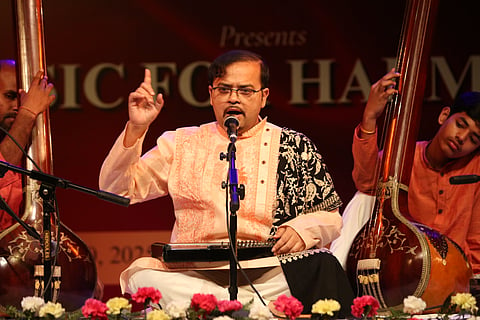
Pandit Iman Das presents a morning raaga concert at Namma Ashram

Bengaluru’s community hub Namma Ashram is set to host a unique morning of hindustani classical music with the launch of a new concert series titled Classical Footsteps. Conceptualised by National Award-winning vocalist pandit Iman Das, the event moves away from traditional auditoriums to create a more intimate experience in the Ashram’s open-air performance space. The inaugural concert on March 8 will celebrate the guru–shishya parampara, with Iman Das performing alongside his 14-year-old disciple Smayan Gautam, offering audiences a rare glimpse into the tradition of musical mentorship and the passing of knowledge across generations. We get chatty with Iman, who talks about this new concert series, performing in a cafe setting and lots more...
What inspired you to start Classical Footsteps?
Indian classical music has always followed the guru–shishya parampara. But this relationship is much deeper than a typical student–teacher equation. A true guru guides the disciple to walk the same path that he has walked. That is why the concert series is called Classical Footsteps. My disciples follow my footsteps and I have followed the footsteps of my own gurus. It is an age-old tradition. This series celebrates that idea and it is the first of many concerts I hope to organise in the coming years.
The concert is happening in a café instead of a traditional sabha or an auditorium. Why did you want to move classical music into such a space?
Classical music is usually presented in a sabha or an auditorium. But I have been observing Namma Ashram for quite some time. It is a beautiful space with a garden, a library, meditation areas and art activities like pottery. It is not just a café. Cultural events also happen there and even Durga Puja celebrations take place. I thought it would be interesting to bring classical music into this kind of environment. It is a challenge, of course, but Indian classical music has always adapted to new generations. In a way, this is like presenting old wine in a new bottle.
Does performing morning ragas in an open café setting change the experience?
The presentation of the music remains the same. What changes slightly is the interaction with the audience. Many people might come to the café for breakfast or coffee. While they are there, they can also experience Indian classical music. It becomes a gentle introduction to our own culture and art form.
How is a morning concert different from an evening performance?
Most concerts happen in the evening, so audiences are more used to that timing. But morning concerts have their own beauty. People arrive with a fresh mind after sleep. When they hear morning ragas in that state, the music often feels more peaceful and soothing.
Why was it important to begin the series with the guru–shishya theme?
I run Omkar Music Academy, which I started about ten years ago. Over the years, the academy has trained nearly a thousand students in Bengaluru. Among them, at least ten are now performing professionally in the city’s music scene. When I moved to Whitefield, which is known as an IT hub, I often said in interviews that I wanted it to become an IC hub as well — an Indian Classical hub. After ten years, I feel I am slowly seeing results. Many musicians focus mainly on their own performances. But from the beginning, my aim was to build a community where this art form can survive and grow.
What does being a guru mean to you today?
A guru’s role goes beyond teaching ragas or technical aspects of music. A true guru teaches humanity first. They guide students about life as much as music. Ultimately, a guru’s journey is complete when the disciple is able to walk that same path forward. That is the philosophy I try to follow while building a community of musicians here in Whitefield.
How did your own gurus shape the musician you are today?
I come from a middle-class family in Kolkata. My first gurus were actually my parents. Without their emotional and financial support, pursuing classical music would have been impossible. Later, I trained under great maestros like Ajay Chakraborty and Kalyan Basu, a disciple of Bade Ghulam Ali Khan. They shaped not only my music but also my outlook towards life.
What are the biggest challenges in training young students today?
The challenges are threefold. First, the younger generation has a shorter attention span. It takes patience to learn classical music, which develops slowly over time. Second, we must convince parents that learning music is meaningful. It helps develop concentration, reduces stress and even improves cognitive abilities. Third, we must sometimes literally take away the phone during lessons. That can be the biggest challenge of all.
How has your relationship with music evolved over time?
Indian classical music has survived for thousands of years because it adapts with each generation. For example, when microphones were introduced nearly a century ago, it changed how musicians performed. Today, even the tanpura can exist as an app on a phone or tablet. Technology has entered the tradition, but we embrace only the good parts of it. Indian music has always been evolving — and that is why it continues to survive.
INR 399 onwards. March 8, 10 am onwards. At Namma Ashram, Whitefield.
Email: alwin@newindianexpress.com
X: @al_ben_so