
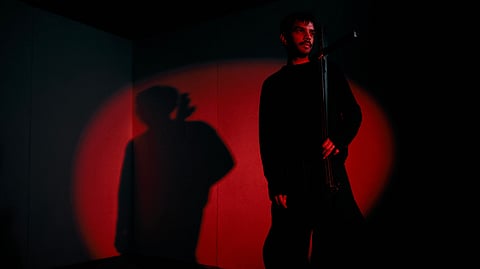
Composer Prateek Rajagopal bridges global sounds in Bejoy Nambiar’s Tu Yaa Main

For Los Angeles–based composer and producer Prateek Rajagopal, music has always been about building worlds. Over the past few years, he has quietly carved a place within Hollywood’s sonic landscape, contributing to projects such as The Mandalorian, Trolls: Band Together and Eddington while collaborating with acclaimed artists like Ludwig Göransson and Lizzo. Now, he turns his focus toward Indian cinema with Tu Yaa Main, directed by Bejoy Nambiar—a project that marks both a creative homecoming and the arrival of a bold, globally shaped musical voice.
Prateek Rajagopal: From Hollywood’s sonic landscapes to Indian cinema’s new voice
You’ve worked inside some of Hollywood’s most sophisticated scoring ecosystems. What invisible disciplines or creative habits from those rooms are you now consciously bringing into Indian cinema?
There’s a level of rigor in Hollywood scoring rooms that really stays with you — the discipline and the way collaboration is treated as sacred. Every project is approached like it’s the last. I carry that with me into Indian cinema: respecting the team and respecting the film enough to give it the best.
You’ve spoken about background score as a fully realised narrative voice. In Tu Yaa Main, how did you decide when the music should speak, and when silence should carry the story instead?
It was fascinating because we didn’t have a formal spotting session — nothing was predetermined. I scored from instinct at first. Then Bejoy (Nambiar) came in with very clear ideas about where silence should take over, or where sound design could speak more powerfully than music. Watching him use sound design as a stylistic narrative tool was really cool.
Your score blends 70s–80s analog synths, chamber orchestra, and modern production. Was this palette driven by the film’s emotional world, or was it also a way of introducing a new sonic grammar to Hindi cinema?
We initially leaned heavily into a synth-forward language. But as the emotional world of the film expanded, the score naturally evolved into something more cinematic and thematic. The key was keeping it wrapped in a contemporary production sensibility.
This project is being described as a creative homecoming. After years in Los Angeles, how has returning to an Indian story changed the way you listen, compose, or even question your own instincts?
I can say honestly, I wasn’t equipped to handle a film of this scale the last time I was here. The years in LA — the training, the mentorship, the long hours in studios — fundamentally changed me. I listen differently now. I write differently. I trust my instincts in a way I didn’t before.
You come from extreme music — death metal, experimental sound, underground scenes. What aspects of that world still show up in your film scores, even if the audience can’t consciously hear them?
Even if the audience can’t consciously identify it, I hope they feel a slightly off-center perspective. Coming from extreme and experimental scenes teaches you to embrace discomfort and unpredictability. That instinct to avoid generic tropes — to push distortion and tension — still informs how I approach film.
Having collaborated with artists like Ludwig Göransson and Bobby Krlic, how has observing their process shaped your own philosophy around world-building through sound?
Being around artists like Ludwig and Bobby taught me the power of conviction. They lean unapologetically into their sonic identity. They’re not chasing trends; they’re expanding their own musical voice. Watching that reinforced something important for me: to do my thing and focus on my voice, too.
You’re entering both Bollywood and Tollywood at a time when Indian cinema is expanding globally. Do you feel a responsibility to challenge how Indian film music is structured, or do you prefer evolution through subtle shifts?
I don’t approach it as a responsibility to disrupt or reform anything. Whether it’s Hollywood, Bollywood, or Tollywood, the project and the director’s vision will always guide the process. My job is to bring my global sensibility into that world without diluting it, and most importantly, making sure my sound cuts through irrespective of industry.
Your work increasingly sits at the intersection of technology, XR, and immersive storytelling. How do these future-facing mediums influence the way you approach a traditional narrative film score?
Music and technology have always evolved together, more than most people realise. Film scores today are already hybrid forms. Working in XR and immersive mediums pushes me to think modularly; to create generative systems or evolving textures that I might not arrive at traditionally. Then I refine those into something emotional and cinematic. Technology has become my best friend.
Being born in Muscat and moving between cultures early on, do you think your sense of musical identity is rooted in geography, or in emotional memory?
It’s probably a balance of geography and emotional memory, but if I’m honest, emotional memory wins. Growing up in Muscat, I was observing and experimenting without pressure. There was a kind of innocence to how I listened. I’m always trying to return to that state — where curiosity leads before expectation does.
From underground metal stages to Hollywood sound stages to Indian cinema, what has stayed constant in your creative compass, and what have you had to consciously unlearn along the way?
The constant has been growth. The moment you feel settled is the moment creativity starts to stagnate. I’ve had to unlearn genre boundaries, ego, even certain technical habits. Staying open to new collaborators, new cultures, new sounds has been essential.