
- LIFESTYLE
- FASHION
- FOOD
- ENTERTAINMENT
- EVENTS
- CULTURE
- VIDEOS
- WEB STORIES
- SPORTS
- GADGETS
- CAR & BIKE
- TRAVEL
- SOCIETY
- GALLERIES
- NORTH EAST
- INDULGE CONNECT

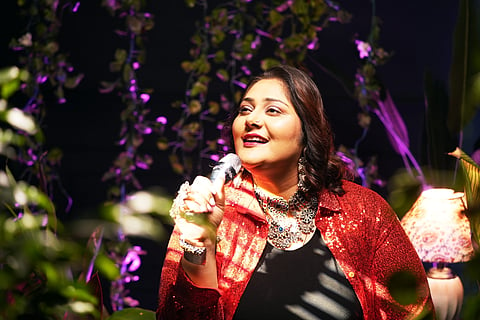
Playback singer—but not quite the Bollywood kind you remember—Runaa Rizvii Shivamani grew up in a home where riyaaz, not routine, defined daily life. The daughter of ghazal maestro Ustad Rajkumar Rizvi and Indrani Chatterjee Rizvi, she briefly brushed mainstream recognition with Jaane Tu Mera Kya Hai (Aditi) from Jaane Tu... Ya Jaane Na and songs like Dekar Dil and Shukriya from Uff Kya Jaadoo Mohabbat Hai. Yet, her artistic journey has largely unfolded beyond the film studio. Moving between Sufi poetry, Kabir compositions, and the raw intimacy of live mehfils, she has shaped a voice that resists noise and leans into depth.
Now, she brings that inward, almost meditative soundscape to Mumbai with The Kabiran Project—a performance that is less a concert and more an experience. Drawing from the centuries-old poetry of Kabir, the production strips music down to its emotional core, inviting audiences to listen, pause, and reflect. In conversation with Indulge Express, Runaa Rizvii Shivamani speaks about her connection to Kabir, her evolving musical path, and why, in an age of speed and spectacle, stillness might be the most powerful performance of all.
What first attracted you to this initiative, and what does singing the poetry of Kabir mean to you personally?
What drew me to The Kabiran Project was the profound honesty in Kabir’s voice. There is a rawness and fearlessness in his words that cut through layers of conditioning to reach the truth. For me, singing Kabir is an inward experience; his poetry acts as a mirror, allowing me to discover something new within myself each time I perform. It becomes a dialogue between the voice, the silence and something deeper within.
Coming from an intercultural background—raised by a Rajput Muslim father, the ghazal maestro Ustad Rajkumar Rizvi ji, and a Bengali Brahmin mother, Smt. Indrani Chatterjee Rizvi—I was taught that music, humility, and humanity are our primary religions. My father taught us the essence of the Bhagavad Gita and the Quran alike, and my parents ensured that every festival was celebrated in our home. I vividly remember my father quoting Kabir: “Chahe Geeta bachiye ya padiye Quran, jo man baache aapna, wo hi hai insaan.” I feel a deep, personal connection to those words.
How do you keep the original spirit while also bringing your own voice and interpretation?
The essence of Kabir lies in simplicity. My intention is never to over-interpret or embellish, but to stay close to the emotional core, stillness, and directness of the poetry. Every artist inevitably brings their own lived experience into their music. My approach is to allow the poetry to lead and let my voice respond honestly in the moment. The interpretation emerges naturally from that balance of surrender and expression.
Was your transition away from Bollywood playback a personal choice, or do you feel the creative space has become smaller?
It has been a bit of both. While the industry has evolved in terms of trends and sound, my own journey began moving inward. I found myself drawn toward music that allows for spiritual exploration and depth—elements that are not always the focus of mainstream film music. It wasn't necessarily a conscious step away, but rather a natural movement toward a different kind of expression. In fact, I believe creative space never truly gets smaller; it expands as an artist evolves and finds their true voice and purpose.
What changes are you noticing in the indie music space?
The most significant change is freedom. Artists are no longer dependent on a single system to share their work, allowing for diverse voices and genres. Audiences are also becoming more open to engaging with music beyond the mainstream. The challenge now is staying authentic amidst the noise; the artists who stand out will be those who remain deeply rooted in their own unique voice and journey.
How has the live performance space changed for singers in recent years?
There is a renewed appreciation for the “real” and immersive experience of live music. In an increasingly digital world, a live mehfil offers a unique sense of shared presence. I’ve noticed that audiences are becoming more receptive to intimate, reflective formats rather than just large-scale concerts. Live performance will always hold a special place because it offers something unique and human.
Do you feel singers should be concerned about AI?
AI is a powerful tool that will undoubtedly change the industry, but the essence of music lies in human experience and emotion. A voice is more than just texture; it carries a life, a journey, and a consciousness. While technology can simulate sound, it cannot replicate the human spirit. There will always be space for the human voice as a living, breathing expression.
What: The Kabiran Project, a live Sufi and Kabir music performance
Where: KKALA – Kailash Kher Academy for Learning Art, JP Road, Versova, Andheri West, Mumbai
When: March 28, 7 pm
For more updates, join/follow our WhatsApp, Telegram and YouTube channels.