
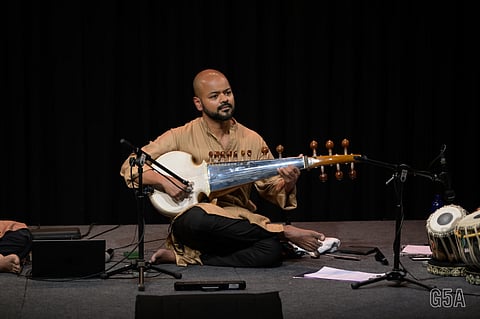
Soumik Datta explores nature, sound and interconnected ecosystems through Melodies in Slow Motion

Over the last decade, composer and sarod player Soumik Datta has built a practice that brings together music and environmental thought. After Jangal and Songs of the Earth, he returns with Melodies in Slow Motion. Based on the idea of trophic cascades, the work looks at how closely connected ecosystems are, using natural sounds and field recordings to bring out rhythms we don’t usually hear. We get chatty with Soumik to uncover everything related to this new project.
When did the idea for Melodies in Slow Motion the show begin?
The seeds were sown about two years ago during a period of forced stillness. I began listening to the sounds we usually ignore. I became fascinated by ‘slow motion’ not just as a tempo, but as a way of seeing. It was a realisation that the acoustic space of our planet is highly organised; that a beehive is a percussion ensemble and a murmuration is a choreographed dance. I wanted to move away from climate statistics and toward a visceral, musical interconnectedness.
What made you choose ‘trophic cascades’ as the main theme?
A trophic cascade is a biological phenomenon where the addition or removal of a single species — like a wolf or whale — reshapes an entire ecosystem. I chose it as a metaphor for interconnectedness. It reminds us that we are part of a global orchestra; when one instrument is silenced, the whole song shifts. Working on this has shown me that nature doesn’t just exist — it communicates with a mathematical and rhythmic precision that I find deeply inspiring as a musician.
How do you turn nature into music?
It’s a process I call ‘ear cinema’. We use microphones to capture frequencies the human ear cannot hear — the flutter of a wing or the pulse of a cell. Through granular synthesis, these halfsecond sounds are stretched into five-minute drones, revealing hidden melodies. The sarod then acts as a biological sensor, using its microtonal range to ‘sing’ alongside these sounds. We also draw from bee waggle dances and cicada prime number cycles as compositional tools, extending Indian classical ragas and talas through eco-inspiration, creating complex passages for musicians.
How did you choose the natural sounds used in the show?
The story behind each sound shaped the selection. I wasn’t looking for ‘pretty’ sounds, but ones rooted in intelligence and survival. Rahul Nadkarni’s recordings of Mumbai’s intertidal zones revealed a ‘rhythmic friction’ where land meets sea. Cicadas, when slowed and processed in spatial audio, resemble an ancient string ensemble. From a bee’s waggle dance to the deep ‘great pump’ of a whale dive, each ecological story guides the musical structure.
You and the band have been working together for quite some time now. But this is the first iteration of Melodies in Slow Motion. What did each artiste bring to the show?
While we’ve collaborated before, this show pushed us into a new ‘ensemble ecosystem’. Sayee Rakshith’s carnatic violin mirrors the microtonal shifts of birds in murmuration. Debjit Patitundi (tabla) and Sumesh Narayanan (mridangam) capture biological rhythms — from insect movements to circadian pulses — grounding the performance as its ‘pulse’ and ‘roots’. We also respond to the audience, who play a vital role in shaping the experience.
You were touring a different piece titled Travellers with the same band. Did that undergo any changes as you travelled and performed it?
Absolutely! Travellers was about borders and migration — human movement. As we performed it across several months, the sound became more layered, incorporating newer textures and the more up to date political climate of the (multi-war) world we are in. It taught us how to be a ‘living’ ensemble, a skill that we’ve now brought to Melodies in Slow Motion, where the ‘borders’ we are exploring are the invisible ones between species.
Did performing in different places affect the music?
Deeply. The acoustic response of a space shapes how you play — in a vast heritage venue, you lean into resonance; in an intimate black-box like G5A, you focus on fine sonic details. More importantly, the energy of a place seeps into the improvisation. In a bustling city like Mumbai, transitions feel more urgent, while in quieter settings like Kochi and Pondicherry, the ‘slow motion’ elements have more room to breathe.
What’s coming next for you?
We are looking to record Melodies in Slow Motion as an album and tour with it. I am currently in the process of capturing these ‘ear cinema’ experiences into a studio album of Melodies in Slow Motion, ensuring that the field recordings and the live energy of the band are preserved. Beyond that, we will be touring this work across the UK later this year, using it as a platform to continue the dialogue between music, science and the urgent need to protect our global orchestra.
Melodies in Slow Motion will soon stream on all audio platforms.
Email: alwin@newindianexpress.com
X: @al_ben_so