
- LIFESTYLE
- FASHION
- FOOD
- ENTERTAINMENT
- EVENTS
- CULTURE
- VIDEOS
- WEB STORIES
- SPORTS
- GADGETS
- CAR & BIKE
- TRAVEL
- SOCIETY
- GALLERIES
- NORTH EAST
- INDULGE CONNECT
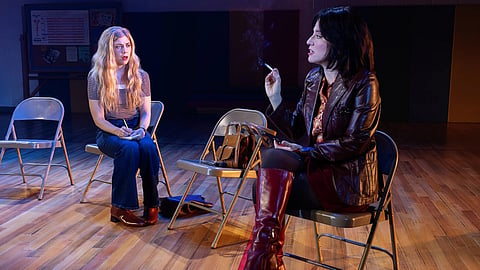
On most evenings at the theatre, applause waits for a cue: a line delivered just right, a blackout, a curtain call. At Liberation, Bess Wohl’s Broadway play about an intergenerational women’s consciousness-raising group, it arrives earlier — and unexpectedly. As the lights rise on Act Two, cheers ripple through the audience before a word is spoken.
The reaction is prompted by what unfolds onstage. Six women, members of a loosely formed group in the 1970s, quietly remove their clothes and remain naked for the duration of a 15-minute scene. It is one of the most striking moments on Broadway this season, not because it seeks shock, but because it refuses it.
Wohl admits she once worried the play might be reduced to “that one with the naked scene”. Instead, the response has been more thoughtful. The nudity, she says, has been received not as spectacle but as part of the work the characters are doing — an exercise in agency, attention and self-knowledge.
The idea grew out of research into real-life consciousness-raising groups, which brought together women across age, race and class. Bodily awareness, Wohl discovered, was central to those conversations. Set largely in the 1970s, Liberation reflects a moment when women were actively reclaiming medical and personal knowledge, shortly after the self-publication of Our Bodies, Ourselves and alongside the rise of feminist publications such as Ms. Magazine.

Actor Susannah Flood, who appears in the scene nightly, explains that the exercise depicted onstage mirrors historical practices. At a time when most doctors and gynaecologists were men, women found power in simply understanding their own anatomy. “So,” she says, “they got naked.”
The scene itself begins awkwardly. The women fret about hygiene, perch uneasily on gym chairs and struggle through the task of naming one thing they like — and dislike — about their bodies. The confessions veer from crude humour to raw grief. Margie, the eldest member, speaks bitterly about her C-section scar, describing it as the residue of a life built for others.
What heightens the impact is the absence of phones. Audience members must lock their devices in pouches before entering, a rule strictly enforced. The effect, Flood notes, is palpable. Without screens, people watch more closely — and talk more freely — during the interval and after the show.
Producer Daryl Roth describes the restriction as liberating rather than punitive. For a few hours, the audience is asked to be fully present, attentive only to the room and the people in it. Even the script acknowledges this shift, with a wry early line asking whether everyone is coping without their phones.
Behind the scenes, the nudity required careful handling. Intimacy coordinator Kelsey Rainwater worked closely with the cast, choreographing movement and pacing through detailed rehearsals. Security staff received sensitivity training, and backstage monitors go dark to prevent recording. The aim, Rainwater says, was not just protection but trust.
For the actors, repetition has eased the initial nerves. Flood now believes the emotional exposure is more daunting than the physical one. Live theatre, she suggests, carries its own form of vulnerability — the risk of indifference, distraction or misunderstanding.
That risk, paradoxically, is what gives Liberation its charge. Each performance exists only once, unrecorded and undistracted. In a room where bodies are visible and phones are silent, attention becomes the most radical gesture of all.
For more updates, join/follow our WhatsApp, Telegram and YouTube channels