
- LIFESTYLE
- FASHION
- FOOD
- ENTERTAINMENT
- EVENTS
- CULTURE
- VIDEOS
- WEB STORIES
- SPORTS
- GADGETS
- CAR & BIKE
- TRAVEL
- SOCIETY
- GALLERIES
- NORTH EAST
- INDULGE CONNECT
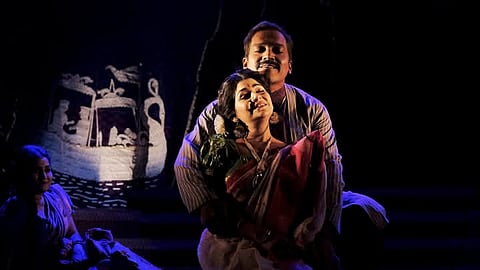
Theatre in Bengal has a rich and dynamic history, evolving from its roots in Jatra, a traditional folk theatre, to the sophisticated urban stage performances of modern theatre. We explore Bengali theatre’s journey.
Jatra, a traditional folk theatre, emerged primarily as a medium for mythological narratives. These open-air performances captivated audiences with their storytelling, vibrant costumes, and powerful dialogues. “Dramatists used to convert historical facts and data in the form of a script and present them to the audience. Jatra used to be about kings, queens, gods, and goddesses,” says Veteran actor Sabyasachi Chakrabarty.
As Jatra flourished, theatre evolved, transitioning from open-air performances to structured stage productions. Acclaimed actor Badsha Maitra says, “Jatra is an Indian traditional art form, whereas theatre is a bit westernised. Jatra is still seen mostly in rural areas. The theatre we see in Kolkata today—proscenium theatre—is inspired by British theatre, where the audience sit in front of the stage.”

This transition brought more organisation, with scripted stories and controlled performances. Over time, theatre in Bengal branched into different forms. Commercial theatre focused on entertaining, with grand sets and popular actors, while group theatre emphasised artistic storytelling and social issues. Badsha adds, “Commercial theatre always focused on one star, whereas in group theatre they formed a group where everyone played a role of equal importance.”
Theatre was once grand and dramatic, with poetic dialogues and mythological themes. Sabyasachi shares, “Earlier, most scripts were converted from books, which is why the dialogues used to be poetic and rhythmic. In the 1960s, Utpal Dutt, Sombhu Mitra, and Ajitesh Bandopadhyay ruled the stage. Girish Ghosh was probably the first person to write about the common man. But still, rhythmic and poetic dialogues continued to make it a form of interesting literature. Bijon Bhattacharya first wrote a play based on the poor. It was initially called Gotrantor and later Nabanya. This is how common-man discourse patterns came in. I personally get charmed when I watch the rise of the common man against oppression.”
Modern-day Bengali theatre blends tradition with innovation, exploring social, political, and personal themes with realism and artistic expression. Actor Biswajit Das says, “Theatre used to be a medium to spread awareness and shape public opinions, but now it has also become partially commercial and intellectual.” He reflects on his research on theatre, “During the pandemic, public theatre moved from stages to roofs, drawing rooms, and small spaces, presented to a limited audience. I named this transition of public theatre ‘Pocket Theatre’.” Theatre versus cinema Theatre thrives on live performances and raw emotions, while cinema captures realism through visuals, editing, and intricate storytelling techniques. Sabyasachi mentions, “Silver screen is an easier medium to perform, but you do not really get time to rehearse, though you have takes and retakes until you get to deliver well. For stage productions, you get plenty of time to rehearse, but once the curtains are up, you cannot stop midway. It is the instant reaction of the audience that gives you the impetus to perform better. Theatre appeals to me more than films. Unlike cinema’s grand visuals, theatre relies on imagination. When a performer says, “Look, the sky is so blue,” the audience wouldn’t see it—they’d believe it through acting, lighting, and sound.”
Theatre will continue to evolve alongside OTT and cinema, offering a live experience that digital screens can never replace. Biswajit emphasises, “Theatre is about experiencing art as a part of the mass, where the audience laughs, cries, and reacts together, which happens in cinema halls too. But OTT is a platform where people individually experience series or movies. As long as humans exist, no other platform will be able to bring the connection between performers and audiences that theatre brings.”
Badsha adds, “Theatre is very lively, where the actor communicates directly with the audience, which is missing in digital platforms. OTT will not make any difference—theatre will survive on its own terms.”
(Written by Addrita Sinha)