
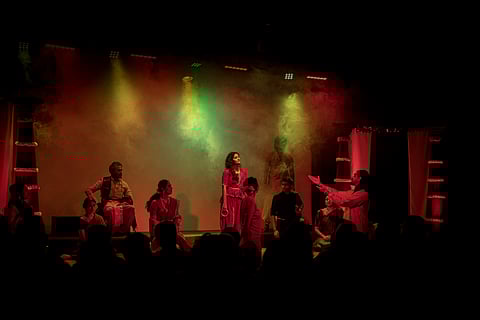
The Anklet brings the story of Kannagi to the stage for a contemporary audience

The Anklet, a new stage adaptation of Cilappatikāram, brings one of Tamil literature’s most powerful stories to contemporary audiences. Directed with a focus on intimacy and emotional truth, the play explores justice, grief and a woman’s refusal to be silenced. In this conversation, Shatarupa Bhattacharyya, the director of the play, speaks about shaping an ancient epic for today, the visual language behind the production and the human questions that make the story feel urgent and alive.
What drew you to adapt Cilappatikāram for the stage?
Honestly, it began with listening. My closest Tamil friends spoke about Kannagi with a kind of fierce tenderness, as if she were not a mythic figure but someone they had grown up with. Their passion made me curious long before the research did. And when I finally read Cilappatikāram, I realised it was not just an epic. It was a sharp study of justice, womanhood and the clarity that grief can bring. As a theatre-maker, I am always drawn to stories where a woman refuses to be softened for comfort.
Kannagi’s rage is not ornamental; it is political. It makes us confront how societies respond to women who refuse to stay contained. Bringing this to the stage felt urgent. Today, when women’s anger is still misunderstood, dismissed or moralised, The Anklet allows us to hold space for a woman who says she has been wronged and will not be quiet about it.
The text is also visually rich. It gives you fire, music, dance, marketplaces, courts, gods and mortals. It is a world that invites performance rather than just reading. So in a way, it was friendship, curiosity, feminism and the excitement of discovering a story that demands to be spoken aloud.
How did you decide on the title The Anklet for this version?
Silappadikaram is the story of the anklet, so the title felt natural. It was chosen by Prof Vijay Padaki.
The story of the play is ancient. How did you make it feel relevant to today’s audience?
To be honest, I did not have to modernise Cilappatikāram. The text is already strikingly contemporary. What I focused on was removing the distance we usually place between ourselves and old stories. Instead of treating it like a sacred relic, I treated it like something alive. The relevance came from asking simple but uncomfortable questions: What does justice look like today? Who gets believed? What happens when a woman’s grief becomes too big, too inconvenient or too political? These questions are not 2,000 years old. They are here now, in every headline and in every home. I also centred the human stakes. The play is not about gods burning cities. It is about a young woman who loses everything because a system failed her. That is a heartbreak we still understand. Visually, we leaned into minimalism with objects, bodies and rhythm, so the audience is not distracted by grand historical spectacle. They are pushed to see the emotional truth. Finally, I trusted the performers. Their bodies, voices and vulnerabilities do the work of translation. When an actor holds grief honestly on stage, it stops being ancient or modern. It simply becomes human.
What was the most challenging part of directing a story rooted in myth and history?
The hardest part was resisting the urge to treat the material with too much reverence. When a story is tied to mythology and cultural pride, there is often pressure to present it in a correct or idealised way. But theatre cannot breathe inside that kind of museum glass. It needs tension, doubt and contradiction. My challenge was to remove the halo around the text and find the humans beneath it: a young couple making flawed choices, a woman facing injustice, a city shaped by desire, greed and power. Myth and history can flatten characters into symbols. I had to work to keep them emotional, vulnerable and real. Staging myth without spectacle was also difficult. I did not want the production to hide behind grandeur. I wanted intimacy. We had to evoke fire, grief, divine moments and social collapse using only bodies, rhythm and objects. It required restraint, clarity and a lot of courage from the performers. So, the challenge was not the myth or the history. It was finding a way to let the audience meet the story at eye level, without bowing to it.
Can you tell me a bit about your visual choices, like costume, set or lighting and what they symbolise?
Our visual world for The Anklet came from a simple question: how do you stage an epic without overwhelming it with ornamentation? The costumes are minimal and earthy. We avoided royal silks because I did not want the characters to look like museum pieces. For Kannagi, absence becomes the costume. What she removes, what she sheds and how her body changes become part of the story of her rage and clarity. The stage is almost empty. The anklet becomes the central object, acting as a witness that holds memory, desire, accusation and truth. The emptiness of the stage reflects the emotional dryness of a society that failed its own people. The idea was to let the audience imagine the world instead of consuming it. Let the body and a single object tell the truth. Let nothing distract from the fire that runs through the story.
What do you hope audiences take away from the play after watching it?
I do not want audiences to leave with a lesson. That is not the intention. If anything, I hope they leave feeling something, whether it is curiosity, discomfort, tenderness or recognition. If they carry anything with them, I would like it to be the sense that old stories still hold space for very real and present emotions such as love, mistakes, injustice and resilience. I hope they remember Kannagi not as a distant legend but as a young woman who was pushed too far. And I hope they see the other characters, including Kovalan, Madhavi, the court and the city, not as heroes or villains but as flawed humans, just like us.
As a director, what did this play teach you personally or artistically?
This play taught me to trust simplicity. When you work with an epic, the instinct is to make everything big, grand and perfect. But The Anklet kept reminding me that the most powerful moments are often the quiet ones, such as a look, a pause, a single object or a line spoken without decoration. Artistically, it reminded me that you do not need spectacle to move people. You need honesty, clarity and a lot of listening to the text, to the actors and to your own discomfort. It is a lesson I will carry forward.