
- LIFESTYLE
- FASHION
- FOOD
- ENTERTAINMENT
- EVENTS
- CULTURE
- VIDEOS
- WEB STORIES
- GALLERIES
- GADGETS
- CAR & BIKE
- SOCIETY
- TRAVEL
- NORTH EAST
- INDULGE CONNECT

In Indian Theatre, it is rare for leading practitioners with national recognition to step away from established institutions and collaborate with a new, inexperienced theatre group. God’s Lioness is one such exception. Written by Mrinal Mathur, this English play blends mythology, history and social satire, reimagining Draupadi not as a victim of fate, but as a woman of desire, choice and consequence.
“In 2024, my friend Mrinal Mathur wrote a play and approached me to direct it. When I read the script, it had a cast of around 10 – 12 actors. However, the producer explained that for a travelling company, it would be difficult to manage such a large group and asked me to limit the cast to three or at most four actors. I felt this was almost impossible, as the play included 12 – 13 characters — the Pandavas, the Kauravas, Krishna and many others. The Mahabharata is a vast epic. Then an idea came to me. As a scenographer with extensive experience in visual design, my painter sensibility took over and I thought — why not stage the play using puppetry?” reveals Satyabrata Rout, director of the play.
Pratibimb Theatre Company, a collective founded in Uttar Pradesh almost 50 years ago, premiered the production in a metaphorical retelling of the Mahabharata in Gurugram last year. The play does not focus on the events of the Mahabharata per se, but on the consciousness behind them.
“The playwright and I worked together to develop a new version of the play. I conceived the concept and he wrote a fresh draft with the use of puppetry, masks and other kathakali theatrical elements in mind. The play focuses on Draupadi’s experiences and her inner turmoil, highlighting how she remained unheard for thousands of years in Indian history. It functions almost as a monologue with Draupadi at the centre and other characters woven around her. As a result, it gradually evolved into a feminist narrative, reflecting themes of women’s empowerment,” he shares.
Puppetry and masks are used as metaphors for power, absence and identity. Live music and elements of chhau infuse the narrative with a primal energy, grounding the Mahabharata in an elemental theatrical language that transcends realism.
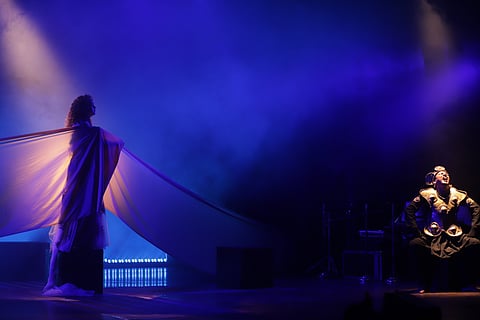
“This is not a linear production at all; it follows an expressionistic approach. When audiences watch the play, they see colours in motion and lines travelling through three-dimensional space. We make extensive use of fabric and one of the actors is a trained kathakali performer, whom I chose deliberately to explore the full potential of his physical presence. While operating two puppets, he incorporates the footwork of kathakali. For instance, after portraying Nakula, he places the puppet in a designated space on stage, picks up the feather and instantly becomes Krishna — shifting from kathakali into the movement vocabulary of chhau,” he tells us.
₹400. January 23, 7.30 pm. At Ranga Shankara, JP Nagar.