
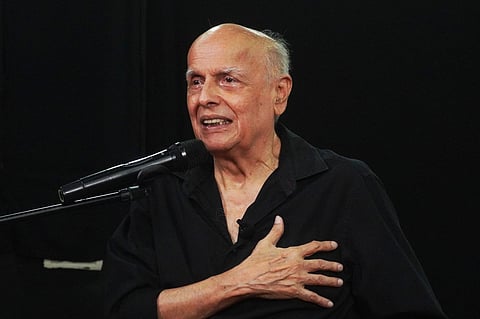
Why Mahesh Bhatt’s stage comeback with Wo Subah Hum Hi Se Aayegi is the theatrical event of the season

When Mahesh Bhatt swaps the director's chair for the theatre stage, you can bet it's never going to be your average night out. From The Last Salute, Milne Do to Arth, his productions have always sparked conversations long after the curtain call. And now, the iconic filmmaker is back with Wo Subah Hum Hi Se Aayegi, a new production inspired by Sahir Ludhianvi's timeless verse. Premiering in Mumbai this weekend (July 5), the play dives into themes of truth, courage and self-discovery, following a young man navigating the shifting realities of the early 1990s.
Mahesh Bhatt returns to stage with Wo Subah Hum Hi Se Aayegi: ‘Creative freedom begins with inner freedom’
Helmed by Tariquee Hameed and penned by Dinesh Gautam, the play stars Imran Zahid alongside Namitaa Sachdeva. As the play revisits the early '90s, it also reunites two names synonymous with that era, Mahesh Bhatt and Anu Malik. Having created cinematic magic together in films like Phir Teri Kahani Yaad Aayee and Sir, the duo are now taking their partnership from film sets to the theatre stage.
Wo Subah Hum Hi Se Aayegi unfolds through lyrical monologues, intimate conversations and powerful moments of silence. It's all about emotions we often keep bottled up—love, fear, hope and finding the courage to be yourself. Excerpts from a chat with the filmmaker.
What inspired you to bring Wo Subah Hum Hi Se Aayegi to the stage?
When I look back at my journey—from Arth and Daddy to Zakhm, and more recently Bollywood Without Make-Up—I realise I've been asking myself the same question time and again. How does a person live truthfully in a world built on performance?
As a young man, I was chasing success, recognition and approval. Then life happened. Success happened. Failure happened. Love happened and so did loss. Over the past three decades, my association with UG Krishnamurti has challenged almost every certainty I held about myself and the world. Gradually, storytelling became less about entertaining audiences and more about understanding what it means to be human.
Theatre feels like the purest place for that exploration. There are no special effects or technological distractions, just one living human being standing before another. At seventy-seven, that simplicity speaks to me more than ever. Wo Subah Hum Hi Se Aayegi is, in many ways, an extension of a conversation I've been having with myself all my life.
What was it about this story that convinced you it deserved to be experienced as a live theatre production?
Because this story is built around questions rather than events. It is about truth. About fear. About whether we have the courage to speak in our own voice rather than borrow the language of the crowd. Such stories gain real power in the theatre because the audience cannot hide behind a screen, and neither can the actors. What unfolds is a direct encounter. When a character on stage struggles with truth, the audience inevitably begins to examine its own relationship with truth. It was this intimacy that convinced me the story belonged on the stage.
What made Wo Subah Hum Hi Se Aayegi the perfect project to reunite with Anu Malik?
Anu and I have shared a lifetime of memories. We have celebrated successes together and faced disappointments together. Relationships that last for decades are built on something deeper than professional convenience.
What drew us both to this project was its emotional core. Beneath all its ideas, it is really about hope and the resilience of the human spirit. In cinema, music often accompanies a story. In theatre, it breathes with the story; it becomes part of the living experience unfolding before the audience. Anu instinctively understood this. He approached the play not just as a composer, but as a fellow storyteller.
The title draws inspiration from Sahir Ludhianvi’s timeless verse. What significance does it hold for you?
Sahir Ludhianvi’s words have endured because they speak to something eternal in the human heart. Wo Subah Kabhi To Aayegi was not just a line of poetry; it was an act of faith. Our title pays homage to that faith while extending its meaning. Wo Subah Hum Hi Se Aayegi. The dawn we seek will not be delivered to us by politicians, ideologies, technology or miracles. It will arrive through human beings who find the courage to live truthfully. Today, when outrage spreads faster than understanding and certainty is often valued more than wisdom, that message feels especially relevant.
At a time when audiences are increasingly consuming content on digital platforms, what role do you believe live theatre plays in contemporary storytelling?
Digital platforms have transformed storytelling and opened up remarkable possibilities. But theatre offers something that technology cannot manufacture-presence. In a theatre, hundreds of strangers sit together and experience the same emotions at the same moment. They laugh together, fall silent together and reflect together. In an age where we are endlessly connected digitally yet increasingly isolated emotionally, theatre becomes almost an act of resistance. It reminds us that human beings are not merely consumers of content, but participants in a shared experience
As the presenter and producer, how closely were you involved in shaping the script, performances and the overall creative vision of the play?
Creative freedom begins with inner freedom. We often speak about external restrictions, and they certainly exist, but the deepest form of censorship usually comes from fear. Fear of disapproval. Fear of criticism. Fear of standing alone. Theatre has always been a space where difficult questions can be asked openly, and I believe it must continue to play that role. Art loses its vitality when it turns into propaganda; its purpose is not to provide answers, but to deepen our inquiry into life. Freedom is essential to that process.
Do you see Wo Subah Hum Hi Se Aayegi as the beginning of a new chapter in your association with theatre? Can audiences expect more stage productions from you?
Without a doubt. The older I become, the more theatre feels like home. For many years, cinema was my primary language. Today, I find myself increasingly drawn to spaces where conversations can happen directly and honestly. Perhaps age does that to you—you become less interested in scale and more interested in substance. If there is one thread connecting Arth, Daddy, Zakhm, my years with UG Krishnamurti, Bollywood Without Make-Up, and now Wo Subah Hum Hi Se Aayegi, it is this: how does a human being remain authentic in a culture built on performance? The stage is a beautiful place to explore that question. So yes, as long as there are questions worth asking, I suspect I will keep returning to theatre.
For more updates, join/follow our
https://www.whatsapp.com/channel/0029Vb677uz60eBXiDYheb0n