
Jagriti Theatre and Munich’s META reimagine TS Eliot’s The Waste Land for a chaotic modern world

Jagriti Theatre joins hands with Munich’s META theatre to bring to life a production titled The Waste Land. Inspired by TS Eliot’s poem — the production aims to retain the intention of the verses while giving their Indian audience a more compelling outlook on our world and the chaos we live in today. In conversations with the director Axel Tangerding, performer Nicole Kleine and musical composer Ardhi Engl — they talk us through the production and the various elements that have gone into its making.
When did you first come across the poem The Waste Land and what impact did it leave on you?
My deeper encounter with The Waste Land began in 2022 while directing the musical theatre production The Human Touch. The composer used fragments of TS Eliot’s poem as the libretto and that immediately sparked my curiosity. It became clear to me that this is not simply a poem from another era, as it continues to be relevant. We are once again living in a time of uncertainty, fragmentation and the search for meaning, just as Eliot was after the First World War. As an artiste, I was fascinated by how a work that is often considered difficult could create such an immediate emotional connection. That experience stayed with me and became the starting point for this production.
From a poem to a theatrical play, how did you go about preserving TS Eliot’s message when making such a huge shift?
For me, preserving Eliot’s work meant resisting the temptation to simplify it. Rather than adapting The Waste Land into a conventional play with characters and a linear story, we chose to preserve the poem itself as the central dramatic force. Our process involved exploring how theatre could reveal the poem’s rhythms, imagery and emotional landscapes through movement, music, voice and physical action. We experimented extensively with space, materials and sound before arriving at the final stage language. The poem’s fragmented structure is its greatest strength. We wanted audiences to experience that fragmentation rather than explain it away. Theatre allows us to embody the poem instead of interpreting it. The result is less an adaptation and more an encounter with Eliot’s world.
What theatrical elements and visuals can one expect to see?
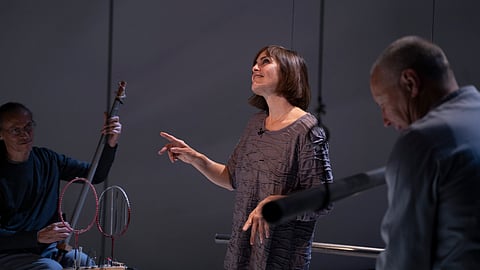
Throughout the performance, the stage itself changes continuously through actions such as scratching, scraping, beating and breaking materials by hand. The audience can expect an immersive theatrical experience where image, sound, movement and poetry exist together. The production also combines spoken poetry, physical theatre, live music, singing and visual composition into one unified experience. The sounds themselves are created using both traditional and unconventional instruments — giving the performance an organic, evolving quality that mirrors the poem’s constantly shifting emotional landscape.
Nicole, you will be performing a solo that portrays the many characters and perspectives of this poem. Take us through your piece and how your preparation has been for this role?
One of the greatest challenges and joys of performing The Waste Land is that I am constantly moving between different voices, emotions and perspectives. The poem shifts rapidly and my task is to follow those changes truthfully while allowing each character or image to emerge naturally. Preparing for this role has meant living with the poem for a long time. Every rehearsal revealed something new — a hidden connection, an unexpected emotion or another layer of meaning. I have found myself tracing its changing moods — from tenderness to despair, from irony to hope and discovering how timeless these emotions still feel.
Ardhi, how significant a role will music play in this production?
Music is at the heart of this production because it creates the emotional spaces between Eliot’s words. My intention was not to illustrate the poem literally, but to create something rooted in the present. Rather than relying on recognisable musical styles or categories, I wanted the sound to remain open and constantly evolving, responding to the performers and the space in real time. The music becomes a bridge between the text and the audience and between myself and Nicole on stage. The audience will hear a unique combination of traditional and handmade instruments, including a trash kalimba, shuttlecock feathers, saz, stick violin, stick cello, PVC fujara and live looping. Together they create an atmosphere that shifts constantly, just as the poem itself does. As TS Eliot wrote, “you are the music, while the music lasts.”
INR 500. July 30, 7.30 pm. At Ramagondanahalli.