
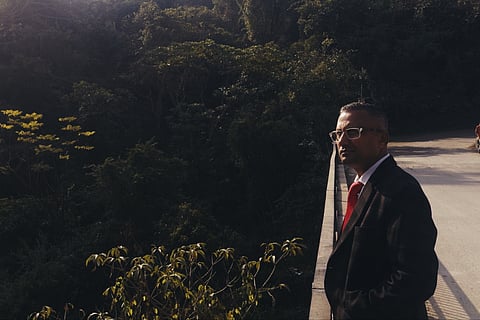
Shankar Borua’s Blue Ocean uses an engaging plot and music to warn of a mountain-range con job

Nature is a character of its own in storyteller and filmmaker Shankar Borua’s upcoming film Blue Ocean. As a necessary film channelling the voices of the Hindu Kush range’s ecosystem and the impact the region has been facing since time immemorial due to ‘short-term benefits’, as Shankar highlights — Blue Ocean is a social commentary that brings the heart and soul of Dehradun (with its locals as the actors in the film and the city’s happenings themselves acting as a background) to celluloid. We chat with Shankar to further delve into the makings of this interesting and important project, while also learning about how the social commentary was integrated using multiple creative elements.
Storyteller and filmmaker Shankar Borua discusses the narrative and thematic core of his upcoming film set in Dehradun — Blue Ocean...
Tell us about the subject that Blue Ocean deals with?
It is this — how do you send an environmental message within a commercial film format or a non-art-house film format? And one of the first contentions that I have as the filmmaker of this film and as someone from the Eastern Himalayas is that I have witnessed large-scale destruction of the fragile mountain ecology. The idea was to tell people that, “look, what is happening is actually not to our long-term benefit,” with the keyword being ‘long-term.’ It was also the idea to look at this whole thing as a scam and a con job that we are committing on future generations. Any high school child is going to tell you that this entire Hindu Kush mountain range is in a highly seismic zone. This is a very young mountain range. This is a very interesting thing that a lot of people, even knowing, just pretend not to know that plates are still colliding.
And how did you arrive at bringing out this observation of a con job to the future generation narratively into the film?
What better way to do it than to show a guy who’s a fraudster running a ponzi scheme. So the idea here was to use that cinematic trope as both the medium and the message; and just like Canadian philosopher Marshall McLuhan said, ‘the medium is the message.’
What can you tell us about the production process, working with non-actors and shooting without a bound script?
Blue Ocean was shot by two of my students on two iPhones. The professional sound crew came from Mumbai. It’s very hard to go back, reach out to them and ask them to come back to the dubbing studio. So, you’ve got to shoot it, whatever happens right there. There’s no second opportunity. Furthermore, for the first time in my life, I was working without a bound script; and since I work largely with sequences and not scenes, that has been my own style — giving me a lot of leeway, a lot of wiggle room. The idea was that, ‘if you need dialogue specifically written for you, we‘ll write it for you, or else, just do your own thing.’
How did you approach the musical integration in the film, keeping in mind a strong social message?
The songs were all written here and recorded here (Dehradun) by lyricist Shelle (Shailender Singh Sodhi). He stayed here for 15 days. I had to really sit on top of his head, talking a lot about the essential core of the film. Ek Chirraiyya and Ki Dassa — two of the songs from the film — directly reflect our larger anxieties, currently known as climate anxiety.
How did your personal background and observations find their way into the story and the main character of Prakash Negi?
When Prakash Negi is talking about WC Square and about his work there, it’s actually me. I’ve done that when I first went as a young man to western Canada and then I started working in this area. And I come from the Eastern Himalayas, where massive deforestation has happened in the name of oil and gas exploration, particularly at the Assam-Arunachal belt, which is one of the last surviving belts of tropical rainforests in the world, after the Amazon.
Blue Ocean will release on streaming platforms soon.
Mail id - pranav.shriram@newindianexpress.com