
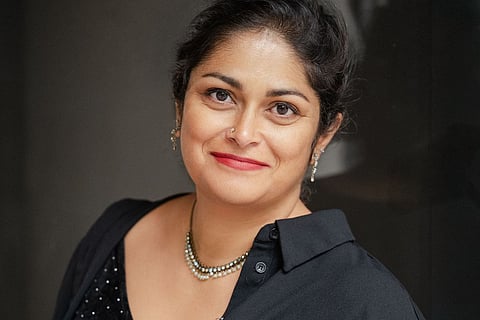
Anu Vaidyanathan’s debut documentary Dispatch tackles grief and motherhood

Stand-up comedian and triathlete Anu Vaidyanathan has just made her filmmaking debut with Dispatch, a lyrical exploration of grief, migration, motherhood, and belonging. We caught up with her to chat about stepping into the director’s chair for the first time and what went into making the film.
Anu Vaidyanathan’s debut documentary Dispatch tackles grief and motherhood
What inspired the idea for Dispatch, which explores grief, migration, motherhood, and belonging?
I first visited the Sundance Film Festival in 2023 and met an African-American filmmaker who told me how she had independently made her debut feature on modest means. Two years later, that advice quietly echoed as I made my own debut feature, also with very limited resources. Returning to Sundance this year to speak about Dispatch and the experience of being a diverse filmmaker felt like life coming full circle.
The film had been brewing for over two years, but the idea truly took shape after we lost someone last year. Grief brings certain clarity. At the time, I was struggling to raise funds for a fiction feature, but filmmaking constantly demands reorientation; responding to life and creating from personal truths often produces work that resonates universally.
With young children and older parents to care for, grief and loss are difficult to process without mindfulness. Making Dispatch allowed me to make sense of what had happened and to pay tribute to the remarkable women in our family who held us together, showing the resilience of womankind despite the challenges we face, and to the men who quietly act as the chassis when things fall apart.
Though born of loss, the film’s sparks had been forming for years; in countless conversations, kitchen sessions, shopping trips, and the mundane moments we shared as women, as well as discussions with other filmmakers navigating their own uncertain paths. The three women featured, all scientists, explore what happens when an objective mind is tested by Indian tradition.
How long has this project been in the making?
Principal photography for this project took place in the summer of 2025, spanning 21 days in extreme heat, with temperatures reaching 42 to 45 degrees Celsius daily. The shoot covered locations across India, much of it in rural areas, and sustaining the schedule required meticulous planning and constant adaptation to the elements. The project is now in post-production and progressing towards the narrative structure we had envisioned from the outset.
Is Dispatch personal in the way your stand-up work is, or does it explore a different side of you?
The visual language of the documentary centres on movement and the poetry of everyday objects. Family symbolism emerges through nature and commonplace items encountered while moving through familiar spaces, from morning to night. From a woman’s perspective, whether in South India, with my mother-in-law in Punjab, or my mother in Bangalore , daily routines are remarkably similar, finding joy in small moments and connecting with the streets we inhabit.
The film portrays the lived experience of women across two generations. We aimed to remain authentic to the characters, capturing how they are traditional in some ways and less so in others. Interestingly, as modern women, we are often less empowered than the older generation in certain aspects. The emotional language of the film balances memory and conversation, reflecting both subject and perspective. Ultimately, the documentary grew from the ability to sit with oneself and one’s memories, dwelling in that space to evoke the essence of a person.
As a debut filmmaker, how did you approach the visual and emotional language of the documentary?
Dispatch speaks to anyone who has lost someone close, navigated intergenerational, cross-border families, or uprooted themselves to start anew in a different place. The film follows two families, one from pre-partition India, the other from South India, highlighting a shared human experience across 3,500 kilometres. At its heart is the connection between mothers, daughters, and potentially granddaughters, exploring the sacred ties of this holy trinity.
It is very much a female-first film, but its resonance extends to anyone with cross-border relationships or parents who nurtured their dreams and believed in them. It reaches those who have struggled to articulate grief, loss, or love amid the clatter of modern life. Processing grief requires mindfulness, and Dispatch offers a space to pause, reflect, and rediscover the profound moments found in the everyday.
What kind of audience are you hoping Dispatch will connect with?
Dispatch resonates with women and men in science who recognise that artists are not so different from them, and with artists who see the parallels with scientists. The film moves between the objective world of science and the subjective realm of art, creating a dialogue that bridges both. It is aimed at those at the intersection of multiple interests, curious minds who navigate between disciplines, and it is to them that Dispatch hopes to speak.
Were there moments during the making of Dispatch that felt as challenging as training for Ultraman?
The summer shoot was gruelling, with temperatures reaching 43 degrees Celsius in South India. Even with a small crew, surviving the heat required constant planning; finding water, coconuts, and shade became part of the workday. Filmmaking itself isn’t a sport, though the discipline, persistence, and commitment it demands mirror the mindset needed to see a project through to the end.
The process taught me the importance of agility, whether as a filmmaker, comedian, or athlete. Debut films are about learning and experimentation; labels like fiction versus nonfiction matter less at that stage. Fiction brings the added challenge of directing actors, which I’m excited to explore next. But in the end, sport and filmmaking only intersect in enduring the elements, though it was amusing to watch a Bollywood set with portable fans and anacondas trying to deliver fresh air.
How has your journey across so many fields influenced the way you tell stories in this documentary?
The journey across different fields informs everything I do. I’m one person, not three separate selves, so all the lessons I’ve learned accumulate. In filmmaking, a touch of objectivity, drawn from my engineering background, proves invaluable. Sport doesn’t correlate directly, but endurance is essential when standing for 16- to 18-hour days with a lean documentary crew; it’s just you, the elements, and the frame you’re trying to capture.
We’re all sums of our parts, and for me the guiding thread is always playing the notes that feel true, rather than forcing anything. That philosophy carried through in making the film. Making the film was both excruciating and exhilarating. I met many like-minded collaborators, learned from their perspectives, and grew as an artiste. The experience has made me more grounded, both mentally and craft-wise, and better prepared for my next project.
What has this project taught you as a filmmaker?
This project taught me that the creation of a film is entirely separate from how it’s received. To survive, you have to separate each stage of the process. In documentary, the filmmaker and camera assistant often bear the brunt of day-to-day work, so I’ve learned to deeply appreciate strong producing partners. Producers, like Karuna and Ashish for this project, act as custodians of your vision, giving you time, space, and support to realise it.
It also reinforced the value of action over dreaming. I lost some of that drive before 2025, as 2023 and 2024 were consumed by comedy, an unexpected path I never imagined. Studying at Philippe Gaulier’s clown school in France was a turning point; he taught me that lived experience is the richest story you can tell. Touring comedy internationally gave me a new wingspan and made me a better director, attuned to performance, presence, and truth, skills that translate directly to both documentary and fiction filmmaking.
Documentary work is improvisational; it requires openness to magic. Even with a clear sense of story, the film surprises you in shooting, editing, and in how sound, music, and colour shape the narrative. It’s a versatile art form that teaches you constantly, and this project pushed me to the next level as a filmmaker.
I’m deeply grateful to my mentors, Dick Fontaine at NFTS and Philippe Gaulier, who reminded me that I am the sum of my lived experiences. Alongside collaborators, editors, sound designers, composers, colourists, camera assistants, and producers, we brought this film to its fullest potential. Making Dispatch in 2025 and reaching the finish line this year has been exhausting, exhilarating, and profoundly rewarding.
For more updates, join/follow our
https://www.whatsapp.com/channel/0029Vb677uz60eBXiDYheb0n