
- LIFESTYLE
- FASHION
- FOOD
- ENTERTAINMENT
- EVENTS
- CULTURE
- VIDEOS
- WEB STORIES
- SPORTS
- GADGETS
- CAR & BIKE
- TRAVEL
- SOCIETY
- GALLERIES
- NORTH EAST
- INDULGE CONNECT

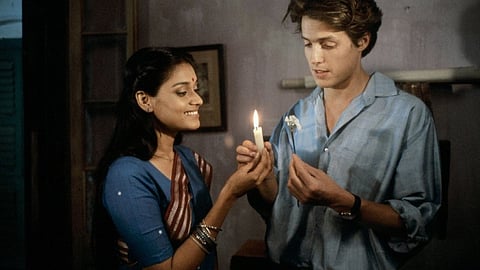
In the winter of 1987, the historic, tree-lined lanes of South Kolkata became an unlikely playground for international cinema. A dashing, relatively unknown 27-year-old British actor named Hugh Grant was in town, rubbing shoulders with Indian cinematic royalty like Soumitra Chatterjee, Shabana Azmi, and a young, luminous Supriya Pathak. They were filming La Nuit Bengali (The Bengali Night), a lavish, high-profile European production backed by French producers.
On paper, it was a prestige project destined for global film festivals. In reality, it was a ticking cultural time bomb.
By the time the film was completed in 1988, it was slapped with a legal restraint so powerful that it never made it to be released commercially. This wasn't any regular case of political/sexual censorship or bureaucratic red tape, rather, the banning of the film stands as one of the most fiercely personal, ethically charged legal battles in Indo-European literary history: A clash over a young woman’s stolen narrative, a devastating breach of trust, and the protective fury of Bengal’s literary elite.
To understand why the film caused such an uproar, one has to travel back to a conservative, intellectually electric Calcutta of 1928. A brilliant 21-year-old Romanian scholar named Mircea Eliade, who eventually became one of the world's most famous philosophers of religion, arrived at the city to study under the formidable philosopher Surendranath Dasgupta.
Surendranath welcomed the young European into his home as a son, Mircea met the philosopher’s 16-year-old daughter, Maitreyi Devi, a prodigiously gifted poet, a cherished protégé of Rabindranath Tagore, and the pride of her family.
An intense, secret romance blossomed soon between the young scholar and the teenage poet amid the bookshelves and monsoon rains. But when the relationship was discovered by her father, the cultural transgression was unforgivable. Mircea was instantly evicted, ordered to leave the country, and sent packing to Europe with a broken heart.
Had the story ended there, it would have been just another bittersweet footnote in history. But in 1933, back in Bucharest, Mircea published Santier and later Maitreyi (translated into French as La Nuit Bengali). It was a highly sensationalised, deeply eroticised, semi-autobiographical account of the affair. And most importantly, Mircea used Maitreyi's real first name and claimed explicitly that their relationship had been physically consummated.
For nearly 40 years, Maitreyi Devi, living a quiet life as a respected intellectual, humanitarian, and Sahitya Akademi Award winner in Kolkata, had absolutely no idea this European bestseller existed. When she finally discovered a translation in the 1970s, she was utterly devastated.
In conservative Bengali society, Mircea’s book was a devastating blow to her dignity. She vehemently denied that the relationship had ever been sexual, labeling Eliade's book a deceptive fantasy that exploited her identity.
As they say, a pen is mightier than a sword, Maitreyi Devi too fought back with her own pen and published her masterpiece: Na Hanyate (It Does Not Die), in 1974. The book is a beautifully raw counter-narrative that corrected the record from her perspective. She even traveled to Chicago to confront an ageing Mircea, extracting a solemn promise from him that his book would never be translated into English during her lifetime.
The fragile peace shattered in 1987 when French director Nicolas Klotz marched into Kolkata with a film crew. They were adapting Eliade’s book, casting Hugh Grant as the Eliade-figure and Supriya Pathak as Maitreyi.
For Maitreyi Devi, now an elderly, revered matriarch, this was the ultimate violation. She was traumatised by the news that a movie was being made on the book and was being shot in Kolkata. “Christinale (Eliade’s widow) has hurt me very badly,” she wrote in 1988. “She gave permission to a French company to film La Nuit Bengali (French translation, 1950). They came to Calcutta for shooting and gave huge publicity pointing at me as the heroine.”
The Bengali writer claimed that Mircea Eliade had breached his promise to never allow the book to be published in English during Maitreyi Devi’s lifetime, let alone permit a film made on it. Maitreyi Devi filed a case against the producer, Philippe Diaz, in the Kolkata courts, accusing the film of having “anti-Hindu and pornographic” content.
The city’s intellectual circle rallied behind her. Even legendary auteur Satyajit Ray, who initially wanted to support the local technicians working on the film, found himself caught in the ethical crossfire.
Maitreyi Devi immediately launched a massive legal battle in the Calcutta High Court. Her legal team sought an absolute injunction against the film on two distinct fronts: Defamation and Misrepresentation and Cultural and Religious Sentiment.
The legal warfare and public protests turned the shoot into a logistical nightmare. While the film was eventually finished, the legal battles that it faced inside India was insurmountable.
La Nuit Bengali was granted a single, heavily restricted screening at an Indian film festival in 1989, but it was permanently barred from a commercial theatrical release across the country. The Indian judicial and cultural ecosystem had drawn a hard line: A woman’s right to her own narrative and consent outweighed the commercial freedom of international cinema.
Maitreyi Devi passed away in late 1989. She left this world knowing that she had successfully protected her name and her truth on the very soil where she had been misrepresented.
The film, however, is now available to watch on YouTube.
For more updates, join/follow our WhatsApp, Telegram and YouTube channels.