
- LIFESTYLE
- FASHION
- FOOD
- ENTERTAINMENT
- EVENTS
- CULTURE
- VIDEOS
- WEB STORIES
- SPORTS
- GADGETS
- CAR & BIKE
- TRAVEL
- SOCIETY
- GALLERIES
- NORTH EAST
- INDULGE CONNECT

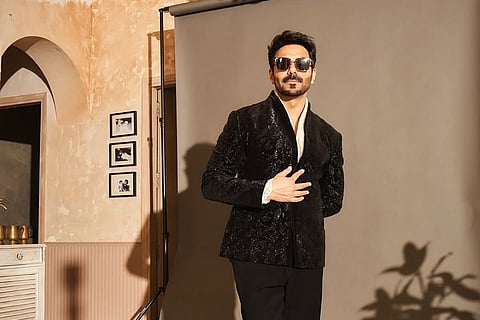
If versatility had a face, it might just be Aparshakti Khurana. One moment, he’s winning audiences over with his effortless comic timing in Dangal and Stree, and the next, he’s lighting up the screen as the flamboyant superstar Binod Das in the period drama Jubilee. Add singer, composer, and RJ to the mix, and you’ve got an artiste who is never one to sit on the fence creatively and is always game to push the envelope.
And now, the Bollywood actor is ready to add another first to the list with his Tamil debut, ROOT. Directed by S Sooriyaprathap, the futuristic sci-fi crime thriller promises to showcase a darker, edgier side to the actor, with his striking look in the film already piquing the curiosity among audiences. Aparshakti seems to have balanced all that brooding mystery with an entertaining time off camera too while in Chennai, effortlessly pulling off the veshti-sattai look and slipping into a yellow cricket jersey like he was born and bred in the Yellove camp.
When we catch up with Aparshakti, he is on his way to pick up his daughter, yet his enthusiasm for finding his feet in Tamil cinema is palpable. He lets us in on ROOT, his upcoming projects, life off screen and why he seems to fit into every universe he steps into.
We begin our conversation with the inevitable question. What made him say yes to the role? “Well, ROOT is a sci-fi thriller revolving around time travel. The look you are seeing comes from a phase in which my character is trapped in a particular period before he travels through time. The aesthetic is inspired by India in the 1940s and 1950s,” begins Aparshakti.
“I was really excited about the opportunity to do something different. I have always loved languages, but Tamil, Telugu and Malayalam have always seemed particularly difficult to master. Having said that, every single line in the film was spoken by me. We did not use anyone else’s voice. In fact, it was written into my contract that I would dub my own lines; otherwise, I would not have taken on the film. The experience of learning a new language was a huge draw for me. I would not claim to have mastered Tamil now, but I can at least say that I have stepped into a world that is very different from what we are accustomed to in Hindi cinema, particularly in terms of language. One phrase I found myself using quite often was 'seekiram, seekiram' (quickly, quickly) in Tamil. Apart from that, filmmaking itself is much the same wherever you go.
When asked whether he follows Tamil cinema and if there are any actors he particularly admires, he says, “Yes, I watch a great deal of Tamil, Telugu, and Malayalam cinema. Everyone has seen and enjoyed major blockbusters such as Baahubali and K.G.F. They are consistently entertaining and visually impressive. However, I also enjoy smaller, more intimate films. I loved Premalu, and I thoroughly enjoyed Super Deluxe, starring Vijay Sethupathi sir. I have immense admiration and respect for the films being made in the South. Given the opportunity, I would love to continue collaborating with Tamil, Telugu, Kannada and Malayalam filmmakers, and I hope I can do justice to their creative vision.”
And if Aparshakti’s Instagram is anything to go by, his time in Chennai has not only turned him from a chai drinker into a full-blown filter kaapi convert, but also given him the chance to explore the city and even catch a CSK match.
“I used to be a tea person, but I’ve now become a filter kaapi enthusiast, almost to the point of addiction. Wherever I go, I find myself seeking out places that serve a good cuppa. Fortunately, Mumbai now has plenty of cafés offering excellent filter coffee. I’ve grown so accustomed to the taste that it has become a regular part of my daily routine. I also tried podi idli for the first time in Chennai and was completely hooked. I was never much of an idli or dosa person before, but now I find myself having them at least twice a week. After spending a month and a half in Chennai, quite a lot has changed; South Indian cuisine has slowly become a staple in my life.”
Moving back to films, we tell him that ROOT director Sooriyaprathap had revealed that he approached Aparshakti after watching his performance in Jubilee, where he portrayed the rise and fall of superstar Binod Das. Asked whether that role changed his perception of fame and stardom, he is quick to clarify, “Not really. I don’t tend to take my characters home with me, so I wouldn’t say the role changed me personally or altered my outlook on life. What it did change, however, was the kind of roles I began seeking out. Before Jubilee, most people approached me for comic roles. While I have always enjoyed comedy, I also wanted to explore more serious and nuanced characters. It simply takes time for people to believe you can do something beyond what they have already seen you do.”
He adds, “I don’t blame the industry for typecasting actors. We all tend to categorise people based on our existing perceptions of them. After my work in comedy, I was fortunate to be offered projects such as Jubilee, Berlin, Dhokha: Round D Corner, and now ROOT. As we speak, I am also filming my first action project, Gunmaaster G9, alongside Emraan Hashmi. I play a negative role in the film, the antagonist. We recently wrapped the Mumbai schedule and will be shooting the next leg in Rishikesh. In between, I also worked on Stree, Badtameez Gill and Jab Khuli Kitaab, which is a slice-of-life comedy. Jab Khuli Kitaab sits very much in that space, with plenty of humour and punchy moments. Badtameez Gill, on the other hand, is a story about a dysfunctional Punjabi family. I believe most Asian families are, in some way, dysfunctional. The comedy, in that sense, arises naturally from those dynamics.”
And that is not all. Aparshakti is also testing waters in Gujarati and Dogri. I’m already in discussions about doing a Gujarati film. In fact, I recently recorded a song in Dogri, a language primarily spoken in the Jammu region. I’ve always been keen to immerse myself in different languages and cultures.”
With Indian cinema becoming increasingly interconnected, collaborations across industries have become far more seamless. Asked whether this has made it easier to work across linguistic and regional boundaries, Aparshakti says, “Absolutely! People are experimenting more than ever before, and I think that’s a wonderful development for everyone involved, not just actors, but also writers, directors, producers, musicians and artistes across the board. It opens up new possibilities for creativity, collaboration and storytelling, which can only be a positive thing for the industry.”
The actor also has a long list of Southern filmmakers he wants to collaborate with. “In Telugu cinema, I greatly admire SS Rajamouli sir for the way he presents his characters and tells his stories. In Kannada cinema, I have immense respect for Rishab Shetty, especially for Kantara, as well as for his work as a producer and filmmaker. I also admire the way Rishab Shetty and Raj B Shetty have helped take Kannada cinema to a pan-India audience. I love Malayalam cinema because artistes there are not confined to a single role. They act, direct, write, and explore multiple creative avenues. I admire the industry’s constant innovation and willingness to experiment. I would love to work with Fahadh Faasil, Dulquer Salmaan, and legendary actors such as Mohanlal sir and Mammootty sir. In Tamil cinema, I deeply admire the legendary Mani Ratnam sir and, among contemporary filmmakers, Lokesh Kanagaraj for his exceptional work in films like Kaithi and Vikram.”
In the meantime, Aparshakti is dipping his toe in the independent music scene as well with Akhri Vaar and Tere Piche. “Music brings out the best in me. I remain actively involved in the space and am always looking to collaborate with emerging musicians. I’m also writing and composing my own songs, a process that has been both rewarding and immen-sely enjoyable.”
With so many plates to spin at once, how does he manage to maintain a healthy work-life balance? “That’s a very important question,” he chuckles. “In the kind of space we are in as artistes, there is a shelf life. Not everyone will be a Bachchan. You cannot work till 85, right? I got my start relatively late in my career. For about 10 years or more, I was doing theatre and radio. So God did take his time in giving me my share of achievements, or the exposure and platform, if I may call it that. Now that I have it, I would like to make the most of it.”
He adds, “These are the working years. Of course, alongside the hustle and the rigour, there is also the desire to give your best creatively. At the same time, spending time with family and looking after yourself is extremely important, and I try to do that whenever possible. My family often visits me on set as well. My wife was with me in Chennai when I was shooting ROOT. That said, there are days when you are simply not available for your family because it is very much a one-person show. You cannot send a proxy. I have to be there myself. It is a tricky situation and not always easy to navigate. Every profession has its pros and cons, especially those where the individual has to be physically present to perform the work, be it an actor, a director, a writer, or even a lawyer, for example. In such roles, your team cannot always step in for you. It is not like a job where you can take a month off and step away completely. Of course, you do crave time with your family. But whenever I do get time, touch wood, as things have been going well so far, I try to make the most of it.”
For more updates, join/follow our
https://www.whatsapp.com/channel/0029Vb677uz60eBXiDYheb0n