
- LIFESTYLE
- FASHION
- FOOD
- ENTERTAINMENT
- EVENTS
- CULTURE
- VIDEOS
- WEB STORIES
- SPORTS
- GADGETS
- CAR & BIKE
- TRAVEL
- SOCIETY
- GALLERIES
- NORTH EAST
- INDULGE CONNECT

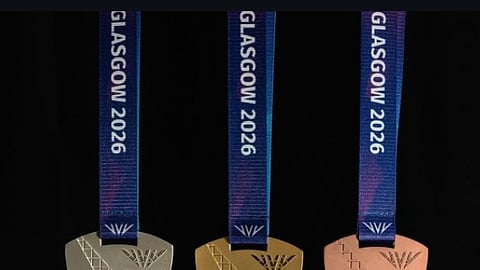
The Commonwealth Games 2026 is historic in more ways than one. While much has already been talked about how the Games ended up being hosted by Glasgow, Scotland, how a number of crucial sports have been slashed due to last-minute arrangement issues, how the King and Camilla entered through a Doctor Who’s Tardis and more, this time, we take a look at the winning medals. While the medals come in three categories – gold, silver and bronze, there are significant design changes and additions which make this year’s medals, go down in history.
The Commonwealth Games took an inclusive stand when it included para-athletes in the competition. Taking another inclusive stand this year, the medals have been so designed that it contains Braille notations for the visually impaired to still feel and understand their achievements. Apart from that, the medals also include tactile elements which have not only improved the quality of the medals but also elevated their status.
These tactile elements give the medals a raised feeling so that one can easily differentiate and recognise them, just by touch. While the overall texture creates a deep sensory understanding the Braille notations identify the medal type for the owner. Although this type of design isn’t uncommon for para-athletes, from this year it is a mandatory design in all medals across competitions.
A slight change in the medal design goes a long way to say about the thought process of the designers and curators of the championships. Not only does this stance promote inclusivity but also sets a new standard for sports medal design. Accessibility becomes crucial rather than an add-on. The design edit also promises how, with time, the Commonwealth Games are evolving and considering every aspect of participation where diversity is a mandate and not an option. Moreover, a brilliantly made medal becomes an emotional keepsake for the athletes.
Who designed the medals this year?
This year, the medals have been designed by Militsa ‘ Milly’ Milenkova a Bulgarian artist, designer and silversmith based in Glasgow. To her credits, she is also an Artist-in- Residence at The Glasgow School of Art. Her practice revolves around memory, identify and the nostalgia attached to everyday objects. She was actually chosen through a medal –designing competition rather than being directly commissioned for the same. The incorporation of Scottish symbolism – the Reuleaux triangle, city’ coat of arms, Finnieston Crane, tartan, and Braille features are the distinguished features of this year’s medals. While Militsa designed the medals, they were produced by heritage medal makers Toye, Kenning & Spencer.
For more updates, join/follow our WhatsApp, Telegram and YouTube channels.