
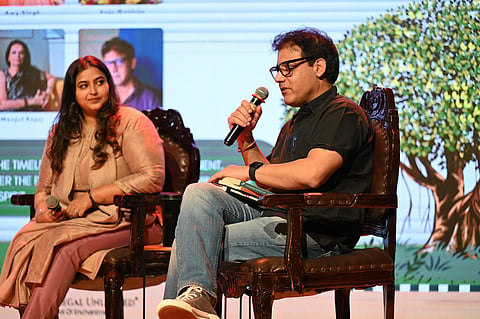
Bengaluru Poetry Festival celebrates 10th edition with voices from across India

As the Bengaluru Poetry Festival marks its 10th edition, the city is once again preparing for a weekend filled with verse, music and conversations that celebrate the many voices of Indian poetry. Since its debut in 2016 — the festival has grown into one of Bengaluru’s most loved literary events. Ahead of this milestone edition, cofounder Subodh Sankar reflects on the festival’s journey, how India’s poetry scene has evolved over the years and what visitors can look forward to this weekend.
This is the 10th edition of the Bengaluru Poetry Festival. Looking back, what are some moments that have stayed with you over the years?
There are too many to count. Every year, there is a different kind of magic that happens. That’s the beauty of this festival. You may know poets by name or reputation, but when they come on stage and do what they do best — something unexpected happens. That’s what I look forward to every year. I can’t point to one, two or three moments because every edition has created its own magic.
From the time you started the festival, has that vision changed over the last decade?
We started with a very simple vision. Poetry as an art form never really got enough space at literature festivals because fiction and non-fiction naturally took up more attention. We wanted to create a platform that was exclusively for poetry and give it two full days to shine. Ten years ago, we honestly didn’t know if it would survive. We knew we could convince poets to come to Bengaluru but we weren’t sure if people would attend. The fact that we’re here a decade later is entirely because of the audiences in Bengaluru. The vision hasn’t really changed. It is still about creating a dedicated space for poetry.
This year’s festival brings together poets writing in many Indian languages. Why was that important?
Every year we’ve featured Indian writing in English, Kannada and Hindi, along with a few other languages. But this year, because it’s our 10th edition, we consciously wanted to represent as many Indian languages as possible. Personally, I listen to more poetry than I read because I love hearing poets read their own work. Even if you don’t understand every word, there is a beauty in the way a language lands in your ears. I remember hearing Odia poetry for the first time. It was so lyrical that it moved me. We wanted audiences to experience that beauty across many languages.
Spoken word poetry and social media have made poetry more popular among younger audiences. Has that changed how you programme the festival?
Not particularly. It doesn’t change the programming, but every year we have to embrace new ways in which poetry is written and consumed. That’s simply evolution. Our job is to bring the best voices we can find to audiences in Bengaluru, whatever form their poetry takes.
Bengaluru is often seen as India’s tech capital. Do you think its literary and cultural side gets overlooked?
I actually think Bengaluru is becoming the cultural capital of India. It’s beginning to rival Delhi, Mumbai and Chennai — not just in one art form but across literature, theatre, music, dance and visual arts. Ironically, I think technology has helped. The arts need patrons. People can only become patrons when they feel secure in their own lives. The tech industry has created that comfort for many people. They’re now willing to spend their time supporting the arts and that culture of patronage is encouraging the next generation to read, write and participate in several creative pursuits.
As the festival enters its second decade, what would you like people to remember it for?
I want people to remember the magic they experienced on stage. That’s all. This year, we’re bringing renowned Hindi poet Naresh Saxena and we’ve been receiving two or three calls every day asking whether he’s definitely coming. He’s over 85 — doesn’t use email, WhatsApp or social media, yet people are eagerly waiting to hear him. That kind of love for an artiste makes everything worthwhile. Art never ceases to amaze me. There’s magic waiting at every corner. That’s also why I worry when arts education is pushed aside. The future belongs to people who can think creatively. An engineer with an arts education becomes someone who can imagine and create, not just follow instructions. We need to invest in the arts so that future generations don’t lose that ability. I truly believe Bengaluru can be known not just as India’s IT capital, but also as its new and upcoming cultural capital.
Entry free. August 1 & 2. At Indiranagar Sangeetha Sabha.
Email: alwin@newindianexpress.com
X: @al_ben_so