
- LIFESTYLE
- FASHION
- FOOD
- ENTERTAINMENT
- EVENTS
- CULTURE
- VIDEOS
- WEB STORIES
- SPORTS
- GADGETS
- CAR & BIKE
- TRAVEL
- SOCIETY
- GALLERIES
- NORTH EAST
- INDULGE CONNECT

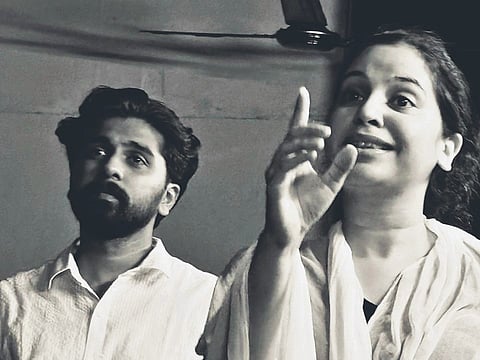
Sometimes the deepest human connections come from the most unexpected places, a park bench, an art gallery, an airport lounge. Water Lilies, written by Gowri Ramnarayan and directed by Krishna Kumar, presents three such imagined encounters. Each short play captures a moment suspended in time, where strangers from different corners of the world open up to each other in ways they perhaps never could with the ones they know.
“It has good characters, it has narration, it has its moments of drama, it has its moment of reflection, it has its moment of banter and humour, it has nuances, it’s a well-written play. And the way Gowri had staged it was also beautiful,” Krishna shares.
First staged in the early 2000s, Water Lilies returns to the spotlight because of how deeply it resonates in today's divided, post-pandemic, post-truth society, where empathy and curiosity often feel radical. The director says, “It talks about something deeply disturbing, geopolitical things which are still relevant.” But the geopolitical context is never heavy-handed. “In fact, they are triggered as a response to something very small and personal that one of the characters asks the other, that’s the playwright’s artifice, to transition from one moment to another,” he explains. Each shift in conversation, from birds to war, or Monet to memory, feels organic, a reflection of the spontaneous intimacy that can unfold between strangers. “Why do I think the anonymity of meeting strangers allows for a certain opening up of one's vulnerability? Well, it’s the case in real life… Sometimes you’re sitting in a bus stand or waiting in a lounge, and without realising, you end up sharing your deepest fears, insecurities, anxieties,” he reflects.
Actor Prasanna Rajaram, who plays one of the strangers, calls his character “quite pragmatic and a realist… despite going through difficult situations in life, he still finds humour in them. He thinks he is open-minded until he realises he is not. Yet he is open enough to hear the other person, even change perspectives.” When he first read the script, he says, “This was the only character I wanted to do. We had zero similarities and that intrigued me. The blurring of realities and imagination was quite interesting.”
Across the three vignettes, Fawn Lilies, Water Lilies, and Black Lilies, we meet a woman and a man in each, strangers who cross paths in a public space: a park in Columbus, an art gallery in Houston, and a blackout-stricken airport just after 9/11. Their dialogues shift from casual to confessional, from light-hearted to philosophical. “In theatre, everything is possible with enough rehearsals,” says Prasanna, crediting his co-actor Malvica Sawhney for helping him “identify the POV of the character” and their director, KK, for guiding them. “The only way to show that level of emotional shift in 30 minutes is by actively listening. Even in real life, there is a dearth of people willing to listen to another person. When you listen, you understand each other better.”
Actor Subh Mukherjee, who performs in another vignette, adds, “It is a lot more about reacting and responding rather than just being ready to say your lines. That’s a very basic rule we follow… In regular life, we listen to somebody and then we respond in a certain way. It’s not pre-planned, it’s quite in the moment.” For him, carrying the emotional weight of the play also means maintaining a delicate balance: “I, as Shubh, do not carry the weight because I’m not him. The character carries the weight. But since I’m embodying the character, I have to reflect everything the character carries… While I’m playing the character, if I focus on the audience and play to the gallery, I let go of the authenticity the character would reflect otherwise.”
For both actors, the play’s theme of strangers sharing their deepest truths hits close to home. “Sometimes, we let our guards down with people whom we feel will harm us the least possible way,” Prasanna says. “The sense of security that we will very likely never meet them again helps us to be more open.” Subh agrees: “Maybe there’s nobody else listening and they feel it’s a safe place to open up and say what they want to say.”
“So there is definitely something for every kind of theatre-watcher,” Krishna says. “If someone comes for some light-hearted moments, they’ll take away. If someone’s a poetry buff, they will take away some nice poetry. If someone is looking for layers and nuances, they will take away that.” Though disconnected in plot, the plays are unified by ideas of transience, trauma, memory, and the quiet radicalism of listening. It’s a story of riding out the rough times, not with denial, but with dignity. “Even the evil in the end gets embraced into goodness. That, I think, essentially is the difference between Eastern and Western philosophies. Our philosophy accommodates even the worst sins and tries to give them a positive direction.”
In that light, Water Lilies also becomes a celebration of tenacity, especially among its women. “Gowri’s characters have always been like that, no?” Krishna smiles. “Her women are strong without forsaking tradition. They’re rooted in culture, yet modern and adaptable. That’s against the men who are grappling with the blackness that life throws at them.” These roles, often orthodox on the surface, unravel into layered portraits of resilience and grace, quietly pushing back against chaos with compassion. Perhaps the play doesn’t offer an antidote, he says, “but it clearly brings across a message, that there’s nothing wrong in opening up and talking to people.” In times like these, maybe that’s enough.
Rs 325 onwards. August 9, 3.30 pm. At Medai-The Stage, Alwarpet.