
- LIFESTYLE
- FASHION
- FOOD
- ENTERTAINMENT
- EVENTS
- CULTURE
- VIDEOS
- WEB STORIES
- SPORTS
- GADGETS
- CAR & BIKE
- TRAVEL
- SOCIETY
- GALLERIES
- NORTH EAST
- INDULGE CONNECT

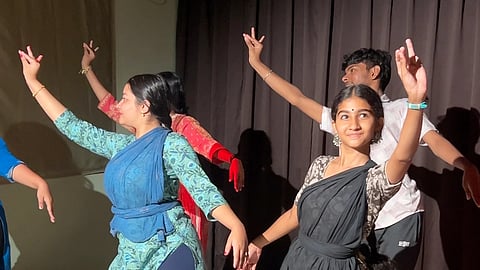
Swarnamalya, dancer, actor, and researcher, has built an entire theatre, music, and dance production around this very mischievous question. The Celestial Congress – A Madras Masala, presented by the Ranga Mandira Sadir Melam ensemble, premieres with over twenty young performers taking on gods, reformers, and mortals in a satirical retelling of history this weekend.
The script draws from Sarva Deva Vilasam, a 19th-century Telugu satire that poked fun at the hypocrisies of colonial Madras. Swarnamalya, who has studied the text for years, reimagines it for today. “The work itself is a farcical take on the changing life of a city,” she explains. “More than critiquing multiculturalism, it critiques the hypocrisy that comes with it. That’s not very different from how one might see the world even today—especially in a city like Chennai, which is always balancing tradition and modernity.”
The production leans into that tension, asking questions about adaptation and identity. “Who is adapting, how are we adapting these cultures into our own, and for what reason, that’s constantly under scrutiny,” she says.
Expect reformer gods like Lakshmi and Saraswati to trade sharp words, alongside whimsical figures such as Apollo Rao, a Greco-Telugu hybrid inspired by real personalities of the 19th century. Each scene of the performance is layered with music drawn from different traditions: devadasi compositions Swarnamalya learnt from hereditary artistes, Irish and Celtic tunes, Tamil rap, and even the British national anthem—translated into Sanskrit for King George V’s 1911 visit. The eclecticism is deliberate. “We are a dance and music ensemble,” she says. “The repertoire itself becomes part of the satire.”
The fusion of forms is central to her vision. “Theatre, dance and music move as one in this piece,” says Swarnamalya. “Our actors slip in and out of roles, switching from character to dancer to musician, so the form itself mirrors the chaos of the world we’re staging.”
For Swarnamalya, it was also important to preserve the integrity of classical traditions while adapting them for a contemporary satire. “The story moves through these traditional pieces. It’s not patchwork,” she explains. “When you watch it, you will see that the music and dance are almost beckoned into play by the dialogue. There’s continuity between the theatrical element and the dance element.”
The play, she says, is not just humorous but reflective. “The best way to hold a mirror to ourselves is to also be able to laugh at ourselves,” she notes. “Sometimes you’ll see a character and be reminded of a neighbour or a Mylapore mama or mami. It’s like taking a walk through your city, its people, their quirks, and their values.”
For the cast, the play has been eye-opening. Pavitra, who plays Brahma, describes the challenge of embodying a largely silent figure obsessed with retranslating the Vedas into Queen’s English. “ I learnt that a character can say a lot even without having to speak. Their mannerisms, their reactions matter a lot. And during the process of the production I realised how much colonial rule shaped our lives and continues to echo,” she says.
Behind the scenes, the production is also a platform for fresh voices, including Sunil, a debuting light designer from a marginalised background. “It is about Madras, but also about today,” Swarnamalya concludes. “It reminds us to laugh, to question, and to remember where we come from.”
Ultimately, what does she want audiences to take away? Laughter, nostalgia, discomfort, perhaps all of the above. “It’s about celebrating plurality, diversity, and multiculturalism,” says Swarnamalya. “To think of ourselves as monochromatic would be a huge mistake. We are a patchwork of borrowed, assimilated, and adapted cultures. The play reminds us to laugh, to question, and to remember where we come from.”
At ₹200. On August 30 at 4 pm. At Medai – The Stage, Alwarpet.
For more updates, join/follow our WhatsApp, Telegram and YouTube channels.