
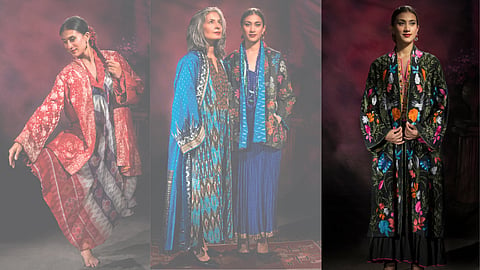
From ikat to bandhini: Sonam Dubal’s Banjaran threads global craft narratives

The story of the wandering banjaran—collecting textiles, pieces of ornamentation, embroidery, and adorning colour through jewellery and tattoo—comes alive in celebrated designer Sonam Dubal’s Banjaran (Gypsy): Dance of Textiles – Transeasonal 25/26. Sonam’s two-decade-old label, Sanskar, is globally acclaimed for its experiments in redefining traditional Indian silhouettes and textiles in Indo-Asian shapes.
The banjaran spirit: Sonam Dubal’s new collection pays tribute to Gypsy muses
“This is a tribute to Gulabi, the banjaran, and Shady Zappa—my two gypsy inspirations through the years who have deeply influenced my work. Gulabi lives in camps on the outskirts of Delhi, and Shady is a Roma gypsy from Europe, one of my first eclectic friends who opened my eyes to the wonders of travel, craft magic, dreamscape, and storytelling,” shares Sonam, who is in Chennai for the showcase.
Playing with colours and different weaves, this story of movement and cultural linkages has been artistically captured by artist-photographer Ajay Shanker, featuring dancer and model Shreyasi Gopinath and style icon Deepa Gopinath.
Sonam, who is showcasing his collection at Amethyst Chennai, shares more about Banjaran in this interview:
You’ve said that this collection is a tribute to two gypsy spirits—Gulabi and Shady Zappa. Who are they to you beyond muses? How did they shape your imagination?
Shady Zappa, whom I met in my mid-20s, is one of my closest friends who deeply influenced my mind through his choice of books, stories, films and experiences. He was a Roma gypsy who spoke of travel, dreams and adventure, and inspired me to find my way to Europe, which I did after my first job with the vanguard of fashion in India, Rohit Khosla.
Much like the film, The Dreamers by Bernardo Bertolucci, I got deeply entrenched in an evolving experiential life, authenticity and the language of design trying to find purpose having studied fashion and the intricacies of style and aesthetics. It felt natural to live through styling campaigns and textile art projects at the time.
Six months ago, as if by magic, I met Gulabi on the road—an old, statuesque banjaran with a forehead tattoo, who spoke of dreams and seemed to be the head of her tribe. As we shared a conversation and chai, she reminded me of another friend I had long forgotten. The nomadic spirit resurfaced, and I felt a deep connection with her. It was as if the gypsy spirit had come alive again while working on this line.
As someone who has always lived between worlds—spiritual, geographical, and cultural—how has this ‘in-between-ness’ defined your aesthetic?
I have always lived between worlds having grown up in a mixed cultural heritage — my Buddhist, Tibetan, Sikkimese mother, and Maharashtrian father, and have always felt comfortable much like a nomad living between places. (I grew up between the Himalayan mountains in the tea gardens in Darjeeling, Assam, and Sikkim and Goa where my father’s family live.)
My design journey became an internal balance through a prism of colour, pattern and aesthetics that I seemed to gravitate to. People have also deeply influenced me through the years from my travels from different fields of life, specially women patrons through the years.
Today, I live between noisy, chaotic Delhi and quiet, tranquil Pondicherry—both are home to me. This in-between-ness has become part of my aesthetic sensibility and spiritual grounding.
You’ve often drawn from Buddhist philosophy.
From the very beginning, I was drawn to my own Buddhist philosophy and began working with the concept of recycling brocades, upcycling textiles, and using natural woven materials like eri silk and ikats—long before it became a buzzword in sustainable fashion.
Since 1999, the foundation of my work has been about being mindful—respecting craft techniques, creating employment, and regenerating without waste. Each collection reflects this ethos, and my textiles embody compassion.
Over time, the collections have evolved into a mix of textiles and weaves that exude quietness—even in their embroidery and patterns. Every piece is handcrafted with love, detail, and a story.
The title itself, Dance of Textiles, feels like a performance.
Dance of Textiles refers to the interplay of tribal embroidery with cotton and silk ikat in vibrant, powerful colours—like a performance on stage. There’s always a story behind my garments.
For instance, working with azul (Spanish for blue), I combined firoza, aasmani blue ikat silk, blue embroidery in wool, and actual turquoise stones sewn into patterns inspired by the Central Asian Silk Route. The result is an elaborate ensemble—an ikat tunic, kimono, and kaftan—that metaphorically brings the sky and sea together.
How did you interpret the idea of movement into the silhouettes and textures of this collection?
Over the years, I’ve worked with Pan-Asian silhouettes, using textiles that absorb and reflect colour through the elements of life. Through structured and draped styles, I introduce movement by using natural vegetable dyeing techniques, tribal embroidery, and handcraft processes.
This collection plays with vintage ikats, eri silk, bandhini, and tribal embroidery. How did you orchestrate harmony between these diverse weaves and traditions?
I’ve always loved textiles, and I try to connect stories through patterns and colours—offering a new dimension for the wearer. I find home in diversity, harmony in differences, and love across borders. It’s this playful balance of colours and motifs that binds the diverse weaves and craft traditions together.
The mythic Bird of Paradise features prominently—what does this symbol mean?
It represents hope and protection for the gypsy spirit. To love and protect all sentient beings—nature, animals, and their habitats—is part of our responsibility. In today’s world, with rampant environmental destruction driven by greed and self-centeredness, the benevolent Bird of Paradise arrives to remind us of our duty to Mother Earth.
From Lakmé to Paris to Vancouver, your journey has been anything but linear.
My first show was in 2003 at Lakmé India Fashion Week. That fall collection retailed in Paris and London later that year. In 2006, I showcased at Australian Fashion Week in Sydney.
In 2012, I travelled to America with my anthropologist-representative, Gail Percy, and presented at Asia Society in New York, which was a defining moment. I later showed at Eco Fashion Week in Vancouver in 2016–17—one of the first Indian designers to do so.
Around that time, through my representative, I also worked on costumes for Italian actress Isabella Rossellini for the Hulu series Shut Eye. I’ve always been a student of life, learning through travel, people, and experience.
If Banjaran is a love letter to the past, what would your love letter to the future look like?
The global nomad, the luxury vagabond—that’s my love letter to the future. Where routes become your roots, and you carry your tribe with you. Simplicity becomes your global language, creating unity in diversity as part of your very essence.
Price starts at Rs 7,000. 11 am to 7.30 pm. Till August 3, 2025. At Amethyst, Whites Road, Royapettah.
—manuvipin@newindianexpress.com
@ManuVipin
For more updates, join/follow our WhatsApp, Telegram and YouTube channels.
https://whatsapp.com/channel/0029Vb677uz60eBXiDYheb0n