
- LIFESTYLE
- FASHION
- FOOD
- ENTERTAINMENT
- EVENTS
- CULTURE
- VIDEOS
- WEB STORIES
- SPORTS
- GADGETS
- CAR & BIKE
- TRAVEL
- SOCIETY
- GALLERIES
- NORTH EAST
- INDULGE CONNECT

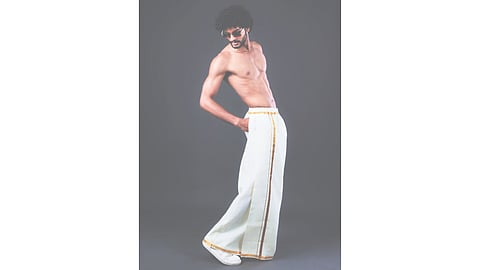
If you’re trying to understand what Purushu Arie’s latest collection is all about, and you don’t speak Tamil or know much about its literary and cultural history, you might feel a little lost at first. With titles like Mozhi Mann Maatram, Aadhi Mozhi, Keeladi, and Semmozhi, the language may feel abstract. But look closer, and you’ll see. It’s not about complicating fashion—it’s about decolonising and demystifying it.
Purushu’s mission is to preserve heritage handlooms not as static artefacts, but as living, evolving textiles with relevance. “I want the money I make to directly contribute to modernising the industry,” he says. “These industries are unorganised, scattered, and often held together by family-run labour. Loss of eyesight due to poor working conditions is common. I work with heritage textiles because the weavers deserve scale, dignity, and a future. Not to be reduced to a cultural badge for elite shoppers.”
Remixing tradition with street culture
To achieve that, Purushu doesn’t just design—he deconstructs and reconstructs. His streetwear blends classical Tamil identity with contemporary rebellion. Think Madras checks styled with upcycled, distressed denim; oversized tees hand-painted with slangy Madras baashai slogans paired with manjappai totes and koodai pinnal baskets. It’s Tamil pride with a punk spirit—assertive, layered, and boldly cosmopolitan.
In Mozhi Mann Maatram (Language, Soil, Change), Purushu traces Tamil identity through linguistic evolution—from Aadhi Mozhi (The primal tongue), to Semmozhi (classical language), to Theru Mozhi (The street language). Language, in his universe, isn’t just spoken—it’s worn, lived, and reinterpreted.
From Keeladi Graffiti to Streetwear
Graffiti from Keeladi, an archaeological site revealing the earliest known Tamil script, becomes print motifs. Fabrics are naturally dyed and handwoven, in hues like turmeric yellow, terracotta red, neem green, kora white, and iron black. Their textures—cracked, grainy, hand-crumpled—evoke the rawness of the earth.
While classical Tamil is often portrayed through temple art and royal courts, Semmozhi by Purushu reclaims the forgotten aesthetics of the everyday—kummi dance, fisherfolk hymns, women planting saplings—folk cultures that survived in the streets, not just the scriptures. Madurai cottons, Rasipuram silk-cottons, and Vanavasi weaves with zari borders pay homage to this culture that thrived among common people.
Not romanticising but reimagining
“Unlike Gandhi, Dr BR Ambedkar didn’t romanticise handlooms—he critiqued their reliance on caste-based exploitative labour. He advocated for fair wages and safe working conditions. That’s often missing in our traditional sectors even today,” says Purushu. “I don’t glorify craft as cultural nostalgia. For me, it’s about the lives of craftspeople—mostly Bahujan workers—who are systemically neglected.”
Founded in 2017, his label was among India’s first to be explicitly gender-neutral, inspired by the gender fluidity already present in Indian textile traditions. “Back then, people dismissed gender-neutral fashion. Today, many understand clothing has no inherent gender,” he reflects.
His silhouettes are practical, never ornamental. Tailored anti-slip lungis and veshtis come with elastic waistbands, drawstrings, and side pockets. The Pudavai Dress offers the visual appeal of a sari but is fully tailored, complete with functional side pockets.
Destruct. Construct. Protect.
“My design process follows three principles,” he explains. “Construct technical upgrades that serve lives. Protect ecological and indigenous knowledge systems. Destruct casteist, classist structures in clothing—who wears what, and why.”
So has he reinterpreted traditional motifs for modern or global tastes? “Yes, but not for trends. It’s about relevance. Our Freedom Shirt, for example, is oversized and cut from a veshti. That’s tradition reimagined by logic, not embellishment. Tradition isn’t meant to be frozen; it’s meant to evolve. It already has. This is just the next step.”
— manuvipin@newindianexpress.com
For more updates, join/follow our WhatsApp, Telegram and YouTube channels.
https://whatsapp.com/channel/0029Vb677uz60eBXiDYheb0n