
- LIFESTYLE
- FASHION
- FOOD
- ENTERTAINMENT
- EVENTS
- CULTURE
- VIDEOS
- WEB STORIES
- SPORTS
- GADGETS
- CAR & BIKE
- TRAVEL
- SOCIETY
- GALLERIES
- NORTH EAST
- INDULGE CONNECT

For designer Payal Jain, fashion is more than design—it is rooted in heritage, refined through experience, and guided by purpose. Her journey began in Delhi’s culturally rich lanes, where a childhood surrounded by art, classical music, and Indian tradition shaped her instinct for balance, form, and beauty. This foundation deepened at the Fashion Institute of Design and Merchandising (FIDM), California, and began defining her design voice—one that seamlessly bridges Indian heritage with global sensibilities.
After returning to India in the early 1990s, she built her atelier from the ground up, without the scaffolding of fashion weeks or organised retail.
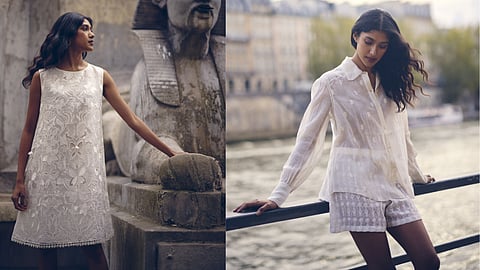
Today, her label is celebrated for quiet elegance, architectural silhouettes, and a deep commitment to sustainable fashion in India. Her latest collection, Paris Mon Amour, is born from her love affair with the Arrondissements and Avenues of Paris. After decades of walking down bustling boulevards or sipping endless cups of coffee in quaint cafés, she continues to be fascinated by the world going by, as one can only be in Paris, the most fashionable city in the world!
“This collection is inspired by the Parisian men and women, who walk past unhurried yet magnetic, perfectly tuned out to the most minute details, with poodles on their arms, espresso in their hands, and an effortless sense of style, almost like models gliding down the runway,” she tells us.
In this collection, she brings that spirit home, weaving it with the timeless textiles and crafts she holds closest to her heart. Light, breezy Katruan cotton from Banaras with Zari accents, Chikankari phanda and murri render delicate floral motifs on ivory mulmul, hand-stitched lace stacks, elaborate cutwork compositions on cotton, tone-on-tone beadwork, and layered appliqué with fringe details in denim—all this and more add a fresh quality to this collection.
“Respecting the purity of craft is always my priority. We retain the handmade essence—the subtle irregularities, the human touch—that makes each textile unique. To make them relevant globally, we translate these traditions into modern, understated and timeless designs. The light, breezy fabrics and delicate embroidery are presented in silhouettes that feel effortless, fresh, and contemporary, appealing to an international audience without losing their essence and soul,” she explains.
So what was the creative challenge in bringing Parisian minimalism into conversation with Indian maximalist craft traditions? “The challenge was knowing when to stop—Indian craftsmanship naturally celebrates abundance, so restraint was key. I kept the colours subtle and silhouettes simple, letting the rich textiles and intricate embroidery, and hand-stitched details shine without overwhelming the design. It was about highlighting craft while maintaining a sense of lightness and ease,” shares Payal.
Her atelier works closely with women-led artisan clusters and master craftspeople. And this has shaped her creative decisions. These collaborations are central to her work. “I see myself as a bridge connecting their traditional artistry with contemporary fashion, ensuring their craft reaches new audiences,” she adds.
She is particularly interested in the revival of Indian’s crafts and techniques, especially the Kadhua weaving technique. “The level of craftsmanship that is required to keep this tradition alive is slowly vanishing and weavers are moving to easier and faster techniques due to fierce competition from mass-produced, cheaper power loom textiles and lack of interest of younger generations in hand woven textiles. The survival of Kadhua weaving is crucial for preserving India’s textile heritage, supporting the livelihoods of communities, and promoting handcrafted luxury in a market increasingly exploding with fast fashion. We have been working with this technique for years and constantly keep creating new and modern interpretations of traditional motifs, sustaining the well being and longevity of the clusters we work with,” says Payal, who sees a move towards more relaxed, easy, free flowing silhouettes, which speak of comfort and gender fluidity.
With more than three decades in the industry, Payal’s aesthetics has evolved over time, and has become calmer, more thoughtful, and introspective. She adds, “Today, I design for a woman who is confident, graceful, and embraces her inner strength. She values authenticity, comfort, and the care behind every little detail.”
For more updates, join/follow our WhatsApp, Telegram and YouTube channels.
https://whatsapp.com/channel/0029Vb677uz60eBXiDYheb0n