
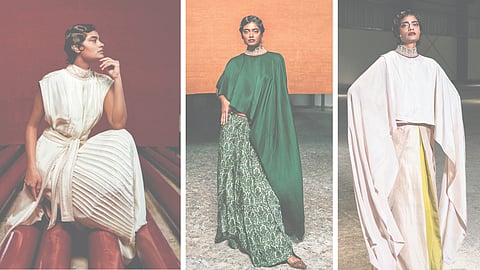
Anand Kabra’s Senkei’ blends Japanese minimalism with Indian handcraft for festive 2025

Anand Kabra presents a collection rooted in heritage and improved by restraint. Just in time for the festive season, he brings to Chennai, Senkei— inspired by Japanese minimalism, woven with the richness of Hyderabad’s handcraft traditions. The ensembles are a study in contrast—fluid yet structured, ornate yet simple.
Inspired by Japanese minimalism, crafted with Hyderabadi artistry
Senkei unfolds in two moods—festive radiance and evening elegance. From burnt lace to French knots, every stitch honours craftsmanship honed over decades. The designer shares rare insights into his inspirations, contradictions, and the cultural influences that shape his work.
What drew you to this particular combination of Japanese minimalism and Indian craftsmanship?
I’ve always been attracted to contrasts and contradictions. In Senkei, I was most intrigued by finding the right balance between Indian richness and Eastern simplicity. I also value the impact of negative space.
How do you define the structural “ease” that runs through this collection? What does that balance between fluidity and form mean to you?
As I’ve mentioned before, I’m most drawn to the beauty of contradictions. In Senkei, the silhouettes are linear yet fluid, mirroring the pace of the modern woman. She looks for comfort that feels effortless without sacrificing sophistication.
What role does fabric play in shaping your silhouettes?
Fabric is always the base of a garment. Choosing the right weight and weave for each silhouette is key. I naturally prefer pure fibres like silk and cotton—their strength, richness, and depth of colour are unmatched. The feel of the fabric is also crucial; how it touches the skin is, for me, the truest expression of luxury.
Cord detailing, tonal layering, hand embroidery... Tell us about the craftsmanship behind this collection and the artisans who realise your vision.
These are signature techniques we’ve developed over time. In Senkei, we looked into burnt lace, a modern take on Hyderabadi zardozi, and exquisite ektaar embroidery highlighted with French knots. Each piece is created by local artisans, with every embroidery developed entirely in-house.
Japanese aesthetics often emphasise “Ma”—the beauty of space and stillness. How does that philosophy show up in Senkei?
The essence of Senkei lies in negative space. The ensembles are decorated only with minimal embroidery to enhance the silhouette or break monotony. This balance is reached through contrast panels, knife pleats, and subtle colour accents alongside embroidery.
Your roots in Hyderabad craftsmanship run deep. How did you achieve harmony between the ornate and the simple in this collection?
The challenge was to find a delicate balance between maximalism and minimalism. It required time, perspective, and a careful editing process to reach the final expression.
Do you see Senkei as a comment on how occasion wear is changing for the modern Indian?
I have continually sought to redefine the codes of Indian clothing—moving it away from the limits of costume to versatile pieces that can be mixed, matched, and styled to express the wearer’s personality and mood.
From your debut collection to now, how has your perspective as a designer evolved—especially in how you interpret cultural overlaps?
I see this as the second chapter of my career. The first was about exploration and finding my voice. Now, I design with more confidence—a clear language, a distinct style, and a strong vision for Indian fashion.
If Senkei were a mood, a scent, or a moment in time, how would you describe it?
The closest comparison I can make to Senkei is the burning of camphor—pure, strong, and deeply spiritual.
What makes this showcase special for you?
We have a long-standing relationship with Collage, Chennai, and it’s always a privilege to collaborate with them. Their attention to detail is remarkable.
What kind of woman do you envision wearing this collection—and how does the Chennai audience connect with that identity?
She is a strong individual—independent, free-spirited, and rooted in tradition, yet brave in embracing modernity. She values quiet luxury and has a sophisticated style. To me, my Chennai clientele perfectly embodies this spirit.
As fashion increasingly embraces quiet luxury and cross-cultural stories, where do you see the future of occasion wear?
Occasion wear is changing—globally influenced, rooted in tradition, and refined for today’s lifestyle: simple, stylish, and relevant.
What’s next? Any new directions on the horizon?
My focus now is on building a fashion brand with a clear voice and lasting style—one that resonates with today while shaping the future of Indian fashion.
Price on request. Available at Collage, Rutland Gate, Nungambakkam.
—manuvipin@newindianexpress.com
@ManuVipin
For more updates, join/follow our WhatsApp, Telegram and YouTube channels.
https://whatsapp.com/channel/0029Vb677uz60eBXiDYheb0n