
Sunita Shanker on bandhani, sustainability, and designing beyond seasons

Sunita Shanker has never believed in chasing seasons. For a designer whose practice is deeply rooted in craft and long-term relationships with artisan communities, clothing has always been about longevity rather than trend cycles. Her latest showcase in the city, while presented as a Spring–Summer edit, continues this philosophy—offering garments designed to be worn, reworn, and reinterpreted across time.
Three decades of working with artisan communities
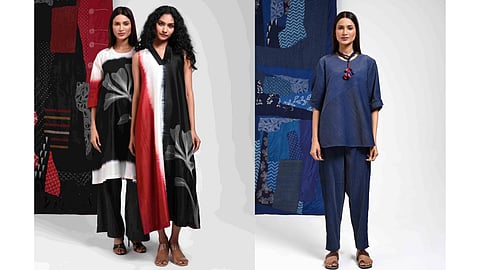
Titled Chromatic Minimalist, Watercolour Series–2, and Clamp Dyed, the collection brings together three distinct yet seamlessly interlinked explorations of colour, texture, and form.
Sunita Shanker talks to us about her latest showcase, why sustainability is more than a buzzword, and reinterpreting craft for the modern connoisseur.
This showcase is being presented as a Spring–Summer edit, but you’ve often said you don’t really design seasonally. Could you tell us more about that?
I don’t really work with the idea of seasons in the conventional sense. I work extensively in the craft sector, and when you’re working with hand processes and rural artisan communities, everything is time-consuming and deliberate. There’s a certain aesthetic and value to these garments that goes beyond a specific season. I believe craft needs to be valued over time, not confined to trends or seasonal forecasts. At best, I may think in terms of wearability—something that feels comfortable in summer or works well layered in winter—but I don’t follow colour forecasts or trend reports. I don’t believe in that approach.
This curation brings together multiple lines. How do these collections come together?
What I’ve done is restrict the colour palette for now, and I’ll introduce more colours later. Chromatic Minimalist is built around strong, solid hues—reds, blues, and ivory—worked on pintucked cotton. Each piece stands on its own. The Watercolour Series is dip-dyed and has stitched floral motifs placed very strategically. It gives the feeling of drawing on textiles—almost like working with watercolours on paper. These are more limited, individual pieces like tunics and shirts. Clamp Dyed, on the other hand, brings in a sense of freshness and exuberance. The silhouettes are relaxed and fluid, and the technique itself creates a very organic, spontaneous feel.
There’s a strong sense of mix-and-match across the collections. Was that intentional?
Very much so. While I’ve styled the garments in a certain way for the photographs, the idea is to give people the freedom to combine anything with anything. You could pick a top from the Watercolour Series and wear it with pintucked trousers, or layer a clamp-dyed overlay over a skirt. It takes time to design pieces that work across collections, but it makes dressing easier and more intuitive. You’re not forced to buy a full look—you get more wear out of each piece.
How does this differ from your earlier work?
Conceptually, it’s not very different. What has changed is that this edit is far more concise. I’ve worked within a tighter framework of three looks that can be worn in multiple ways. Pintucking, for instance, is not just a surface detail—it adds texture, strengthens the fabric, and gives longevity to the garment. These are staples. You can wear them with pieces you already own; they don’t demand a complete wardrobe overhaul.
Your use of colour—especially in techniques like bandhani—feels like a departure from tradition. Is that intentional?
It has always been a departure. The reds, blues, blacks, and ivories I use are not traditional Indian colours in the conventional sense. They feel more universal and practical. They’re easy to wear, easy to style, and adaptable. The idea is to give people possibilities—to dress pieces up or down, to layer, to play with them over time.
Bandhani has become almost synonymous with your name. Does it still feel close to your heart?
Absolutely. I began working with bandhani in 2003 when I was sent by the ministry to work with artisans after the Gujarat earthquake. My first bandhani collection was showcased at Amethyst in 2004. My approach has always been restrained—both in colour and motif placement—largely influenced by Japanese aesthetics. That restraint has stayed with me over the years. Bandhani is something I will always return to.
Your work is often described as minimalist yet deeply grounded. How would you define your design philosophy?
I’m definitely more of a minimalist. For me, creativity is therapeutic—it’s about simplifying ideas to their most essential form. I also deeply respect the people I work with, especially artisans in rural areas. That automatically grounds my design process.
My clothes are not for everyone, and that’s okay. They’re for people who enjoy wearing thoughtful, well-made garments—clothes that don’t need excessive styling.
You’ve worked with artisan communities for over three decades. How has that shaped your understanding of sustainability?
Sustainability is not a buzzword for us—it’s a lived practice. Artisans are extremely judicious with raw materials. Dyes are planned carefully, water usage is monitored, and colours are built gradually from light to dark. When each piece is dyed individually, cut individually, and stitched with care, you automatically become conscious of not wasting resources. Sustainability, to me, is about making practical, timeless clothing that people can wear and rewear over years.
You’ve called yourself a ‘reluctant entrepreneur’ in the past. Does that still hold true?
Yes, in many ways. I always wanted to draw and design; entrepreneurship came with the territory. But it has been a learning process, and it’s kept me grounded. I don’t feel the need to expand aggressively. There’s still so much to explore and learn within the space I work in, and I’m happy with that pace.
When reinterpreting traditional crafts for a contemporary wardrobe, do you feel designers carry a responsibility?
Craft survives because it evolves and remains relevant. That responsibility is shared between designers and artisans. Over the years, there’s been greater acceptance of contemporary silhouettes—shirts, dresses, jackets—crafted using traditional textiles. It’s been a continuous process of reinvention and exploration, and that journey is ongoing.
Prices start at Rs 5,000. On till February 21. 11 am to 7.30 pm. At Amethyst, Whites Road, Royapettah, Chennai.
— manuvipin@newindianexpress.com
@ManuVipin