
- LIFESTYLE
- FASHION
- FOOD
- ENTERTAINMENT
- EVENTS
- CULTURE
- VIDEOS
- WEB STORIES
- SPORTS
- GADGETS
- CAR & BIKE
- TRAVEL
- SOCIETY
- GALLERIES
- NORTH EAST
- INDULGE CONNECT

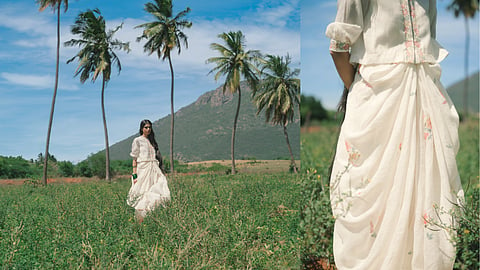
For designer Anavila Misra, inspiration didn’t arrive in a sketchbook or on a mood board. It arrived on an evening walk. A row of ageing jasmine plants, heavy with Madurai malli blooms, lined the quiet lane near her home. Their fragrance lingered in the air—subtle yet unmistakable—while moonlight caught the layered white petals in a way that felt almost ethereal. That fleeting sensory experience eventually blossomed into Malli Kili, her latest collection, unveiled at Amethyst, Chennai, and perhaps her most immersive exploration of South India yet.
“I didn’t begin with the flower,” she says. “I began with a feeling.”
That distinction defines the collection. While jasmine is its starting point, Malli Kili resists the temptation of literal storytelling. There are no embroidered blossoms scattered across saris, no parrots perched on borders, no obvious references to the iconography of Madurai. Instead, Anavila translates atmosphere into textiles. White echoes moonlit jasmine petals, tender greens recall coconut palms and banana leaves, and deep reds mirror the iron-rich earth surrounding the Vaigai river. Delicate geometric borders borrow from the rhythm of kolam rather than reproducing it.
“I wanted people to feel what it is like to stand in that landscape,” she explains. “Not simply recognise its symbols.”
The journey to Malli Kili began long before the collection itself. Previous visits to Chettinad had already sparked an enduring fascination with Tamil Nadu’s layered cultural history. Conversations about Madurai malli, however, led her down an entirely new path. Research introduced her to writer Uma Kannan’s work on the famed flower, its sacred association with the Meenakshi temple and the centuries-old traditions surrounding its cultivation. One discovery led to another—temple rituals, Sangam literature, the jasmine trail and the parrot that accompanies Goddess Meenakshi in mythology.
Soon, Anavila found herself returning to Madurai, this time with a camera crew, photographing the villages and jasmine farms that had inspired her imagination. Farmers, who rarely allow outsiders into their fields, welcomed the team into spaces considered deeply personal.
The experience transformed the collection from research into something lived. “What fascinated me wasn’t just the flower,” she says. “It was everything around it—the colours, the landscape, the people, the rituals, the poetry.”
That philosophy extends to the craftsmanship. Linen, the cornerstone of her label for nearly 15 years, finds new expression through intricate Jamdani borders that resemble strands of jasmine weaving across the fabric. Cotton silk joins linen in seamless constructions, while colourful Jamdani motifs drift gently across khadi garments. Rather than reinventing linen, Anavila has chosen to deepen its vocabulary.
For her, however, textiles are only one part of the narrative.
“Fashion has always documented culture,” she reflects. “When we look at sculptures in temples, we understand how people dressed, what they valued, how they adorned themselves. Clothes carry history.”
That belief has become central to her practice. Each collection begins not with trends but with cultural research, asking what stories deserve to be preserved. For Anavila, garments are as much about documentation as they are about design.
Perhaps the most revealing moment in the conversation comes when she explains why South India continues to draw her back. The answer has little to do with aesthetics.
Her family traces its roots to regions now in Pakistan. Partition left those histories fragmented and inaccessible. The landscapes her grandparents once knew can no longer be revisited in the way memory longs for.
“I can’t go back and experience my own family’s past,” she says quietly.
In Tamil Nadu, she found something unexpectedly healing: history that remains tangible. Whether wandering through Chettinad mansions, studying heirloom furniture, reading temple inscriptions or listening to lullabies passed down through generations, she encounters traditions that continue to live in everyday life.
“You can still touch history here,” she says. “It is preserved—in architecture, in literature, in rituals, in textiles. That is incredibly moving.”
She is particularly captivated by Tamil Sangam literature, whose poetic descriptions of landscapes have begun shaping her creative process. Instead of isolating a flower, those ancient poems describe entire ecosystems—the fragrance carried by the wind, rivers nourishing the land, birds gliding overhead and colours shifting with the seasons. It is a way of seeing that has profoundly influenced her design language.
“When you start looking at the landscape as a whole,” she says, “everything changes. The flower is no longer just a flower.”
For a designer whose work has always celebrated handwoven textiles, there is another reason Tamil Nadu resonates so deeply. She admires the quiet confidence with which people embrace their traditions.
“The simplicity here is beautiful,” she says. “People appreciate textiles for what they are. They understand craftsmanship.”
She believes younger generations are also rediscovering that confidence. Much like the resurgence of saris over a decade ago, today’s consumers are returning to Indian textiles, rituals and cultural identities—not as nostalgia, but as expressions of contemporary pride.
The most memorable moment of Anavila’s Madurai journey, however, had nothing to do with fashion.
Stopping at a roadside stall after a day of shooting, she noticed an elderly woman stringing jasmine flowers into a garland. Smiling, the woman walked over, cut a strand from her basket and gently tucked it into the designer‘s hair.
Instinctively, Anavila reached for her wallet. The woman stopped her. She didn’t want payment. She simply wanted her visitor to enjoy the flowers.
“It was one of the most touching moments of the trip,” Anavila recalls. Like the fragrance that first inspired Malli Kili, it was fleeting. But it stayed with her long after the flowers had faded.
Perhaps that is what this collection is really about—not jasmine itself, but the memories, generosity and cultural inheritance that linger quietly, waiting to be noticed.
Price on request. At Amethyst, Whites Road, Royapettah.
For more updates, join/follow our WhatsApp, Telegram and YouTube channels.