
- LIFESTYLE
- FASHION
- FOOD
- ENTERTAINMENT
- EVENTS
- CULTURE
- VIDEOS
- WEB STORIES
- SPORTS
- GADGETS
- CAR & BIKE
- TRAVEL
- SOCIETY
- GALLERIES
- NORTH EAST
- INDULGE CONNECT

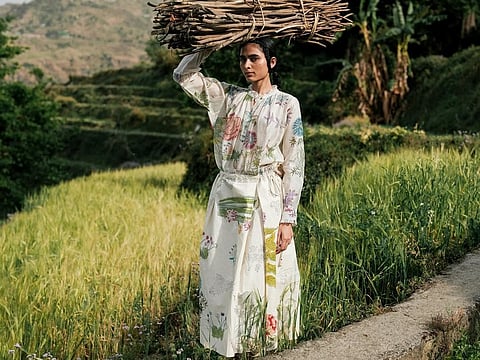
A pressed flower carries more than its form. Flattened between pages, its colours soften, its texture changes, and it becomes a record of a moment remembered. From cyanotypes that use sunlight to imprint botanical forms onto paper and fabric, to natural dyeing, and flower pressing, these practices transform natural phenomena into lasting records. At their heart is an act of observation — of preserving a moment. It is this dialogue between nature, and material that shapes Herbarium, the latest edit by Injiri.
The collection begins with an archive of pressed flowers gathered over years of travel. Yet these specimens were never intended as a design resource. “ They were simply a way of recording moments during my travels. Some came from long journeys, others from places I returned to often. Over time, I realised I had created an archive without meaning to — an archive that held not just flowers, but memories, colours, and observations that kept resurfacing in my work,” says founder and designer Chinar Farooqui.
Over the years, the archive revealed recurring forms, colours, and textures that resonated with Injiri’s textile language. What began as a personal act of collecting gradually evolved into a framework for studying shape, structure, and surface. Rather than creating literal botanical reproductions, Herbarium explores the act of observation itself, translating fleeting natural details into textile expressions that feel evocative rather than descriptive. “When you look closely at a flower that has been pressed for years, what remains is not necessarily its original form but a certain gesture or character.
That became more interesting to me than accuracy. I wanted the textiles to evoke that experience of looking closely and discovering small details over time,” shares Chinar. Dried petals, pollen dust, and cactus spines became points of departure rather than motifs to be copied directly.
The result is a language of suggestion rather than representation, where the viewer is invited to complete the story. Colour, too, is filtered through memory rather than realism. “The colours came from flowers, but not at the moment of bloom,” Chinar explains. “I was much more interested in what happens afterwards — the fading, the softening, the way a colour changes after years between the pages of a book. The palette evolved into muted tones such as pale turmeric, dried rose, dusty greens, and sun-faded indigo. Memory works in a similar way; it rarely preserves things exactly as they were. The palette emerged from that space between reality and recollection.”
Across the collection, fragile natural forms are reinterpreted through craft. Petals become delicate contours within prints, pollen inspires subtle marks and dye impressions, while cactus spines inform radiating embroidered structures. Rather than reproducing nature literally, the collection focuses on retaining its tactile qualities.
No single textile technique defines Herbarium. Instead, it unfolds through a conversation between weaving, block printing, and embroidery. Weaving creates nuanced textures, block printing introduces impressions and traces, and embroidery captures moments of close observation. Together, these techniques build a layered narrative that mirrors the accumulation of memories within an archive.
An ode to nature, the collection is a study in looking closely. Its impact lies not in spectacle but in details that reveal themselves gradually through texture, stitch, weave, and surface variation. Herbanium began with an archive of preserved flowers, but it evolved into something broader: a meditation on memory, observation, and the ways in which nature leaves its traces on cloth.
Prices start at Rs 25,000. Available online.
Mail ID: anshula.u@newindianexpress.com
Twitter: @indulgexpress
For more updates, join/follow our WhatsApp, Telegram and YouTube channels